Page 1
revue de l'art actuel troisième série numéro 7-8 juin-juillet-août 1956 E I M A S Deyrolle CICLIMAIIS
Premières pages de l'ouvrage, en accès libre.
revue de l'art actuel troisième série numéro 7-8 juin-juillet-août 1956 E I M A S Deyrolle CICLIMAIIS
Mills 11, Boulevard de Clichy Paris 9 Trudaine 82-23 Matériel tubulaire pour expositions et musées Classement des œuvres pour les ateliers et les collectionneurs Toutes charpentes et constructions tubulaires
Sommaire Couverture de Deyrolle Textes anglais 4 Gonzalez by R.V. Gindertael 6 Deyrolle by Herta Wescher Textes français 7 Gonzalez par R.V. Gindertael 15 Deyrolle par Herta Wescher 21 Esthétique et art absrait par C.L. Popovici 24 Le retour de Jawlensky par Will Grohmann 27 Informations 28 La sculpture actuelle dans l'École de Paris 36 L'actualité par Julien Alvard, René Déroudile, R.V. Gindertael, Michel Ragon, Pierre Restany, Jacques-Louis Thibault Texte anglais 47 Esthetic and abstract art par C.L. Popovici --- Cimaise revue de l'art actuel 34 rue du Four, Paris 6 Directeur: J.R. Arnaud Rédacteur en chef: Herta Wescher Secrétaire général: John Koenig Rédaction: J. Alvard, R.V. Gindertael, M. Ragon, C.H. Sibert La rédaction reçoit sur rendez-vous Abonnement (8 numéros) 1.400 frs - Par avion: 2.300 frs 34, rue du Four, Paris 6, téléphone Littré 40-26 C.C.P. Librairie Sélection Paris 5542.39 Diffusion: Allemagne: Horst Beck, Hoedingen ueber Uberlingen, Bodensee PS ch A Karlsruhe (Bd) 43328 Argentine: Editorial Victor Leru, Cangallo 2233, Buenos-Aires Autriche: Arnulf Neuwirth, Paracelsusgasse 8, Vienne 3 Belgique: Jean Milo, 28 rue de l'Arbre Bénit, Bruxelles C.C.P. Jean Milo, Bruxelles 1591.50 Danemark: Meiners Kunstforlag, Peder Skramsgade 5, Copenhagen Grande-Bretagne: Alec Tiranti Ltd, 72 Charlotte Street, London W1 Japon: Meiji-Shobo, Surugadai, Kanda Tokyo Norvège: J.W. Cappelen, Sortimentebokhandel, Oslo Suède: Eric H. Olson, Upplandsgatan 3, Stockholm, 10 23 77 Suisse: E. Genton, «L'Entr'acte», rue du Lion d'or 4, Lausanne, C.C.P. II 144-56 U.S.A.: Wittenborn and Co, 30 East, 57th Street, New-York 2 M. Flax 10846 Lindbrook Drive, Los Angeles 24 2 --- A nos lecteurs Avec ce numéro double 7-8 (3e série) se termine la troisième année de «Cimaise». L'amélioration constante que nous avons apportée à notre revue, au cours de cette saison, lui a valu d'atteindre une vaste audience internationale. A partir de la 4e série, dont le premier numéro paraîtra au mois d'octobre, nous avons décidé de publier six numéros par an au lieu de huit. Par contre, nous augmenterons chaque numéro de huit pages supplémentaires. Cette transformation nous permettra de publier des études plus approfondies, plus documentées et plus abondamment illustrées, sans restreindre la place que nous accordons à l'actualité. Cette nouvelle transformation ne modifie pas le prix de l'abonnement qui reste fixé pour un an (6 numéros) à 1.400 francs, le prix du numéro étant porté à 260 francs, tant pour la France que pour l'étranger. Nous continuerons de même à assurer une traduction intégrale en anglais des principaux articles, cette initiative ayant été très appréciée de nos lecteurs de l'étranger. Pour la majorité de nos abonnés, leur abonnement se termine avec ce numéro, nous leur demandons de bien vouloir, sans plus attendre, nous adresser le montant de leur nouvel abonnement. Ils nous faciliteront ainsi notre travail en nous évitant l'envoi d'un rappel. D'autre part, nous demandons à nos lecteurs au numéro de s'abonner. C'est du nombre de ses abonnés que dépend le sort d'une revue, ce sont eux qui font sa force, leur appui est précieux. Tout règlement d'abonnement (un an, 6 numéros : 1.400 francs) peut être fait par chèque bancaire ou par versement au nom de «Cimaise» au compte chèque postal Paris 5542-39. Nous avons bon espoir d'être entendus et comptons sur l'adhésion de tous. Cimaise --- Au sommaire du premier numéro de la quatrième série qui paraîtra en octobre vous pourrez lire parmi d'autres articles: Une étude d'ensemble sur l'art américain comprenant: Un article de Dore Ashton sur la peinture Un article de K.B. Sawyer sur les galeries Un article de Goldwater sur la sculpture Une étude sur Hartung de R.V. Gindertael Une visite d'atelier de Sugai par Michel Ragon Une visite d'atelier de Van Haardt par Julien Alvard Un article de Herta Wescher sur la Biennale de Venise
Complete translation of the main articles translation by J.-F. Koenig To our readers and subscribes With this double number 7-8 of the 3rd Series, ends the Third Year of “Cimaise”. The constant improvement that we have brought to our review during the season has led it to reach an international audience. Beginning with the 4th Series, whose first number will come out in October, we have decided to publish 6 numbers instead of 8. However, we are adding 8 pages to each number. This change will allow us to publish longer articles that will be even better documented and more abundantly illustrated, without cutting down the space that we give to articles of current interest. This new change does not modify the cost of subscription that remains the same: for 1 year (6 numbers), 1,400 francs; the single copy will cost 260 francs, outside as well as inside of France. We will also continue to insure complete translations in English of the main articles, this initiative having been highly appreciated by our foreign readers. For the majority of our subscribers, their subscription runs out with number; we would like to ask them to send us without delay the sum for their new subscription. They will thus facilitate our task, for this will prevent us from having to remind them later. Also, we would like to ask our readers who buy single numbers to subscribe. It is on the number of subscribers that depends the destiny of a review, it is they who support us, their aid is precious. All payments for subscriptions (1 year, 6 numbers: 1,400 francs) may be made through your personal check; by payment to “Cimaise” at the Postal Check Account: CCP Paris 5542.39; through a postal subscription in the following countries: West Germany, Belgium, Denmark, Finland, Italy, Luxembourg, Norway, Holland, Portugal, Sweden, and Switzerland; or through our dealers. We hope that your will answer us, for we count on your aid. Cimaise Gonzalez (p.7) by R.V. Gindertael The words that Gonzalez pronounced a short while before his death: “Now I know where I’m going, everything is clear to me” — and the obstinacy that he had in repeating all during his life that the moment had not as yet arrived for him, do not alone express the tardy certitude that may have come to this great artist, tormented and uncertain, after his long hesitation in accepting himself as the sculptor that nonetheless he was at birth. I would like rather to let it be understood that he was hardly able to have a presentiment of the development and the consequences of the work that his genius had rendered, if not unusual, at least premature, and which, at the time of his death, his first admirers didn’t even as yet avow the grandeur, nor did they understand its full meaning nor all of its scope. We know today (but only since a short time, for it was necessary for his mastery to be consecrated throughout the world, and his influence to exercise itself already on a number of the younger artists) that Gonzalez was the first to be conscious of the new relations between matter and space, of a new conquest of space through a new sculpture that opened into it, and the first to have taken on this conquest. Far from thinking that this discovery was an empirical result, we must insist upon the full consciousness of Gonzalez, since we find in his notes the precise statements of his research: “Project and design in space with the aid of new means, profit by this space and construct with it as if we had to do with a newly acquired substance, that is the whole of my endeavour.” And when he writes again: “In the disquietude of the night the stars seem to indicate to us the points of hope in the sky; this motionless arrow (that of the cathedral) shows us also an unending number — they are these points in the infinite that were the predecessors of this new art: Designing in space” — doesn’t he show the proof of the same extra-lucidity as that of Mondrian when he discovered the principle of orthogonal balance, basing it in the terms: “On observing the sea, the sky, and the stars, I had the idea of noting their plastic function by means of multiple vertical and horizontal crosses.” The circumstances of the often difficult and sometimes painful existence of Gonzalez have been often related recently, on the occasion of the large retrospective expositions that in Paris, Amsterdam, Brussels, and the United States, have finally brought, ten years after his death, the moving revelation of a work that was little known except by the familiar friends of this modest and reserved artist, who brought it to perfection in an almost complete solitude, and above all, in an absolute disinterestedness. Thus I can resume briefly the life of Julio Gonzalez. It is nonetheless not useless to know that nothing opposed his career in the family of artistic ironworkers in which he was born in Barcelona in 1876, and who brought him up in an atmosphere of artistry and craftsmanship. It is thus that he learned very early, at the same time with his brother Joan who was seven years older, how to work metal; at the same time he followed the night courses at the School of Fine Arts. On the death of his grandfather, his brother Joan took over the management of the iron-work shop, but his health didn’t allow him to take on this task for a long period, and in 1899, the Gonzalez family came to settle down in Paris. Immediately, a contact was established with the group Picasso, Manolo, Max Jacob, and Maurice Raynal, and a productive period of drawings and paintings began for the two Gonzalez brothers. But several years later, Joan Gonzalez returned to Spain to die, and Julio Gonzalez, after a quarrel with Picasso, lost contact immediately with all of his innovating comrades, and entered a long period of solitude. His evolution hence was led astray, all the more so since his early training, and also undoubtedly his natural gentleness, disposed him towards a harmonious classicism, and on the other hand he had a preference for painting. In spite of his intermittent attempts to resolve the conflict that opposed him to his profound dispositions of a creator, this stagnation and confusion kept on for numerous years. Certainly duality was not a stranger here, or the instability of his character that we can guess at when his daughter Roberta Gonzalez calls up his memory: “I can still see him, calm and nervous, gentle and violent, irritable and relaxed, discouraged and full of hope, kind and reticent, confident and mistrustful, taciturn and jovial: it is thus that he often passed through opposite states of being”. Nevertheless, at times he reacted to his taciturnity that was intensified by unending ordeals, and made himself some new acquaintances, and some friendships, among the artists and writers of his age. He had also patched things up with Picasso. It is nonetheless only during the years of 1927-1930, when he had reached 50 years of age that Gonzalez found his way, and engaged himself into it with assurance. There only remained a bit more than 10 years for him to fulfill himself, but he used
them completely. In this short lapse of time, and in spite of the difficulties that were never settled, in spite, also, near the end, of the new ordeal of the war that placed him in the material impossibility of doing sculptures, he accomplished the work that gives him today his universal renown. This work that the family tradition, perhaps, and his youthful apprenticeship had dedicated to metal, and to making evident its plastic and expressive properties, we can make out their beginnings in the first masks and busts in repoussé bronze or copper that he hammered out around 1910. Afterwards came the temptation of cubism and its geometric rigor that marked his research and realisations, among which the strongest are the masks that are stamped with a severe truthfulness that we have only seen, preceding him, in High Period primitive sculptures. But his most meaningful creations are perhaps those that announce the great work of Gonzalez, such as the “Kiss”, or “The Harlequin”, whose constructive elements are stripped down to abstract forms of an absolute geometric purity; or as the “Don Quixote”, that already projects the tracing of the line into space, in order to enclose the immaterial planes. One will remark that the “cubist” works of Gonzalez are still assembled with the aid of rivets. It isn’t until much later on that Gonzalez will use for the execution of his sculpture the process of autogenous welding, that he had nonetheless known and used around 1916-17 when, during the war, in order to insure his and his family’s existence, he had worked for some time in the Renault factories, requisitioned by the military authorities. It is only when he had definitely made iron and scrap (often recuperated because of economy in junk-heaps) his chosen material, that he remembered his experience of welding, and took up its practice again. Today we cannot regret that circumstances brought about his rupture with his early cubist friends, and the abandon of this avant-garde group for more peaceful surroundings, that caused his interest to turn away from the cubist adventure. Otherwise, Gonzalez might have become the best cubist sculptor. From “the night of distress and anguish” into which he thrust himself alone, he come out the victor of all the ordeals, as the great and unique Gonzalez. I could almost refrain from describing, analysing, and comparing the numerous plastic inventions that he created in the crucial years of his assertion, from 1927 to 1942, for their images spontaneously come to mind on hearing Gonzalez’s name. From 1930 through 1933, Gonzalez executed his most linear sculptures, whose abstractions goes so far that they seem to us almost as abstract sculptures, such as the large dancing woman called “The Angel” that belongs now to the Musée d’Art Moderne of Paris, the “Maternity”, the “Woman Combing Her Hair”, the “Standing Personnage”, or “The Prayer”, and these tiny sculptures in silver that are humorously nicknamed “The Little Trumpet”, or “The Fireman”. Then, without abandoning because of this the utilization of the space-material, Gonzalez, in introducing compact elements, came to conceive because of this a sculpture with fuller forms, that led him to abandon, bit by bit, his linear style. The great works that mark this period are the “Woman Combing Her Hair” of 1936 (of the Museum of Modern Art of New York), the “Woman At The Mirror” of the same year (at the same time Gonzalez executed his large figurative sculpture “La Montserrat” that was shown at the Spanish Pavilion of the Exposition International of 1937, that belongs now to the Amsterdam Museum) to finally lead up to his final iron sculptures, to the “Cactus Men” of 1939. The outbreak of the war forced him to abandon several unfinished works in beaten iron, for it had become impossible for him to procure acetelyne gas and the oxygen that was necessary for the welding. From this period, he left numerous drawings, that are projects for sculptures as well. On his return from the exodus, there remained barely the time to begin the execution of two plaster sculptures, an “Abstract Figure”, and another naturalistic one, a new “Montserrat”, whose terrified expression showed the personal suffering of the artist “before the unthinkable catastrophe.” When he died, at the age of 66, in his little house at Arcueil, in the parisian suburbs, the 27th of March, 1942, in the absence of his daughter and his sisters who had taken refuge in the Free Zone, Gonzalez knew just what he was able to do, but he didn’t perhaps have an inkling (for his modesty certainly blinded his clairvoyance on this subject) of the power of the drive of his work that would lead the destiny of the art of our time. It is to the degree, for that matter, that is premature, (that is to say, projected towards the future by its foreknowledge) that the work of Gonzalez remains exemplary to us and shows itself as being “of today.” The present interest of Gonzalez is first founded on the plastic invention that he proposed to us, that he stated in this manner: “The importance of the problem that we have to solve here not only has to do with obtaining a harmonious work that makes a perfectly balanced ensemble. No, not that, but to obtain rather this result by the union of Substance and Space, by the union of real forms with imagined and suggested forms through established points, or even by perforations. These forms must be linked together or rendered indivisible one from the other, just as the body and the soul are indivisible. The synthetic deformations of material forms, of color, of light; the perforations, the absence of compact planes, give to the work a mysterious, fantastic, or even diabolical aspect. It is thus that the artist, while transposing the forms of nature, in blowing into them a new life, collaborates at the same time with the space that deifies them.” This present interest is also attached to the contribution, or more exactly to the assimilation, by bringing it into application, of a material capable of receiving new intentions: this material was iron, and Gonzalez wanted even to humanize its career. Didn’t he explicitly say: “The age of iron began, centuries ago, by (unhappily) producing arms, though some of them were very beautiful. In our time, it allows more and more the construction of bridges, of industrial buildings, of railways, etc. It is high time that this material ceased to be murderous, and simply a material of mechanized science: the door is wide open today for this material to penetrate into the domaine of art, to be beaten and forged by the peaceful hands of artists.” I wouldn’t like to think that the resistance to functionalism and mechanization, to the profit of a more humanistic conception thus expressed, would reduce, in the minds of certain modernists, the durable presence of the work of Gonzalez, nor that they would retain against this permanency, the fact that it is never abstract. It isn’t this, for that matter, and has never pretended to be. The sculpture of Gonzalez is not abstract, for if we reason things out well, a plastic work of art cannot not exist as such, that is to say, a pure concept, distinct from any image, and seperate from any sensation or sentiment. Even more so, if we feel to this degree the presence and permanency of the work of Gonzalez, just as we feel that of Brancusi, and if we can unite in a single sentiment of admiration and confidence these two pioneers, in spite of their oppositions and even the contradictions of their interest and means, it is truly because of the clarity of their refusal to the petitions of principles of purely theoretical constraints and to dogmatic defi-
nitions and determinations, to the profit of the usage of the complete liberties that insure the dignity of the creative act and of its product: the work, and its “naturalization” into the world. These two artists are great because they didn’t satisfy themselves with purely speculative exercises, and because each of their sculptures is the result of a complete human experience, and the realization of a no less complete reality. For my part, I actually recognize the exemplary present-day character of the work of Gonzalez, by the evidence that it gives to us of a premonitory by-passing of the status of abstract art, and the spontaneous resolution of the antinomy of figuration-abstraction. But we mustn’t neglect either the fact that Gonzalez’s craftsman’s humility, as well as Brancusi’s, found again the fundamental dignity of “making”, and that of substance, and doubtless also the primeval sense of the human act of fabricative intervention, in bringing back natural proceedings into the relations between man and nature. R.V. Gindertael Deyrolle (p. 15) by Herta Wescher In the art of today, Deyrolle holds a rather singular place, due in part to his years, that designate him, as one might say, as the “elder of the young painters.” The five or ten years advance that he has on those that form the first team of the young generation, tie him to the french tradition of before the war, whereas the young fellows have only received a dim echo of this. From the cubist works, he took the order for discipline: this was imperious for him, and decided the path he was to take. He joined the abstract movement at the time when painting made ready to dispose freely of its primary elements — line, form, and color — and he adopted these classical elements in order to adapt them to the most varied exactions that have imposed themselves on him in the course of his evolution. Refusing all the means of haphazard effects, he struggles, one might say, with the most stubborn kind of substances in order to extort from them the same power of expression that others draw from more suggestive techniques. If the artists of the same “middle-generation” who were trained in other countries, such as Hartung or Wols, who came from abstract expressionism, were able to approach informal art to the point of being regarded today as it predecessors, Deyrolle has moreso taken a path on the edge of the large currents, but in a parallel sense, towards a painting full of an extremely profound resonance. He found out how to give his plastic vocabulary an astounding flexibility, varying constantly the constitutive forms of his compositions. They may have fine or heavy contours, with lines that are straight or cursive, broken, cut through, or enlaced in gracious ornaments. Sometimes, he distributes his plane, areas in a clear and ordered rhythm, other times he overlaps them in infinite sequels that are prolonged into space. Some large forms may almost swallow up the small ones, which nonetheless insist on singing. Often the surface seems as transparent as a crystal ball inside of which broken pieces of forms move and stir about. More surprising still is the revelation of the colors that is developed by Deyrolle with a moving sensitivity. His strange scale of colors degrades itself in subtle nuances: he puts them one against the other in a manner that is both audacious and prudent. To the refinement of the tones are allied the different intensities of the substance that is spread out by the brush in layers that may be liquid or solid. Deyrolle has never been against working by means of impastos, but subjects them to a severe control, giving them, by the use of stripings or planned touches, the value that was exactly planned. It’s thus that in bringing his method continually to a point that Deyrolle has elaborated his pictorial conceptions that for 15 years now tend towards the internal enrichening of non-figurative art. He has “crossed the line”, jumping from one side to the other, without a transition, that has placed him immediately on his own ground. His youthful works — landscapes of Brittany that with their massive forms and their heavy colors remind us of the Breton period of Gauguin — didn’t lead him to the “boundary line”. His vocation rather came to him from the outside. It was Domela who in showing him the unlimited possibilities of an autonomous art of pure forms and lines, brought out the spark. Deyrolle didn’t take these new propositions as an initiation to a simple change of style: he felt here essential function that art, regarded in this manner, could have in life. Painting would lend itself from now on to translate the most universal ideas, and to participate, in its own domain, in human progress. Understanding the meaningful role of abstract art in its full richness, he kept himself away from any plastic sclerosis. He didn’t adopt any manner, any formal order, but seized onto the complete liberty to follow his inspiration, that im each canvas can lead him towards other solutions. His imagination finds nourishment in reveries as well as in meditation, in vague visions as well as through precise intuitions. Sometimes the spontaneous outburst opposes itself to any definite expression, the theme being indicated through large tracings that are supported by the weight of the colors; more often it is only realized in the meticulous finishing touches, the subtly weighed values uniting in the most delicate harmonies. If Deyrolle is always conscious of the means that are used, the subconscious doesn’t participate in a lesser degree in his creation, throwing into purely abstract compositions reflected images of the real world. Thus, a hallucinating architecture, seen in the distant past, can reappear in the structure of a canvas; the light or the vegetation of Southern France can impregnate another, finished in the studio in Paris, even though the artist may not be consciously aware of all this. The titles that he gives to his paintings belong to an imaginary language, whose alphabet aids him to group them under the sign of a similar sonority. But these titles correspond strangely to his singular and personal poetry, where dazzling fairytales come after wan and melancholy stories. You often have the impression that Deyrolle amuses himself in asking us guessing games of which he doesn’t know the exact answer. Art to him is a subtle game where the creative intelligence triumphs, without necessarily having a determined goal. In this game, he always holds several trump cards in reserve that finally cause him to win. And it isn’t always the principal harmony of the elements that brings it off, but sometimes little signs or humorous spots that come forth as if to put into question the gravity of the ensemble. Deyrolle doesn’t like, and doesn’t know how to give explanations about his painting. When he shows you his canvases, he waits with a visible curiosity your reaction without, however, trying to incite it. He acknowledges the spectator’s right to interpret his paintings as he pleases, considering them as “the support for the multiple possibilities of the dream.” It is curiously in the process of the vast link associations that we encounter the artist; you find here an immediate contact, that difficultly establishes itself afterwards through the use of everyday language, or sometimes you feel yourself fatally a stranger opposite this painter, the most typical Frenchman in the School of Paris.
Gonzalez par R.V.Gindertael Les paroles que Gonzalez prononça très peu de temps avant sa mort: « Maintenant, je sais où je vais, tout est clair pour moi » et l'obstination qu'il avait mise à répéter tout au long de sa vie que le moment n'était pas encore venu pour lui, n'expriment pas seulement la tardive certitude qui pouvait être venue à ce grand artiste tourmenté et inquiet, après sa longue hésitation à se reconnaître le sculpteur qu'il était pourtant de naissance. Je veux plutôt entendre qu'il lui était à peine donné de pressentir le développement et les conséquences de l'œuvre que son génie avait faite sinon insolite, du moins prématurée, et dont, à ce moment, ses premiers admirateurs mêmes ne s'avouaient pas encore la grandeur et ne comprenaient ni toute la signification, ni toute la portée. Nous savons, aujourd'hui, mais pas depuis si longtemps, car il fallait que sa maîtrise fut consacrée mondialement et que son influence s'exerçât déjà sur nombre de ses cadets, nous savons que Gonzalez a été, le premier, conscient de nouveaux rapports entre la matière et l'espace, d'une nouvelle conquête possible de l'espace par une sculpture s'ouvrant à lui, et le premier à avoir entrepris cette conquête. Loin de penser que cette décou-
Gonzalvez: Tête dite «Oncle Jean No 1», fer, 1930, Tête dite «la Suissesse», fer, 1932, collection Graindorge, Liège Tête dite le «le Tunnel», fer, 1933, collection Roberta Gonzalez verte a été un résultat empirique, nous devons insister sur la pleine conscience de Gonzalez puisque nous trouvons dans ses notes les données précises de ses recherches: « Projeter et dessiner dans l'espace à l'aide de moyens nouveaux, profiter de cet espace et construire avec lui comme s'il s'agissait d'un matériau nouvellement acquis, là est toute ma tentative. » Et lorsqu'il écrit encore: « Dans l'inquiétude de la nuit, les étoiles semblent nous indiquer des points d'espoir dans le ciel; cette flèche immobile (celle d'une cathédrale) nous en indique aussi un nombre sans fin — ce sont ces points dans l'infini qui ont été les précurseurs de cet art nouveau; Dessiner dans l'espace », ne fait-il pas preuve de la même extra-lucidité que Mondrian lorsque celui-ci découvrait le principe de l'équilibre orthogonal et le basait en ces termes: « Observant la mer, le ciel et les étoiles, j'eus l'idée de noter leur fonction plastique au moyen de multiples croisements verticaux et horizontaux. » Les circonstances de l'existence souvent difficile et parfois douloureuse de Gonzalez ont été souvent relatées, ces temps derniers, à l'occasion des grandes expositions rétrospectives qui à Paris, à Amsterdam, à Bruxelles, aux Etats-Unis ont enfin apporté, plus de dix ans après sa mort, la révélation bouleversante d'une œuvre imparfaitement connue sinon par les familiers de cet artiste modeste et secret qui l'avait fait aboutir dans une solitude presque complète et surtout
Gonzalez: Torse, fer, 1936, collection Musée d.Art Moderne, New-York
dans un désintéressement absolu. Je puis donc résumer brièvement la vie de Julio Gonzalez. Il n'est pas inutile, cependant, que nous sachions que rien ne s'opposa à sa vocation dans la famille de ferronniers d'art dans laquelle il naquit à Barcelone en 1876 et qui l'éleva dans une atmosphère artisanale et artistique. C'est ainsi qu'il apprit, tout jeune, en même temps que son frère Joan, de sept ans son aîné, à travailler les métaux, tout en suivant les cours du soir à l'Ecole des Beaux-Arts. A la mort du grand-père, le frère Joan prit la direction de l'atelier de ferronnerie, mais sa santé ne lui permit pas d'assurer longtemps cette charge et, en 1899, la famille Gonzalez vint s'installer à Paris. Aussitôt s'établit le contact avec le groupe Picasso, Manolo, Max Jacob et Maurice Raynal et commença, pour les deux frères Gonzalez, une période productive en dessins et en peintures. Mais quelques années plus tard, en 1908, Joan retourne mourir en Espagne et Julio Gonzalez, à la suite d'une brouille avec Picasso, perd aussitôt le contact avec avec tous ses camarades novateurs et entre dans une grande période de solitude. Son évolution s'en trouve désorientée, d'autant plus que sa première formation et sans doute aussi sa douceur native l'inclinaient à à un classicisme harmonieux et que, d'autre part, il avait une préférence pour la peinture. En dépit de tentatives intermittentes pour résoudre le conflit qui qui l'opposait à ses dispositions plus profondes de créateur, cette stagnation et son désarroi se prolongèrent pendant de nombreuses années. N'y était certainement pas étrangère la dualité, sinon l'instabilité de son caractère que nous pouvons soupçonner lorsque sa fille Roberta Gonzalez évoque son souvenir: « Je le revois, calme et nerveux; doux et violent; irritable et détendu; découragé et plein d'espoir; aimable et fermé; confiant et méfiant; taciturne et enjoué; c'est ainsi qu'il passait souvent par des états extrêmes. » Il réagissait cependant par moment à sa taciturnité que renforçaient les épreuves après les épreuves, et il s'était fait des relations nouvelles, quelques amitiés parmi ses contemporains artistes ou écrivains. Il avait aussi renoué avec Picasso. Ce n'est pourtant que dans le courant des années 1927-1930, alors qu'il avait atteint la cinquantaine, que Gonzalez reconnut sa voie et s'y engagea avec assurance. Il ne lui restait qu'un peu plus de dix années pour se réaliser, mais il les utilisa pleinement. Dans ce court laps de temps, et malgré les difficultés qui ne s'aplanirent jamais, malgré aussi, sur la fin, la nouvelle épreuve de la guerre qui le mit dans l'impossibilité matérielle de sculpter, il accomplit l'œuvre prodigieuse qui fait aujourd'hui sa gloire universelle. Cette œuvre que la tradition familiale, peut-être, et l'apprentissage de sa jeunesse avaient vouée au métal et à la mise en évidence des propriétés plastiques et expressives de ce matériau, nous en reconnaissons les prémices dans les premiers masques et bustes de bronze ou de cuivre repoussés qu'il martela
vers 1910. Par la suite, c'est la tentation du cubisme et de sa rigueur géométrique qui marquent sa recherche et ses réalisations dont les plus fortes sont ces masques empreints d'une vérité sévère que nous n'avons connues avant lui que dans les sculptures primitives de haute époque. Mais ses créations plus significatives sont peut-être celles, annonciatrices du grand œuvre de Gonzalez, comme « le Baiser » ou « l'Arlequin » dont les éléments constructifs sont dépouillés en formes abstraites d'une pureté géométrique absolue, ou bien comme le « Don Quichotte » qui lance déjà le dessin de sa ligne dans l'espace pour enserrer des plans immatériels. On remarquera que les œuvres « cubistes » de Gonzalez sont encore assemblées à l'aide de rivets. Ce n'est que bien plus tard que Gonzalez utilisera pour l'exécution de ses sculptures le procédé de la soudure autogène qu'il avait connue pourtant et pratiquée vers 1916-17 alors que pendant la guerre, pousser son existence et celle de sa famille, il avait travaillé quelque temps aux usines Renault réquisitionnées par les autorités militaires. C'est seulement lorsqu'il eut définitivement fait du fer, de la ferraille souvent récupérée par raison d'économie dans les débris, son matériau d'élection qu'il se souvint de son expérience de la soudure et en reprit la pratique. Nous ne devons pas regretter, maintenant, que les circonstances aient voulu sa rupture avec ses premiers amis cubistes, l'abandon de ce milieu d'avant-garde pour un milieu plus sage, et détourné ainsi son regard de l'aventure cubiste. Autrement, Gonzalez fut devenu sans doute le meilleur sculpteur cubiste. De « la nuit d'inquiétude et d'angoisse » dans laquelle il s'enfonça solitaire, il est sorti vainqueur de toutes les épreuves, le grand et unique Gonzalez. Je pourrais presque m'abstenir de décrire, d'analyser, de comparer les inventions plastiques qu'il multiplia pendant les années cruciales de son affirmation, de 1927 à 1942, car leurs images surgissent spontanément au seul énoncé du nom de Gonzalez. A partir de 1930 et jusqu'en 1933, Gonzalez exécute ses sculptures les plus linéaires dont l'abstraction va si loin qu'apparemment elles semblent abstraites comme la grande danseuses dite « L'Ange » qui appartient maintenant au Musée d'Art Moderne de Paris, la « Maternité », la « Femme se coiffant », le « Tub », le « Personnage debout » ou « La Prière » et ces toutes petites sculptures en argent surnommées avec humour « La petite Trompette » ou « Le Pompier ». Ensuite, sans abandonner pour autant l'utilisation du matériau-espace, Gonzalez, en introduisant des éléments compacts, en vient à concevoir une sculpture aux formes plus pleines qui lui fait abandonner peu à peu le linéaire. Les grandes œuvres qui jalonnent cette période sont la « Femme se coiffant » de 1946 (au Museum of Modern Art de New York) la « Femme au miroir » de la même année — dans le même temps, Gonzalez avait exécuté sa grande sculpture figurative « La Montserrat » qui fut exposée au pavillon espagnol de l'Exposition Internationale de 1937 et appartenait maintenant au Musée d'Amsterdam — pour aboutir à ses dernières sculptures en fer, aux « Hommes Cactus » de 1939. La guerre survenant le force à abandonner plusieurs œuvres en fer forgé inachevées, car il était devenu impossible de se procurer le gaz acétylène et l'oxygène nécessaires à la soudure. De cette période, il a laissé de nombreux dessins qui sont autant de projets de sculptures. Au retour de l'exode il lui resta à peine le temps de commencer l'exécution de deux sculptures en plâtre, une « Figure abstraite » et une autre naturaliste, une nouvelle « Montserrat » dont l'expression terrifiée traduisait la souffrance personnelle de l'artiste « devant l'impensable catastrophe ». Lorsqu'il mourut, à soixante-six ans, dans sa petite maison d'Arcueil, dans la banlieue parisienne, le 27 mars 1942, en l'absence de sa fille et de ses sœurs réfugiées en zone libre, Gonzalez savait jusqu'où il pouvait aller, mais il ne soupçonnait peut-être pas, car sa modestie aveuglait certainement sa clairvoyance sur ce point, avec quelle puissance l'impulsion de son œuvre entraînerait le destin de l'art de notre époque. C'est dans la mesure même où elle fut prématurée, c'est-à-dire projetée vers l'avenir par sa présience, que l'œuvre de Gonzalez reste à nos yeux exemplaire et se découvre vraiment « actuelle ». L'actualité de Gonzalez est d'abord fondée sur l'invention plastique qu'il nous propose et qu'il avait énoncée ainsi: « L'importance du problème à résoudre ici n'est pas seulement d'obtenir une œuvre harmonieuse d'un ensemble parfaitement équilibré. Non! mais d'obtenir ce résultat par l'union de la Matière et de l'Espace, par l'union des formes réelles avec les formes imaginées et suggérées par des points établis ou bien par des perforations. Ces formes doivent être confondues et rendues indivisibles les unes des autres comme le sont l'un de l'autre le corps et l'esprit. Les déformations synthétiques des formes matérielles, de la couleur, de la lumière; les perforations, l'absence de plans compacts, donnent à l'œuvre un aspect mystérieux, fantastique, voire diabolique. C'est que l'artiste tout en transposant les formes de la nature, en leur insufflant une nouvelle vie, collabore en même temps avec l'espace qui les divinise. » Cette actualité est rattachée aussi à l'apport ou plus exactement à l'appropriation, par sa mise en œuvre, d'un matériau susceptible de recevoir les intentions nouvelles: le fer, dont Gonzalez a en même temps voulu humaniser la vocation. N'a-t-il pas dit explicitement: « L'âge du fer a commencé, il y a des siècles, par produire (malheureusement) des armes, quelques une très belles. De nos jours, il permet en plus la construction de ponts, d'édifices industriels, de rails de chemin de fer, etc... Il est grand temps que ce matériau cesse d'être meurtrier et simple matériau d'une science mécanisée: la porte est toute grande
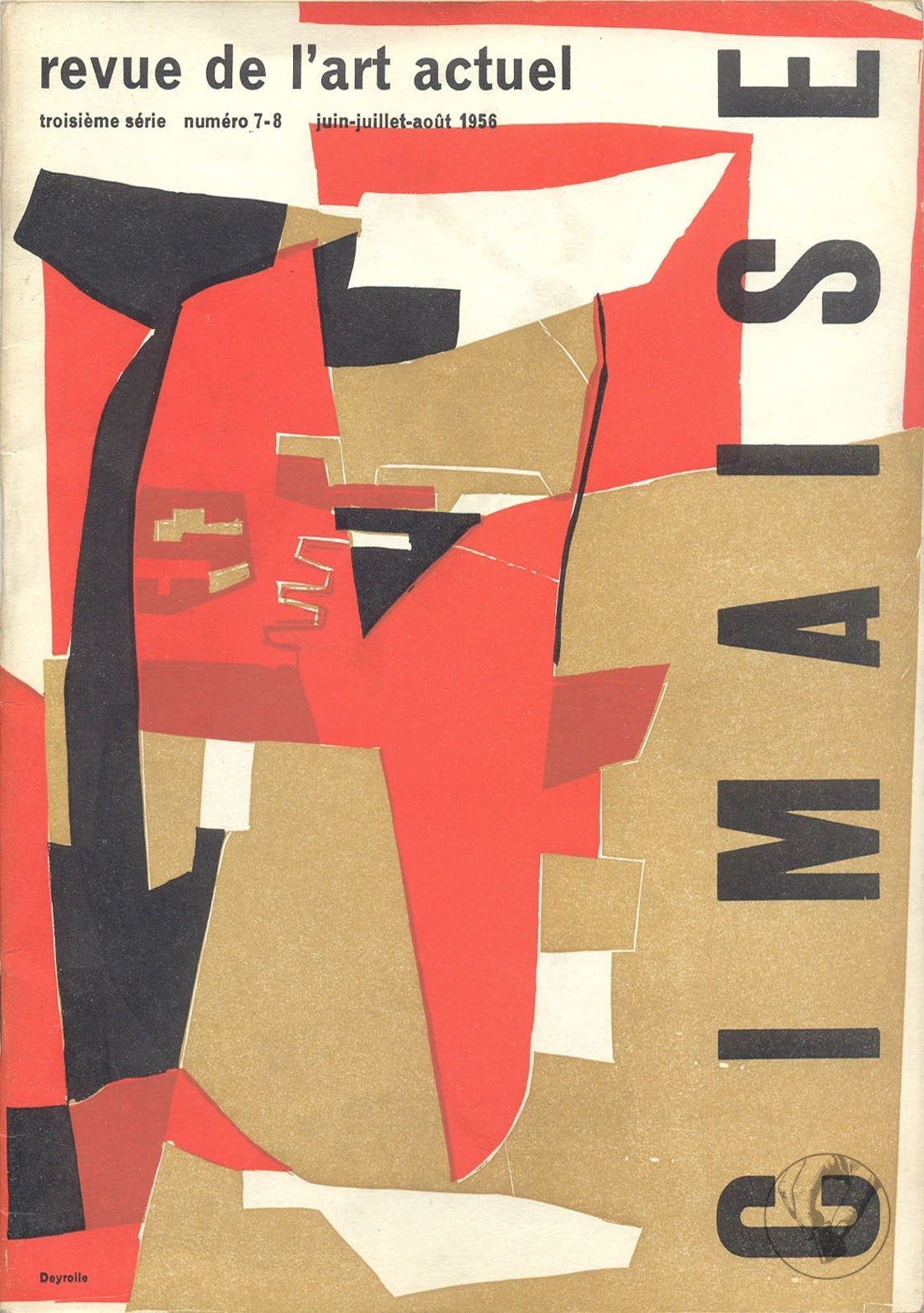
La revue "Cimaise" publie son numéro double 7-8 de la troisième série, couvrant les mois de juin, juillet et août 1956. Cet ouvrage présente des articles sur les artistes Gonzalez et Deyrolle, ainsi que des réflexions sur l'esthétique de l'art abstrait et l'actualité de la sculpture. La revue annonce une transformation pour sa quatrième série, passant à six numéros annuels plus longs et plus illustrés.