Page 1
revue de l'art actuel troisième série numéro 5 avril 1956 CLIMAISSÉS
Premières pages de l'ouvrage, en accès libre.
revue de l'art actuel troisième série numéro 5 avril 1956 CLIMAISSÉS
Galerie de France 3 Faubourg Saint-Honoré, Paris 8, téléphone Anjou 69-37 Music œuvres récentes mai --- Galerie Craven 5 rue des Beaux-Arts, Paris 6, Danton 94-98 --- Galerie de l’Institut 6 rue de Seine, Paris 6 --- Giorgio de Giorgi sculptures du 20 avril au 11 mai --- Suzanne Duchamp du 20 avril au 3 mai Nathalia Gontcharova du 4 au 24 mai Michel Larionov du 25 mai au 14 juin ---
Sommaire Couverture de Alcopley Textes anglais 6 Schneider by Michel Ragon 8 Nicolas de Staël by Herta Wescher 33 Dumitresco by R.V. Gindertael Textes français: 9 Schneider par Michel Ragon 15 Nicolas de Staël par Herta Wescher 20 Vers un théâtre abstrait par Michel Ragon 21 Jeu des portraits En un combat douteux 23 Informations 25 Les expositions 32 Bibliographies --- Cimaise revue de l'art actuel 34 rue du Four, Paris 6 Directeur: J.R. Arnaud Rédacteur en chef: Herta Wescher Secrétaire général: John Koenig Rédaction: J. Alvard, R.V. Gindertael, M. Ragon, C. H. Sibert La rédaction reçoit sur rendez-vous Abonnement (8 numéros) 1.400 frs - Par avion: 2.300 frs 34, rue du Four, Paris 6, téléphone Littré 40-26 C.C.P. Librairie Sélection Paris 5542.39 Diffusion: Allemagne: Horst Beck, Hoedingen ueber Uberlingen, Bodensee PS ch A Karlsruhe (Bd) 43328 Argentine: Editorial Victor Leru, Cangallo 2233, Buenos-Aires Autriche: Arnulf Neuwirth, Paracelsusgasse 8, Vienne 3 Belgique: Jean Milo, 28 rue de l’Arbre Bénit, Bruxelles C.C.P. Jean Milo, Bruxelles 1591.50 Danemark: Meiners Kunstforlag, Peder Skansgade 5 Copenhagen Grande-Bretagne: Alec Tiranti Ltd, 72 Charlotte Street, London W1 Japon: Meiji-Shobo, Surugadai, Kanda Tokyo Norvège: J.W. Cappelen, Sortimentebokhandel, Oslo Suède: Eric H. Olson, Upplandsgatan 3, Stockholm, 10 23 77 Suisse: E. Genton, «L’Entr’acte», rue du Lion d’or 4, Lausanne, C.C.P. II 144-56 U.S.A.: Wittenborn and Co, 30 East, 57th Street, New-York 22 M. Flax 10846 Lindbrook Drive, Los Angeles 24 --- H. Couignoux 24 rue de Charenton, Paris 12, Dorian 63-04 Fournitures générales pour les arts Arrangements spéciaux pour les lecteurs de Cimaise --- Galerie Arnaud 34 rue du Four, Paris 6, Littré 40-26 Lutka Pink du 26 avril au 9 mai --- Romain Weingarten 3 rue de Savoie, Paris 6 Odéon 81-11 Encadrements Robert David 26 rue Bonaparte, Paris 6, Danton 16-26 Photographe spécialiste pour photos de tableaux dessins, objets d’art
Complete translations of the main articles translation by J.-F. Koenig --- Schneider (page 9) Born in Switzerland, in 1896, Gerard Schneider came to Paris in 1916 to study here at the Ecole des Arts Décoratifs, and afterwards at the Ecole des Beaux-Arts. From 1922 on, he took up the trade of restorer of paintings. At the same time, he slowly brought his own painting to maturity. Post-impressionist until 1926, surrealist, expressionist, he passed on to abstract art in 1944. “I wanted to see the result of each research,” he told me, “not to keep on with it, but more so in order to leave it. If I hadn’t gone through so many academies, today I might be still going through them.” The abstract painting of Schneider has itself followed an evolution. He began by furnishing his painting with very finished forms, but they were still, in 1945, haunted by an expressionist bestiary. Then he really painted abstractly, that is to say, his invented forms no longer had anything in common, neither by the matter nor by the form, with the outside world. They corresponded undoubtedly with a certain concern for murals. At this same period (around 1948), he brought into form, for that matter, the principles of a monumental type of painting that he was however unable to apply, because of lack of orders. Persuaded that the role of today’s artist is rather that of applying oneself to research, he has come today through this to a lyrical abstraction, where the violent tracings, with the wide brush, counter the subtilities of the color areas. If the painting of Soulages is architectural, that of Atlan “zoological,” that of Bissière “rustic,” the more purely abstract view of Schneider and Hartung evokes music. Questioning Schneider on this point, the painter denied the desire to suggest any musical allusion, but the admits that there exists, for that matter, a certain parallel between music and his painting. By the emotive character of his painting, Schneider feels himself, in fact, drawn more by musical than literary expression. Rejecting all naturalistic inspiration, does Schneider remain absolutely closed off from the outside world? “I believe that abstract art is a realm disengaged from all external influence,” he told me. “In front of his canvas, the painter liberates the things inside him, but this has no name.” “I know that Matisse said on this subject: ‘You cannot make something with nothing.’ But whoever is cultivated, and gifted with a sense of perception, is not able to base his inspiration on nothing.” “If I use this out-of-date term of ‘inspiration,’ it is because it is the only one that allows me to express the thing that is the basis of my painting. I have the proof of it in my irregularities. Sometimes, I take up the same theme ten times.” “When you paint figuratively, the model stays there. You can go have lunch, and then take up your work again. But in abstract art, everything is fleeting. An instant of distraction, and the promises of the departure are lost. The painting, so well begun, can even become negative.” “Nonetheless, it is possible that the climate, or certain characteristics of nature, influence my inspiration. In any case, these will never be reproduced on the canvas in a descriptive manner. If I remember nothing of things outside, these may nonetheless mark me. Thus, when I went for the first time to Gordes, my sensitivity was struck by the surrounding nature, and I did gouaches that were very different from those that preceded them. Outside nature can serve as nourishment to inspiration. Improvisation frees all of that. If I worked in the back-country of Provence, my painting would doubtless be different from what it is. Nonetheless, I wouldn’t do landscapes. To me, the abstract transposition of something seen is cheating.” Schneider doesn’t acknowledge any influences. He prefers nature to museums. He didn’t come to abstract art through the theories of Kandinsky, but, as so many others who only knew Kandinsky much later, through a logical evolution of his painting. “I love all art up until the 12th century,” he told me. “And also Oceanic, Mexican, and African art. But I have never found anything more complete than romanesque art, notably at Vezelay. I’m not sure if this doesn’t contain all of the things that I admire. The taste for the exotic often makes one forget what you have at home.” “Among the painters, I am fascinated by certain primitives; from then on, I don’t see hardly any personnages that I really admire, if it isn’t Greco and Cézanne. Cézanne is still greater than all that has been said about him.” Schneider never makes a sketch before he starts a painting. He sometimes looks at his rough drafts, and if one of them attracts him more than the others,
he starts off with this one, but somewhere along the way, he reacts against it, in order not to be bound by it. He rather needs complete liberty from the beginning. He then improvises, placing the harmonies that give the tone to the possible developments. A theme is born, and orchestrates itself. To wish to express a painting through language is a drama that doesn’t cease to be anguishing. You feel something, you grasp what you want to say, and you find yourself invalid. Everything is said with a few words, or else you need thousands of pages. A support is necessary in order to apprehend this unexplainable thing that is “pure painting.” With Schneider, we have said already, this support is music. Whether we have to do with the creation of the painting, or with its description, we always come back to musical references. Improvisations... the placing of the harmonies... giving the tone... It is the vocabulary of the music critic that comes up again and again, when we talk of Schneider’s art. “Schönberg,” he told me, “seemed to me to be very near to what we are doing.” But he loves also Bach, Beethoven, Mozart, and even Wagner, whom, he finds, has sometimes an “intense spirituality.” People frequently compare concrete music and abstract art. But these two avant-garde arts rarely coincide, since concrete music is imitative(1). There is no equivalent today in poetry of this plastic revolution of which we are speaking. Schneider never ceases to be astounded, even stupified by the adventure of abstract art. He is astonished to see that an abstract form, a pure color, can suggest something; that art, completely freed from figuration, can nonetheless translate sentiments and emotions with forms and colors that are not in nature; that a communication is established between the abstract artist and the “spectators” who are unknown to him. Schneider works directly with the color. In his spontaneous creation, much automatism comes into play. But, he specifies, “there is no real automatism for a conscious being. His culture, his faculties, his reflexes are always present.” In the work of Schneider, automatism comes into being as soon as the brush touches the canvas, but the critical spirit of the painter follows from that moment on the path the brush follows. All of his paintings are skillfully composed. “You must re-invent everything every time,” he says, “even the technique. The forms come into being, and are created on the canvas, with colors, and the expression of drama.” Schneider generally works on several paintings at the same time, but they contradict one another. If one of the paintings is baroque, the next will have a more classical tendency. If sometimes he uses again the same theme, it is after having been separated from it for a long while. If, in 1947, Schneider’s art was of a classical structure (the latter being one of the factors that engendered an academism of abstract art), he didn’t fall into the trap where certain of his followers are still stagnating. Like a real creator, Schneider has exploded his too rigid forms, that might have imprisoned him in a formula. He has not ceased since then, because of a perpetual tension, to tend towards a paroxysm, that is to say, the pathetic. One can talk of romanticism, and even a baroque style, in Schneider’s present way of working. Certain people have even spoken of a “spiritual projection,” of a sentiment of the supernatural, but these allusions to the spiritualistic character of abstract art, that date from Kandinsky’s book, have never seemed convincing to me, except when they concern a deliberately religious painter, such as Manessier. To Schneider’s way of thinking, Manessier is not, for that matter, an abstract painter, since he is a painter of religious subjects. All recollections of nature seem to him to be a case of cheating with the authenticity of expression. Schneider comes back unceasingly to this problem, in his conversation. He said to me: “The need for any kind of identification with a figurative remembrance must be abandoned, for this would falsify or denature completely the true character of “abstract” expression. I reject also the idea of a transposition of a figurative motif, “decanted” from its subject. This is, to my way of thinking, “to do abstract,” while real abstract art is an autonomous creation. The form is born, lyric or dramatic, with its color and its technical means, without the slightest reference to outside nature.” “It is the world of the emotions that is expressed by an appropriate technique. The spectator is free to interpret, according to his sensations, our sentiments and our mental states, in the same manner that he would react to a sonata. Behind the “sight” of the plastic realization, it is proper to feel the contents, to be receptive to the emotion which becomes the “subject.” From this, the work finds the necessity of its contribution, communication, or message. This “content matter” is the life “within the work,” that 1) However, concrete music liberate sounds; and explode, them just as abstract art has liberated forms.
gives it its particular value. If it doesn’t have this, it is only decorative.” “The painter had to find his own language in order to communicate his affective conditions without having to have recourse to the representative outside world. By abstract art, he has brought about the perfect unity between the “condition” and the “work.” In fact, I don’t describe a condition, but I follow up a condition, and the work communicates it in the same manner that music might do it.” “The work is not previously conceived in the imagination. In the course of its execution, its profits by the contribution brought by certain discoveries of new ideas or techniques, and thus elaborates itself, just like an adventure that is always new.” “I do not seek to determine the part of the subconscious or the conscious mind in this elaboration. Expression is an external necessity. The conscious mind brings it its plastic structure.” The recent works of Schneider never stop increasing in violence. After having experimented in all kinds of techniques, he wants now to free himself, and his painting shows a sort of explosion in the form and the color. Tumultuous, dynamic, with large tracings of the brush, and a great density of the paint, he is looking for this intensity of expression to which he so often refers, this “pathos” of certain musicians, and finally, “his passion.” Michel Ragon Nicolas de Staël (page 15) In the too-brief period of a dozen years, the work of Nicolas de Stael pursues a vertiginous, breath-taking curve, that has marked definitively the art of this century. He followed the different stages in a reversed order from the ordinary one, beginning by the most up-to-date propositions of non-figurative painting, to end up with the very doubts from which he had contributed in freeing the others. Born in 1914, he was never hampered by a traditional art, and he disposed, at the first onset, of a complete liberty of means. With the old masters, Rembrandt, Vermeer, Seghers, he discovered the pictorial elements that were necessary to him; tone values, light reflections, the substance of matter. And in the few figurative attempts, as in the portraits of Jeanine, dating from his years of study, he became conscious of the necessary contraction of forms, inspired by Cézanne. Then, when he was 28, he flung himself immediately into a painting without restrictions, using the non-figurative vocabulary to express everything that happened inside him, accepting the formal framework only in order to establish the emotional charge that he had to exteriorize. He does compositions with zig-zag lines, and superposed planes that are compact or transparent, between which a lyrical atmosphere of colors slides itself, enveloping the subjects with a rare poetry. Thus the canvases done in 1942 translate already this spirit that determines the present phase of painting, at our period of its evolution since the war. From this point of departure. Stael progressed with an astounding vigor, creating from one year to the other a series of astonishing painting, of a rare vital force. Sometimes, the compositions are gathered together as if they were multiform crystals, placed in the universe that glitters here with secret lights; but more often they explode in a dynamic turbulence of fractured forms. The paint applied with a putty-knife transforms the lines into sticks that pile up like fallen trees. The earthy tones placed over the warm colors of the background lend a tragic note to the subject. In a small sketch of 1944, Stael had already tried to reveal the essential character of paint, which, in thick layers, spread out and striated, will constitute, from this moment on, a new expression, along side that of forms and lines. After the canvases such as “Image à froid” of 1947, opposing such matter-planes to the linear movements, he attained, two years later, several compositions of finely nuanced geometrical planes, that form a strange enclave of disciplined mastery in this group of works, dominated by a temperament of revolt. The abandon of intersecting lines, used to frame the surfaces, is already in sway; just a while later, the liberated squares will swell into volumes, bringing to bear their intrinsic consistency. Around 1950 come into being the masterpieces of the compositions “in gray and red,” or “light-colored,” or “red background,” made of building-stones of thick paint, with toothed edges, or prudently profiled by a pronounced color, some darker accents cutting into their pearly settings: melancholy and tender, or profoundly tragic themes. The numberless associations of ideas that are brought into being by these stark canvases, become limited as soon as the subject is specified, whether it be with the “Roofs,” with its form-color elements that transpose reality, or with “Flowers,” that only shows the mirror of an illusionist. The painting of Stael draws back to the other side, to the figurative world.
Schneider par Michel Ragon Né en Suisse, en 1896, Gérard Schneider vint à Paris en 1916 pour y étudier à l'École des Arts Décoratifs puis à l'École des Beaux-Arts. À partir de 1922, il prit le métier de restaurateur de tableaux. Parallèlement, il n'amena que très lentement sa propre peinture à la maturité. Post-impressionniste jusqu'en 1926, surréaliste, expressionniste, il passa à l'abstraction en 1944. — Je voulais voir le résultat de chaque recherche, me dit-il, non pas pour y rester, mais afin d'en sortir. Si je n'avais pas fait tant d'académies, aujourd'hui j'en ferais. La peinture abstraite de Schneider a suivi elle-même une évolution. Il meubla d'abord son tableau de formes très sûres, mais encore hantées en 1945 d'un bestiaire expressionniste. Puis il fit réellement de l'abstraction, c'est-à-dire que ses formes inventées n'avaient plus rien de commun, ni par la matière ni par la forme, avec le monde extérieur. Elles répondaient sans doute à un certain souci du mur. À cette même époque (vers 1948), il mit au point, d'ailleurs, les principes d'une peinture monumentale qu'il ne put appliquer faute de commandes. Persuadé que le rôle des artistes actuels est plutôt de se donner à la recherche, il en est venu aujourd'hui à une abstraction lyrique où les tracés violents, à la brosse large, se heurtent aux subtilités des taches. Si la peinture de Soulages est architecturale, celle d'Altan « zoologique », celle de Bissière « champêtre », la vision plus purement abstraite de Schneider et de Hartung évoquent la musique. Interrogeant Schneider sur ce point, le peintre se défendit de vouloir suggérer toute allusion musicale, mais il admit qu'il existait en effet un certain parallélisme entre la musique et sa peinture. Par le caractère émotif de son inspiration, Schneider se sent en effet plus attiré par l'expression musicale que littéraire. Repoussant toute inspiration naturaliste, Schneider demeure-t-il absolument hermétique au monde extérieur? — Je crois que l'art abstrait est un état dégagé de toute influence extérieure, me dit-il. Devant sa toile, le peintre libère ce qui est en lui mais qui n'a pas de nom. « Je sais que Matisse a dit à ce propos : « On ne fait rien avec rien. » Mais celui qui possède une culture, qui est doué d'un sens de la perception, ne peut pas baser son inspiration sur rien. « Si j'emploie ce terme périmé d'inspiration, c'est parce qu'il est le seul qui me permette d'exprimer ce qui est à la base de ma peinture. J'en ai la preuve par mes inégalités. Parfois, je reprends dix fois le même thème. « Lorsque l'on peint figuratif, le modèle reste là. On peut aller déjeuner et le reprendre. Mais, dans l'art abstrait, tout est fugitif. Un instant d'inattention --- 1) Texte extrait de «L'Aventure de l'Art Abstrait» par Michel Ragon, ouvrage à paraître en Mai aux Editions Robert Laffont.
et les promesses du départ sont perdues. Le tableau, si bien commencé, peut même devenir négatif. « Toutefois, il est possible que le climat ou certains caractères de la nature influencent mon inspiration. En tout cas, ceux-ci ne seront jamais reproduits sur la toile d'une manière descriptive. Si je ne retiens rien des faits extérieurs, ceux-ci peuvent me marquer. Ainsi, lorsque je suis allé pour la première fois à Gordes, ma sensibilité a été frappée par la nature ambiante et j'ai fait des gouaches très différentes de mes précédentes. La nature extérieure peut servir d'aliment à l'inspiration. L'improvisation libère tout cela. Si je travaillais dans l'arrière-fond de Provence, ma peinture serait sans doute différente de ce qu'elle est. Pourtant, je ne ferais pas de paysages. La transposition abstraite d'une chose vue est pour moi une tricherie. » Schneider ne se reconnaît pas d'influences. Aux musées, il préfère la nature. Il n'est pas venu à l'art abstrait à travers les théories de Kandinsky mais, comme tant d'autres qui ne connurent Kandinsky que plus tard, par une évolution logique de sa peinture. — J'aime tout l'art jusqu'au xii^e siècle, me dit-il. Et aussi les arts océaniens, mexicains, africains. Mais je n'ai jamais rien trouvé de plus complet que l'art roman, notamment à Véselay. Je ne sais si cela ne contient pas toutes mes admirations. Le goût de l'exotisme fait souvent oublier ce que l'on a chez soi. « Parmi les peintres, je suis séduit par certains primitifs, puis je ne vois guère de personnages que j'admire vraiment si ce n'est Gréco et Cézanne. Cézanne est encore plus grand que tout ce qu'on en a dit. » Avant de commencer un tableau, Schneider ne fait pas de maquette. Il lui arrive parfois de regarder ses croquis. Si l'un d'eux le touche davantage, il part de celui-ci, mais réagit en cours de route pour ne pas lui être soumis. Il lui faut plutôt toute liberté au départ. Il improvise alors, plaque des accords qui donnent le ton aux développements possibles. Un thème naît et s'orchestre. Vouloir exprimer une peinture par le langage est un drame qui ne cesse d'être angoissant. On sent, on saisit même ce que l'on veut dire et l'on se trouve infirme. Tout est dit en quelques mots ou bien il faudrait des milliers de pages. Un support est nécessaire pour appréhender cet inexplicable qu'est la « peinture pure ». Chez Schneider, nous l'avons dit, ce support est la musique. Que ce soit dans la création du tableau, dans la description du tableau, on en revient toujours à des références musicales. Improvisations... plaquer des accords... donner le ton... C'est le vocabulaire du critique musical qui revient sans cesse à propos de l'art de Schneider. ph. Friters-Drucker
— Schönberg, m'a-t-il dit, m'a paru très proche de ce que nous faisons. Mais il aime également Bach, Beethoven, Mozart et même Wagner auquel il trouve parfois une « spiritualité intense ». Il est fréquent de comparer la musique concrète et l'art abstrait. Mais ces deux avant-gardes ne coïncident guère, puisque la musique concrète est imitative (1). Il n'y a pas non plus d'équivalence, actuellement en poésie, de la révolution plastique dont nous parlons. Schneider ne cesse d'ailleurs d'être étonné, stupéfait même, par l'aventure de l'art abstrait. Il s'émerveille qu'une forme abstraite, qu'une couleur pure puissent suggérer quelque chose; que l'art, totalement libéré de la figuration, puisse cependant traduire des sentiments et des émotions avec des formes et des couleurs qui ne sont pas dans la nature; qu'une communication s'établisse entre l'artiste abstrait et des « spectateurs » qui lui sont inconnus. Schneider travaille directement dans la couleur. Dans sa création spontanée, il entre beaucoup d'automatisme. Mais, précise-t-il, « il n'y a pas de véritable automatisme pour un être conscient. On garde sa culture, ses facultés, ses réflexes ». Dans le travail de Schneider, l'automatisme surgit lorsque le pinceau touche la toile, mais l'esprit critique du peintre suit ensuite le cheminement du pinceau. Tous ses tableaux sont savamment composés. — Tout est à réinventer chaque fois, dit-il, même la technique. Les formes naissent et se créent sur la toile avec leurs couleurs et l'expression du drame. Schneider travaille, en général, plusieurs peintures à la fois, mais elles sont contradictoires. Si l'un de ses tableaux est baroque, le suivant sera à tendance plus classique. S'il reprend parfois le même thème, c'est après s'en être longuement détaché. Si, en 1947, l'art de Schneider était de structure classique, et celui-ci a été parmi les facteurs qui ont engendré un académisme abstrait, il n'est pas tombé dans le piège où croupissent encore certains de ses suiveurs. En vrai créateur, Schneider a fait éclater les formes trop rigides qui eussent pu l'emprisonner dans une formule. Il n'a cessé depuis, par une tension perpétuelle, de tendre au paroxysme, c'est-à-dire au pathétique. On peut parler de romantisme et même de baroquisme, dans la démarche actuelle de Schneider. Certains ont même parlé de « projection spirituelle », d'un sentiment du surnaturel, mais ces allusions au caractère spiritualiste de l'art abstrait, qui datent du livre de Kandinsky, ne m'ont jamais semblé convaincantes, sauf si elles concernent un peintre délibérément religieux comme Manessier. (1) Toutefois, la musique concrète libère des sons, les fait éclater, comme l'art abstrait a libéré les formes. Figure Caption: Schneider: Peinture, 1945, 92 x 73, Galerie L. Conti
Pour Schneider, Manessier n'est d'ailleurs pas un peintre abstrait, puisqu'il est un peintre à sujets religieux. Toutes réminiscences de la nature lui paraissent tricher avec l'authenticité de l'expression. Schneider revient sans cesse à ce problème, dans sa conversation. Il me dit encore : — Il faut abandonner le besoin d'une identification quelconque à un rappel figuratif, ce qui fausserait ou dénaturerait entièrement le caractère propre de l'expression « abstraite ». Je repousse également l'idée d'une transposition d'un motif figuratif « décanté » de son sujet. Ceci est, à mon sens, « faire de l'abstraction », sorte de moyen terme entre le figuratif et l'abstrait, alors que la véritable abstraction est une création autonome. La forme naît, lyrique ou dramatique, avec sa couleur et ses moyens techniques, sans référence aucune à la nature extérieure. « C'est le monde des émotions qui s'exprime par une technique appropriée. Libre au spectateur d'interpréter selon ses sensations, nos sentiments et nos états
mentaux, de la même manière qu'il réagirait à une sonate. Derrière le « voir » d'une réalisation plastique, il convient d'en sentir le contenu, d'être réceptif à l'émotion qui devient « sujet ». Par là, l'œuvre trouve sa nécessité d'apport, de communication ou de message. Ce contenu est la vie « dans l'œuvre », qui lui donne sa valeur propre. Si elle en est privée, elle n'est que décorative. « Le peintre devait trouver son langage pour communiquer ses états affectifs sans recourir à la représentation du monde extérieur. Par l'art abstrait, il a réalisé l'unité parfaite entre « l'état » et « l'œuvre ». En effet, je ne décris pas un état, mais je suis cet état que l'œuvre communique de la même manière que la musique pourrait le faire. « L'œuvre n'est pas préalablement conçue dans l'imaginaire. Dans le cours de son exécution, elle profite de l'apport de certaines trouvailles d'idées ou de techniques et s'élabore ainsi comme une aventure toujours nouvelle.
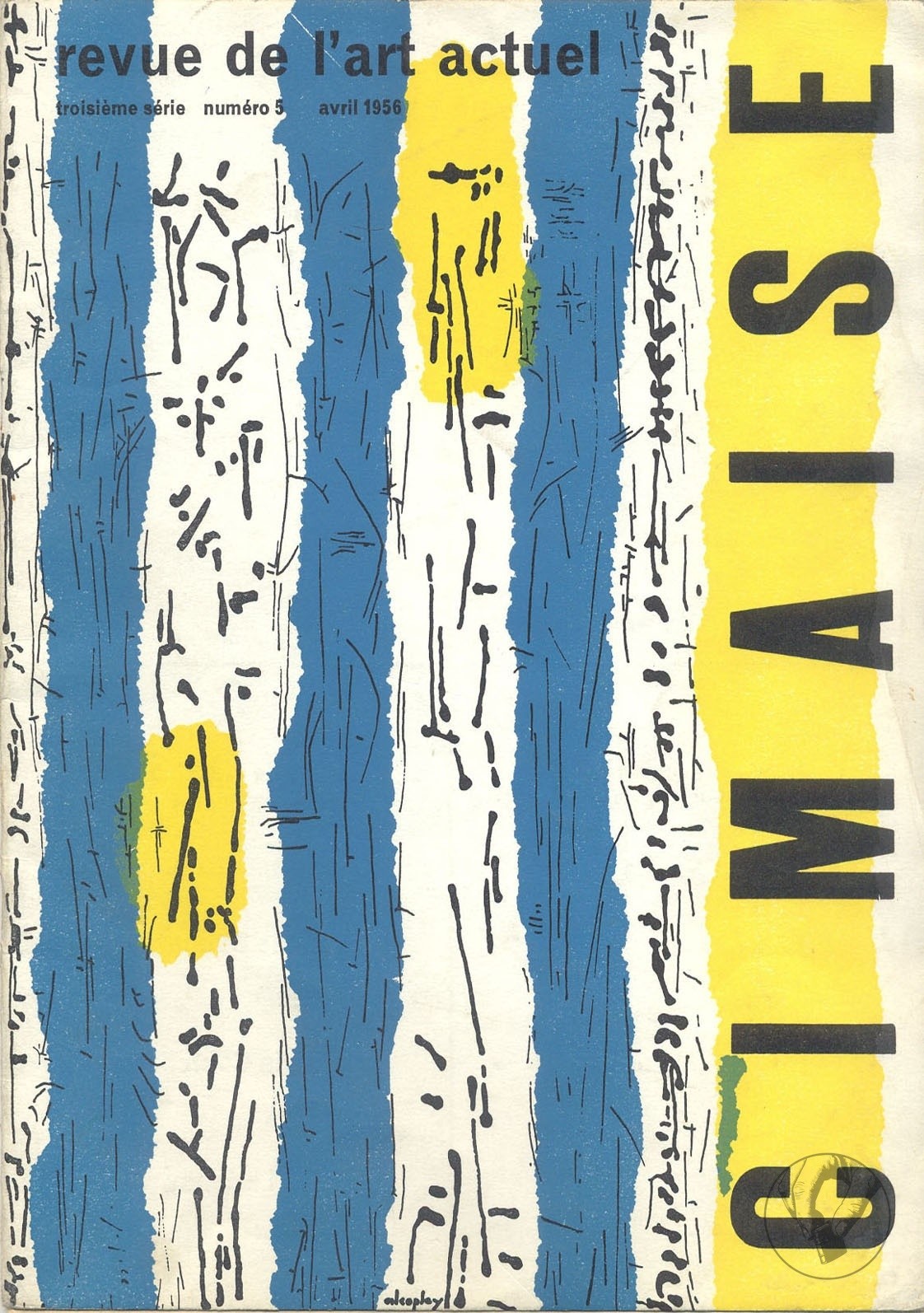
La revue "Cimaise" présente dans ce numéro des articles sur les artistes Gérard Schneider et Nicolas de Staël, avec des textes de Michel Ragon et Herta Wescher. Elle aborde également le thème du théâtre abstrait et propose une section d'informations sur les expositions et les bibliographies artistiques. Le numéro inclut des textes en français et en anglais.