Page 1
revue de l'art actuel quatrième série numéro 2 novembre-décembre 1956 L'ES Yunkers
Premières pages de l'ouvrage, en accès libre.
revue de l'art actuel quatrième série numéro 2 novembre-décembre 1956 L'ES Yunkers
Galerie de France 3 rue du Faubourg-Saint-Honoré, Paris 8, Anjou 69-37 --- Singier janvier --- contemporary paintings --- Stable Gallery 924 7th Ave. (at 58th St.) New York, Cl 6-3323
Kootz Gallery 1018 Madison Avenue, New York 21, N.Y. exclusive representatives for: William Baziotes, Herber Ferber, David Hare, Hans Hofmann, Ibram Lassaw, Philippe Hosiasson, Georges Mathieu, Iaroslav Serpan, Gérard Schneider Pierre Soulages selected works by: Picasso, Dubuffet and others --- André Emmerich Gallery 18 East 77th St, New York 21, N.Y. --- John Levee first New York show november - december --- Sidney Janis 15 East 57th St. New York paintings by Albers, De Kooning, Gorky, Guston, Kline, Pollock, Rothko --- Meltzer Gallery 38 West 57, New York paintings, drawings, sculpture, prints Agents for: Jankel Adler, Alva, Huguette-Arthur Bertrand, Dorr Bothwell, Louis Bunce, Rhys Caparn, Madeleine Gekiere, Rolf Nesch --- Rose Fried Gallery 40 E 68 St., New York, NY. Contemporary works of Arp, Gilili, Kandinsky, Kupka, Léger, Miro, Nicholson, Picasso, Severini, Schwitters décembre : Edgard Pillet january : 60 Character studies of famous artists, architects, composers. and collectors by B. F. Dolbin february : Esteban Vicente, oils and collages
aujourd'hui art et architecture Une grande revue d'art Chaque numéro 100 pages largement illustrées nombreuses quadrichromies, une planche couleur d'un des meilleurs artistes actuels Parmi les problèmes traités : - L'art abstrait constructif - L'intégration des arts dans l'architecture Le numéro 900 frs. Abonnement 1 an, 6 numéros: France 4.500 frs, Etranger 4.800 frs Aujourd'hui : 5 rue Bartholdi, Boulogne-sur-Seine Téléphone: Molitor 61-80 et 61-81 C.C.P. Paris 1519.97 --- Revue internationale d'art moderne 240 pages, 170 illustrations, 12 planches couleur, 16 pages en héliogravure, 1 dépliant, 1 fac-simili Publié par A.D.C.A. Palais des Beaux-Arts de Bruxelles Diffusion française, Paris le no 2 vient de paraître Georges Fall, éditeur 58 rue du Montparnasse, Paris 14 L'œuvre des peintres d'aujourd'hui Le Musée de Poche 12 hors-texte en couleurs Manessier, Jean Cayrol Bissière, Max-Pol Fouchet Pignon, Henri Lefebvre Vieira da Silva, René de Solier Poliaikoff, Michel Ragon La Jeune École de Paris, Hubert Juin 690 frs. dans toutes les librairies
Marcel Brion Art abstrait Sa place dans l'histoire de l'art des précurseurs à nos contemporains un véritable musée 60 magnifiques hors-texte, en couleurs et en noir, d’œuvres modernes capitales. Editions Albin Michel --- Wittenborn & Co New address: 1018 Madison ave. New York, 21, N. Y., USA Recent publications: Carola Giedon-Welker Contemporary sculpture, An evolution in volume and space 8.50 dollars Covarrubias in collaboration with the Andre Emmerich Gallery Mezcala, Ancient mexican sculpture 1.50 dollars --- Réimpression Michel Ragon L'aventure de l'art abstrait Ce livre est le résultat d'une aventure de dix années. C'est à la fois le livre d'un critique, d'un historien, et le récit vivant, anecdotique parfois, pamphlétaire lorsqu'il le faut, d'un témoin de l'avènement de l'art abstrait dans l'École de Paris. Éditions allemandes et japonaises en cours d'impression 244 pages, 30 reproductions, 960 francs Robert Laffont éditeur, 30 rue de l'Université, Paris 7 --- European art this month editor and publisher: James Fitzsimmons Froschaugasse 5, Zurich, Switzerland In European art this month you find - Factual accounts of recent and current exhibitions - News of event and personalities, auctions, salons, and prizes - An extensive check-list of art books - Descriptions of museum collections - A calendar of exhibitions in all parts of Europe European art this month appears ten times yearly. A one-year subscription costs 6 dollars or 2100 frs
Cimaise revue de l'art actuel 34 rue du Four, Paris 6 Directeur: J.R. Arnaud Rédacteur en chef: Herta Wescher Secrétaire général: John Koenig Rédaction: J. Alvard, R.V. Gindertael, M. Ragon, P. Restany La rédaction reçoit sur rendez-vous Abonnement (6 numéros) 1.400 frs - Par avion: 2.800 frs 34, rue du Four, Paris 6, téléphone Littré 40-26 C.C.P. Paris 5542.39 Diffusion: Allemagne: Horst Beck, Hoedingen ueber Uberlingen, Bodensee PS ch A Karlsruhe (Bd) 43328 Argentine: Editorial Victor Leru, Cangallo 2233, Buenos-Aires Autriche: Arnulf Neuwirth, Paracelsusgasse 8, Vienne 3 Belgique: Jean Milo, 28 rue de l’Arbre Bénit, Bruxelles C.C.P. Jean Milo, Bruxelles 1591.50 Danemark: Meiners Kunstforlag, Peder Skramsgade 5, Copenhagen Grande-Bretagne: Alec Tiranti Ltd, 72 Charlotte Street, London W1 Japon: Meiji-Shobo, Surugadai, Kanda Tokyo Norvège: J.W. Cappelen, Sortimentebokhandel, Oslo Suède: Eric H. Olson, Upplandsgatan 3, Stockholm, 10 23 77 Suisse: E. Genton, «L’Entr’acte», rue du Lion d’or 4, Lausanne, C.C.P. II 144-56 U.S.A.: Wittenborn and Co, 1018 Madison Ave, New-York 21 M. Flax 10846 Lindbrook Drive, Los Angeles 24 2 --- Sommaire Couverture de Yunkers Textes anglais 7 Painting Today in New York by Dore Ashton 8 The New York Galleries by K.B. Sawyer 10 Jackson Pollock by K.B. Sawyer Sculpture Today in New York by R. Goldwater Textes français 11 La peinture actuelle à New York par Dore Ashton 17 Les Galeries de New York par K.B. Sawyer 22 Jackson Pollock 1912-1956 par K.B. Sawyer 24 La sculpture actuelle à New York par R.Goldwater 29 Potentiel américain par Julien Alvard 31 Informations 32 Vitalité de l’Ecole de Paris par Herta Wescher 35 Les expositions par Julien Alvard, R.V. Gindertael, René Déroudille, Pierre Restany, Michel Ragon, Herta Wescher Textes anglais 44 The American Potentiality by Julien Alvard 45 Vitality of Paris by Herta Wescher Dans notre prochain numéro : Une étude de Michel Ragon sur Atlan Un essai de R. V. Gindertael sur le langage pictural Plusieurs articles sur les rapports de l’architecture et l’art moderne Peintres et sculpteurs d’aujourd’hui: Pierre Fichet par Herta Wescher Martin Barré par J. L. Thiébault Et comme dans chaque numéro : actualité, informations, bibliographie --- Otto Seligman Gallery E. 47th and University Way, Seattle 5, Washington, U.S.A. Tobey prix Guggenheim U.S.A. 1956 and contemporary works of American and European artists
The articles by J. Alvard and Herta Wescher were translated by J. Koenig. The others are the original manuscripts. --- Painting Today in New-York by Dore Ashton Every two weeks in New York, some 150 art galleries spew forth exhibitions ranging from the most pedestrian traditional works to the most explosive avant-garde work. With this blinding volume of exhibition activity, it is difficult to assess particular trends, yet I would venture to say that this past season of shows has indicated a few clear lines of development. What has been called the «abstract expressionist» movement here is still ascendant. The only binding common feature among those practitioners of «abstract expressionism» is the general non-geometric basis of operation. Those painters who have grown more from surrealist, automatic traditions than from cubist or neo-plastic roots have extended their horizons, willfully banishing remnants of classical European theories. Of the younger generation, it can be said that they have grown out of violent automatism toward what can be called a lyrical naturalism. There has been much talk lately of “abstract impressionism”, a modified version of the more aggressive works of leaders like deKooning and Pollock. Many of the younger painters working in this idiom search now for metaphor, basing their concepts on distinct experiences with nature. Nevertheless, the possibilities offered by revolutionaries like Pollock and deKooning in terms of pure pigment manipulation has had its effect too. Many incipient styles are being formed based on the nature of paint applied freely and without premeditation. And along with this comes the danger of academism. Unlike Europe, New York has few organized media of partisanship. There are no magazines frankly dedicated to examining a certain point of view; no gallery organs, and few manifestos or collective expressions on the part of the artists. Therefore, most shifts in style and thinking are discernable only in vague terms postulated after the fact of exhibitions. On the other hand, the major institutions like the Museum of Modern Art and the Guggenheim Museum participate in cataloguing trends and giving status to individual leaders. For that reason, an ambiguous situation, which has probably never existed before, has created another dimension in the art world here. Namely, that certain of the best known avant-garde painters have become canonized. They who create works for the future are being accepted in the present. The pressures this puts on the artists, who are expected to come forth every year with something “new” to vindicate the trust of the authorities, are strangely compelling. This year, for the first time, the full onus of that responsibility begins to reveal its adverse effect. The scramble to stay “on top” and hold on to “leadership” is more hectic than ever in this city which one painter has said “has the shortest memory in the world.” At this point in history, when the wildest of the avant-garde are welcomed with zealous enthusiasm, three major exhibitions—Jackson Pollock, Franz Kline, and Willem deKooning—highlighted achievements since the end of the recent war. All three of these men have influenced American painting immeasurably, and all three, in my opinion, have reached a point where they must either withdraw to recreate themselves, or be destined to parrot their own statements. Pollock’s impressive achievement was illustrated with an exhibition of fifteen years’ work dating from his first break with representational painting. Early Pollock was based on an understanding of Picasso — the expressionist Picasso who nevertheless carefully constructed all his paintings with knowledge acquired in his Cubist days — plus an interest in surrealism. He sought, along with Rothko and others, to call up a private myth with symbols which could be read only obliquely. The allover patterns established in even the symbolic works could be traced to the automatic paintings which gained him the attention of the world. Parenthetically, this all-over pattern, with equal emphasis on every part of the picture, was signalled by Clement Greenberg who likened it to polyphonic music. The tendency to large scale, evenly figured painting became very pronounced here for several years, but has now subsided. This show, which indicated each of Pollock’s advances — from the elegant “drip” paintings, to the heavily brushed, furry-textured combinations, to the black-and-white semi-figurative, and back to the skeins of non-objective painting again—served to indicate to younger painters the organic progression of an academically trained painter’s ideas. However, the works of the past three years in that show are slightly hesitant. The most recent painting was ironically titled “Search.” Pollock has, in fifteen years, run a gamut of development which in former periods might have been spread out over half a century. And the very speed of this metamorphosis brings in new disquieting problems. Franz Kline, who only began to paint his large black signs on white some seven or eight years ago, showed recent work which has hardly deviated from the original powerful thrust. Kline’s imagery is again impossible to define, yet many beholders identify the speed of machinery with his veering line, and the giant constructions of modern engineering. The most important lesson in Kline’s show was that the necessary asceticism which led him to eliminate “matière” and color, and to streak his rugged characters in outside scale, is a truly static asceticism. Once the speed and bravura are registered, there is little left to say. Kline, of course, must say it again and try to amplify his statement, but his baby was born full-grown and now there is nothing for it to do but grow old, it seems. With deKooning, the story is more complicated. DeKooning has always been an extraordinary painter and his work has never been submitted to programmatic asceticism. His volatile temperament has lead him into many variations, among them the important but disputed “Women” series. After the flat, suave series of excavations and attics, deKooning went for the human image in the shape of an expressionistically distorted woman painted again and again. This woman caught up, in her lustily brushed being, the excitement of a city world, the calm of the countryside, the womb-like enclosure of the studio and the hell that can be a home. Yet, she was painted as a medium, not as an object, to project a number of unrelated but important emotions. In the course of the “Woman” series, deKooning became increasingly free, letting his wide brush swing vigorously all over the canvas. He used shrieking colors, vermiliions, violets, acid greens and numerous, fat pinks, which were applied in layers of now glossy, now dry pigment. His surfaces became the most important aspect at first glance. It was a normal step for deKooning to work out of the women into abstraction again, carrying along all the effects he had developed in the women series. His last exhibition consisted of large canvases covered with the “scoop” strokes of broad brush, muddy passages, brilliant, daring color juxtapositions, and the crafty alternation of fat and thin matter. They were virtuoso paintings, which, in their masterful manipulation of paint are beyond criticism. But they were tantalizingly inconclusive. As one artist said, one felt as though if deKooning had had a studio a mile long and canvas to match, he could have made the painting continue for a mile. The content was the gesture, which, after analysis, threatens to be empty. It may well be that deKooning, who is indisputably a master painter in America, has felt the awkward onus of acceptance.
The gestation period must be truncated when the public and authorities are waiting. It may also be that the time for aggression in past, and the mere gesture is no longer either as provocative or efficacious as before. One of the most important exhibitions this season brought tentative guesses about the shift in winds to a certainty. It was an exhibition of three years’ work by Philip Guston who was, at one time, one of the leading realist painters in America. Guston has been involved in a profound search for an autographic style and philosophy, and has arrived at what may be an important seminal idiom. Unlike the other three, Guston in introspective, seizing an idea and buffeting it about in his mind for lengthy periods before committing it to paint. His recent unique paintings were brought forth slowly and with great effort, though the effort is thoroughly concealed beneath the masterfully articulated surfaces. In a sense, he is like our great painter Mark Rothko who contains a tremendous violence within misleadingly beautiful bounds. The paintings, which emanated a silvery light, were built up of many layers of strokes, scraped now and then to a marble polish, and left in relief in parts. These were kept in low scale grays and pinks. Over this carrier, Guston dashed broad strokes of rusty vermilion or sooty gray which rode like waves on what appeared to be a horizon. A deep rumble beneath the surface was the drama. The over-riding strokes were simply climaxes paced according the mood he was trying to create. The important aspect of the Guston show was its assertive unity; its homogeneity and emotionally exacting projections of distinct sensations (among them sound and color.) In these works, Guston comes near the synesthetic dream of the romantic poets. Furthermore, he brings new possibilities for other painters who are temperamentally not attuned to violent abstract expressionism. He has gone to his personal experience, extracted its essence, and presented accurate equivalents. It is lyrical and contemplative, based on an exquisite sense of craft and respect for medium. Others artists, many of them younger, have also begun to specify their feelings more accurately, and more elegantly. Esteban Vicente who for years was a magnificent colorist doing abstract still-lifes and interiors, has cleared away small forms in favor of irregular squares (which many others as well have resorted to) making them serve as modulators. Angelo Ippolito, also using angular forms, paints sunny abstract landscapes which in their poise and lyricism mark him as a dissident from former abstract expressionist terms. Joan Mitchell another younger painter, uses the long stroke found in deKooning but gently, with soft color, to creates limitless vistas in multiple perspectives. Nicholas Carone who recently showed gray-black-and-white abstractions has also made use of the free brushing of the abstract expressionist school, but in terms of definite symbol. His is an attempt to convey, via the matter of pigment and barely indicated symbol, a sense of the complications of contemporary “grand themes.” James Brooks, a non-objective painter, also treats his canvases in the broad manner of the expressionist, but his color, always retaining its body in spite of thin application, carries a lyrical message. From the West, there are still reverberations of the teachings of Still and Rothko. The very nature of the western landscape modifies the painting, for the great sea, desert, mountain and plain spaces insist on scale and mystery. Richard Diebenkorn is one of the outstanding younger men whose work is frankly based on landscape, with horizontal bands of earth colors surmounted by a span of deep blue. Diebenkorn uses the dissonance learned from deKooning, the loose brushing and occasional dirty passage, but his intent is still to create a direct equivalent to nature. The same is probably true of Edward Dugmore, though his large paintings seem more introspective on the whole. Scale and use of extensive void characterize his paintings. Dore Ashton --- The New-York galleries by Kenneth B. Sawyer With the emergence of an indigenous American art—that is, an art, whatever its initial inspiration, that is recognizably of the New World—during the past fifteen years, it has become increasingly fashionable among critics to play at the charades of impetus. Much has already been written about the Orientalism of Tobey (and of Graves), the impact of Clyfford Still, and later of Mark Rothko, on Far Western painting, the importance of the Hans Hofmann School and of the Kandinskys in the Museum of Non-Objective Art (now the Solomon R. Guggenheim Museum) toward a comprehension of the total picture of the complex sociological phenomenon that is native American art. What has been generally neglected is the role played by private galleries. Let me insist from the outset that neither galleries nor dealers create an art. That remains for the artist alone. What the gallery can do is gather an audience, possibly even a clientele, for the work of specific talents. It can make this work available to other artists (stimulated far less by some ambiguous ‘nature’, than by Life—which includes works of art). A few perceptive and courageous dealers can help to make possible a direction that might otherwise perish in the studio for lack of nourishment. Peggy Guggenheim’s Art of this Century Gallery in New York pioneered avant garde painting and sculpture in the early forties. Although other dealers had from time to time exhibited European contemporaries earlier (in some cases much earlier), Miss Guggenheim was unique for her catholicity and scale. Basically, her private collection, which formed the nucleus of the gallery’s early exhibitions, was European, with its emphasis Cubism, Surrealism, and Constructivism. But Art of This Century proved itself friendly to unknown Americans from the beginning. Gathering a group of young New Yorkers about her—a group that included Jackson Pollock, Clyfford Still, Mark Rothko, Robert Motherwell, and William Baziotis among others—Miss Guggenheim presented their work to a skeptical if not hostile art world. While the Art of This Century Gallery has become something of a legend, with fact and myth inextricably interwoven, it was unquestionably the most important incubator for contemporary American art. A projected mural, a joint undertaking by some of the loftiest names on the American scene, never materialized; it nonetheless exists in spirit and anecdote to this day. Of such stuff are epics made. Probably it would have been monstrous, but the impulse was prompted by the genuine creative fury of the gallery’s milieu. When Art of This Century closed its doors for the last time in 1946, it was Betty Parsons who assumed the leadership of the New York avant garde. On the occasion of the tenth anniversary of the Betty Parsons Gallery, Clement Greenberg wrote: > “Mrs Parsons has never lacked for courage. It is not a virtue signally associated with art dealers (or, for that matter, with art critics or museum directors either), but then she is not, at least for me, primarily a dealer. I have seldom been able to bring her gallery into focus as part of the commercial apparatus of art (I am not sneering at that apparatus); rather, I think of it as belonging more to the studio and the production side of art. In a sense like that in which a painter is referred to as a painter’s painter or a poet as a poet’s poet, Mrs Parsons is an artist’s—and critic’s—gallery: a place where art goes on and is not just shown and sold.” It was by a rare combination of percipience and good luck that Betty Parsons was the first to show the mature work of Pollock, Still, Rothko, Stamos, Reinhardt, and Tomlin. Peggy Guggenheim had exhibited most of them earlier. But it was with Mrs Parsons that they arrived at their major phases. As well, she has shown Hans Hofmann, Barnet Newman, Alfonso Ossorio, Herbert Ferber, Day Schnabel, and Seymour Lipton. While many of her original artists have left the
gallery, it is due to Mrs Parson’s efforts on their behalf that they have become both accepted and influential. One of the most dedicated and articulate of dealers, she has carried the message of art to a popular audience with perhaps more force than any other gallery owner. In 1951, she defended contemporary painting on Radio Station WNYC: “...These artists are establishing a relationship with the world through their own experience, and I have made a place where their expression can exist. That the strength of this liberation is so important, so vital, in a world where we see freedom being submerged all around us, is adequate compensation for my commitment. And this is why I am involved. But, on the other hand, I should not be the only one; I would like to make the work of these men available to all, so that each will really understand liberation! I don’t feel that by doing this I am carrying a special torch—this freedom of the spirit has always existed, and my devotion to it and presentation of it to the public is a simple human act, and all I am asking of the public is to come—and if they can feel these pictures, and when they do, to act on the basis of their own feeling, with courage. I think their work has messages for all, and can be part of any man’s life.” And a little later within the same context: “The world (my) artists are interested in is beyond the world of romance and nostalgia. They are involved in a truth rather than a mere translation. They want to escape into reality not from reality.” After more than a decade’s battle for the acceptance of the new forms, Mrs Parsons is still a vigorous searcher after the valid truths and realities of personal expression. In this she is unique. It is only a few steps from the Betty Parsons Gallery to that of Sidney Janis and a hardly less creative attitude prevails there. Indeed, Mr Janis has among his group some of the most powerful painters in America. Jackson Pollock, Mark Rothko, Willem de Kooning, Philip Guston, and, since the spring (1956), Franz Kline exhibit exclusively there—a stable of Americans perhaps unequalled in any other New York gallery. Although Janis can scarcely be called a pioneer among avant garde dealers, he has selected his group cannily and promoted its work with singular success. Of the aims of this gallery, Mr Janis has said “Our policy is simple: we believe in showing the most creative things of a given artistic epoch and since ours is the 20th century, we concentrate there.” Actually, the Janis Gallery has attempted more ambitiously, with frequent well-chosen surveys and retrospectives. Among the most significant have been “Fauvism”, “Climax 1913”, “Futurism 1910-14”, “Cubism 1910-12”, “50 Years of Mondrian”, “XXe Century Masters”, “French Art”, and “15 Years of Pollock”. As well, Mr Janis has been an ardent partisan of French art in America; indeed, the gallery opened in 1948, with a sizable exhibition of work by Léger, whom he has continued to show more or less regularly. Sidney Janis is a quiet, enterprising man with a large and remarkably faithful clientel; while he has not been an outstanding discoverer of artists, he has been, on the whole, perhaps the most successful promoter of their work on the modern scene—certainly an important function of a dealer. At the corner of Madison Avenue and 57th Street—the very heart of the American art world—is the Kootz Gallery, founded by Mr and Mrs Samuel Kootz in 1945. Mr. Kootz, a genial man with a keen eye for the international situation, summarizes his original aims in the following way: “When I founded the gallery, with my wife, it was with the intention of helping younger American painters in two ways: 1. In exhibiting and fostering their work; 2. In concrete subsidiation; feeling that by purchasing the entire production of a man I could give him economic freedom and confidence in himself... Actually, we opened the gallery in 1945 with an exhibit by Léger, to tell collectors and museum directors that we had no interest in American painting as such, but would devote ourselves to international painting.” It is as an international gallery that the Kootz has made its reputation. Like Sidney Janis, Mr Kootz favors France, but with this significant difference: he has chosen some of the most brilliant younger Frenchmen for presentation in America. Among those he has sponsored with signal success are Mathieu, Soulages, and Schneider; among the Americans he shows regularly are Hans Hofmann and William Baziotes. In another respect Mr Kootz has proven himself an astute judge of the contemporary scene. While other dealers were becoming increasingly timid of sculpture, he frankly stressed it, bringing to the public the work of Lassaw, Herbert Ferber, and David Hare. But perhaps the most significant contribution he has made was the introduction of his artists to the modern architect. Mr Kootz says: “I watched our artists doing larger and larger paintings and sculpture, anxious for a wall. On the other hand, I saw that the architect was imprisoned in his belief that his pure white wall should not be embellished; added to this was the architect’s complete unawareness of what was going on in modern art (a few architects were so much the exception that it was painful to contemplate).” “After six years of architectural contacts, all the artists in the gallery (with the exception of Baziotes, who refuses to work on architectural commissions) are now busily engaged in many commissions: sculpture, mosaics, tapestries, murals, etc.” “It has been a very brilliant solution to the modern artist; he has ambitious projects to fulfill; he is well paid; publicity has accrued, making more people anxious to see his work. Altogether, terrific.” The soundness of Kootz’ reasoning was more than confirmed with the unveiling of Hans Hofmann’s magnificent mosaic in the new Lescaze building at 711 Third Avenue, New York, in April. Martha Jackson is a relative newcomer to the New York art scene. Her first gallery, a small, two-room affair, opened with little fanfare and seemed at first destined for an undistinguished future. But after several meticulously chosen exhibitions, the art world began to take notice; so did the museums. In 1954, Mrs Jackson explored Europe for new art, and, on her return, New York rubbed its eyes and admitted that here, indeed, was a dealer to be reckoned with. She contracted Karel Appel, Sam Francis, and John Hultberg; brought back work by Marini, Moore, Scott, Burri, and Hepworth. A little later, she showed for the first time an extensive collection of the Marsden Hartley Munich abstractions. This she followed with a brilliant de Kooning exhibition, which, despite its cramped quarters, won critical accolades. When Mrs Jackson announced the opening of a new gallery farther uptown, the entire New York art world turned out to celebrate the occasion. No one was disappointed. Her new gallery, almost museum size, with two floors of showing space, a sculpture court, and private exhibition rooms, seemed an ideal situation for the vast canvases by Gottlieb, deKooning, Pollock, Gorky, Appel, Francis, and the dozen others included in the opening show. Her early exhibitions in the new gallery proved worthy of the situation: Francis, Hultberg, and Jenkins in quick succession, followed shortly afterward by Boardman and Appel. In three brief years, Mrs Jackson has indicated forcefully what her policy is to be: to show the best available painters and sculptors, celebrated and unknown. She is well on the way to fulfilling this promise. In retrospect, I am acutely aware that I have omitted many galleries and dealers of integrity and position: Pierre Matisse, who shows Riopelle, Dubuffet, and Roszak; Willard, which shows Mark Tobey and David Smith—unquestionably America’s greatest sculptor; The Stable, with Robert Motherwell and the exciting group shows of younger modernists; Catherine Viviano, who has introduced Alan Davie to the United States; Elinor Poindexter, with her courageous championing
of younger artists; Rose Fried, who had a comprehensive Collage show this spring; Grace Borgenicht—there are many others fulfilling the mission of the dealer, engaged in independent action in a country where independence becomes increasingly unfashionable. It is to these intelligent and courageous human beings and those who went before them that we owe an unpayable debt—for they have helped to guide America out of the creative wilderness of a phillistine past. K.B. Sawyer Jackson Pollock (1912-1956) by Kenneth B. Sawyer To C. G., who said it all better ten years ago. Jackson Pollock is dead at forty-four. His position in American art was unique in a sense that no other painter’s was. During his brief maturity (1946-56), his name rang out as a symbol of all that was vital and creative in painting. Conversely, he was enfant terrible, scapegoat, and whipping boy to the middle-brow press (Jack the Dripper), and the womans club art group (But is it really painting?). His art had many sources: Picasso of the early thirties, Masson, Miró, Siquieros, Hofmann, Matisse; indeed, he was the most ‘European’ of the Abstract Expressionists (I exclude Hofmann and DeKooning, who arrived in the United States as adults), and the most original. An artist of talent varies his sources; an artist of genius transmutes them. Pollock’s genius, as abundant as his creative energy, made him at once impregnable and vulnerable: impregnable, because genius has a way of transcending the currents of its climate; vulnerable, because no degree of removal wholly distances the swarm of epigones who abuse and distort the profoundest compulsion. Pollock’s first period to attract public attention was that of ‘The She-Wolf’ (1943). In it, he carried forward Picasso’s shallow space to a new and more immediate function, to a redefinition of the picture plane. His ‘totems’, which followed shortly after, returned his brushing to the elegance of Matisse’, his spatial consciousness to that of the great Venetians. In 1946, he painted his first series of uncontained compositions (I am disregarding experiments in that direction done in 1936-7, while he was working on the W.P.A. Art Project. While the single example from that period I have seen—in the collection of Clement Greenberg—is a remarkable picture, it is only a rehearsal of the following decade). It is somewhat beside the point to insist that Tobey had shown similarly conceived compositions in New York as early as 1944; Pollock arrived at the device independently, used it dissimilarly and on a scale that Tobey never attempted. Almost simultaneously, he evolved his famous ‘drip’ technique (actually, a direct pouring of enamel onto canvas laid flat on the floor). The most controversial of his contributions to lay viewers, it was the most influential among his fellow painters. Lest too much be made of this device, let me add at once that it partook of trickery neither more nor less than any other technical convention. Every artist worthy of the title discovers the form which is his unique contribution. It is compelled into being by that very congeries of factors that makes him an artist. Its success can be measured not by a set of academic dicta, but by the impact—the validity—of the creation. To achieve the paintings which made him a great artist, Pollock needed the twining threads of color that spun in interlocking arabesques across the surface of his canvas. He needed them for the precise reason that they forced the eye to participate with the surface. For no less valid a reason, he required the stains that spread and expanded behind them. His great genius was for binding the rectangle of the canvas into a single unit, organic and ambiguous, capable of vitalizing a wall or a gallery. He faced the problem of painting-as-gesture squarely and with obsessive violence. At that moment of embarrassment, that moment in which every painter must come to terms with the plastic presence of his picture, Pollock was capable of destroying the image in the fury of his creative impulse (although only Greenberg seemed to have an unerring eye for the successes and failures). Such power can ruin pictures; it can also create masterpieces. Perhaps fifty oils remain to testify to the measure of Pollock’s genius. He is irreplaceable. Kenneth B. Sawyer Sculpture Today in New-York by R. Goldwater For almost a decade it has been the custom to talk of a revival of sculpture here in the United States. There are more young sculptors, it is said, and more interest in sculpture on the part of the public, the public, that is, with an interest in a truly contemporary art. It is certain that artists groups, and museums and dealers have behaved as if this were so, and with a consciousness that sculpture is a neglected art (in contrast to painters who are neglected artists) have deliberately made room for sculpture. Whether cause or effect, this does in its own way constitute a revival. Perhaps this has also been happening in Europe. But there are notable differences: Outdoor exhibition in America is not, as in Europe, a showing of sculpture in a garden. It is held instead on a terrace, a back-yard, a large vacant lot surrounded by the blank surfaces of tall buildings. This is of essential importance, for the starkness of space in which sculpture is thus shown defines that sculpture with a clarity and relentlessness altogether different from the mitigating light and softness of outline produced by a park—whether in Battersea, Arnhem, or the Rue de Vaugirard. It is perhaps for this reason too that metal sculpture (which has also been important in Europe) has for the most part been much more “contemporary” than European sculpture. I mean by this that it has neither continued the fruitless post-Mondrian exercises nor fallen back into the undeniably charming archaelogies of the type of Marini, Manzu, etc. In this sense, recent American sculpture of importance has been much closer in style to painting: the work of Lassaw, Lippold, Roszak, Ferber, Smith, Hare, Bourgeois, Nivola, etc. is recognizable of the same period as that of the “younger” painters, and at its best is as significant. The parallel with the more popular and publicized painting has raised a problem with which the sculptors themselves have had to deal in the self-examination of their own work, as well as in its reception. For with both the true qualities of abstract-expressionist painting, and its momentary avant-garde virtues firmly planted in the minds of artists and public, the question of how to categorize the work of the younger sculptors has been constantly present. If this should be a false question, it has nevertheless been a psychologically actual one. Artists societies being what they are, and the monolithic nature of momentary taste being what it is, it cannot be dismissed; it has been a very real hazard in the creation of recent sculpture. But first what of the influence of the older men? Calder of course is the best known of American sculptors, and his vision was an important factor some years ago. He has, nevertheless, created no school—of artists. Instead, by a process of rapid vulgarization and popular acceptance of decreed style that is typically American, (cf. the mass production of French fashion originals), and which has its great virtues in the education of taste even if it is sometimes the cause for utter despair, the mobile has become an almost standard item of “modern” interior decoration. It is also characteristically something that the amateur carpenter makes rather than buys—half mocking himself and half the art he is imitating. Nor do the older and so to speak more masterly masters—Lipchitz and Gabo—have any greater following. Personally, neither has had any real contact with American artists, each
Kline: Chef, 1950, 148 x 186, collection Museum of Modern Art La peinture actuelle à New-York par Dore Ashton Chaque quinzaine, à New York, quelques 150 galeries lancent des expositions allant du style le plus pompier à l'avant-garde le plus explosif. Au sein d'une activité aussi ahurissante, il est difficile de dégager quelques tendances spécifiques; je crois pourtant que, la saison dernière, plusieurs se sont manifestées. Ce que l'on appelle «l'expressionnisme abstrait» progresse encore; le seul lien entre ceux qui s'y adonnent étant un refus de principe de toute géométrie. Ces peintres, héritiers du surréalisme et de l'automatisme plutôt que du cubisme et du néo-plasticisme, ont élargi leurs horizons, bannissant délibérément toute séquelle des théories classiques européennes.
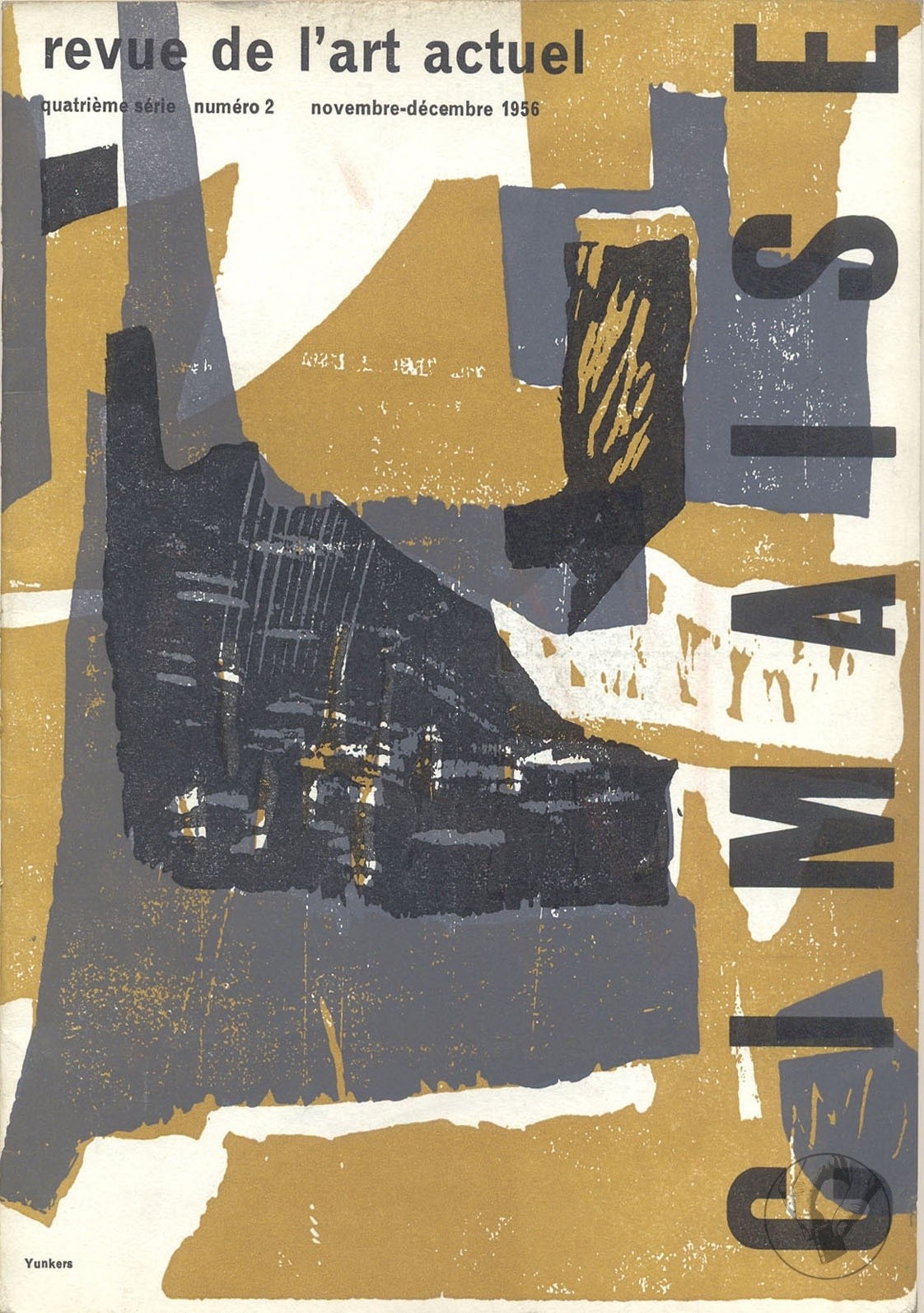
La revue d'art actuel « Cimaise » présente son numéro de novembre-décembre 1956. Ce numéro contient des textes en anglais et en français sur la peinture et la sculpture contemporaines à New York, notamment des articles sur Jackson Pollock et le mouvement expressionniste abstrait. Il aborde également la vitalité de l'École de Paris et les expositions d'art moderne. Le prochain numéro annoncera une étude sur Atlan et des articles sur l'architecture et l'art moderne.