Page 1
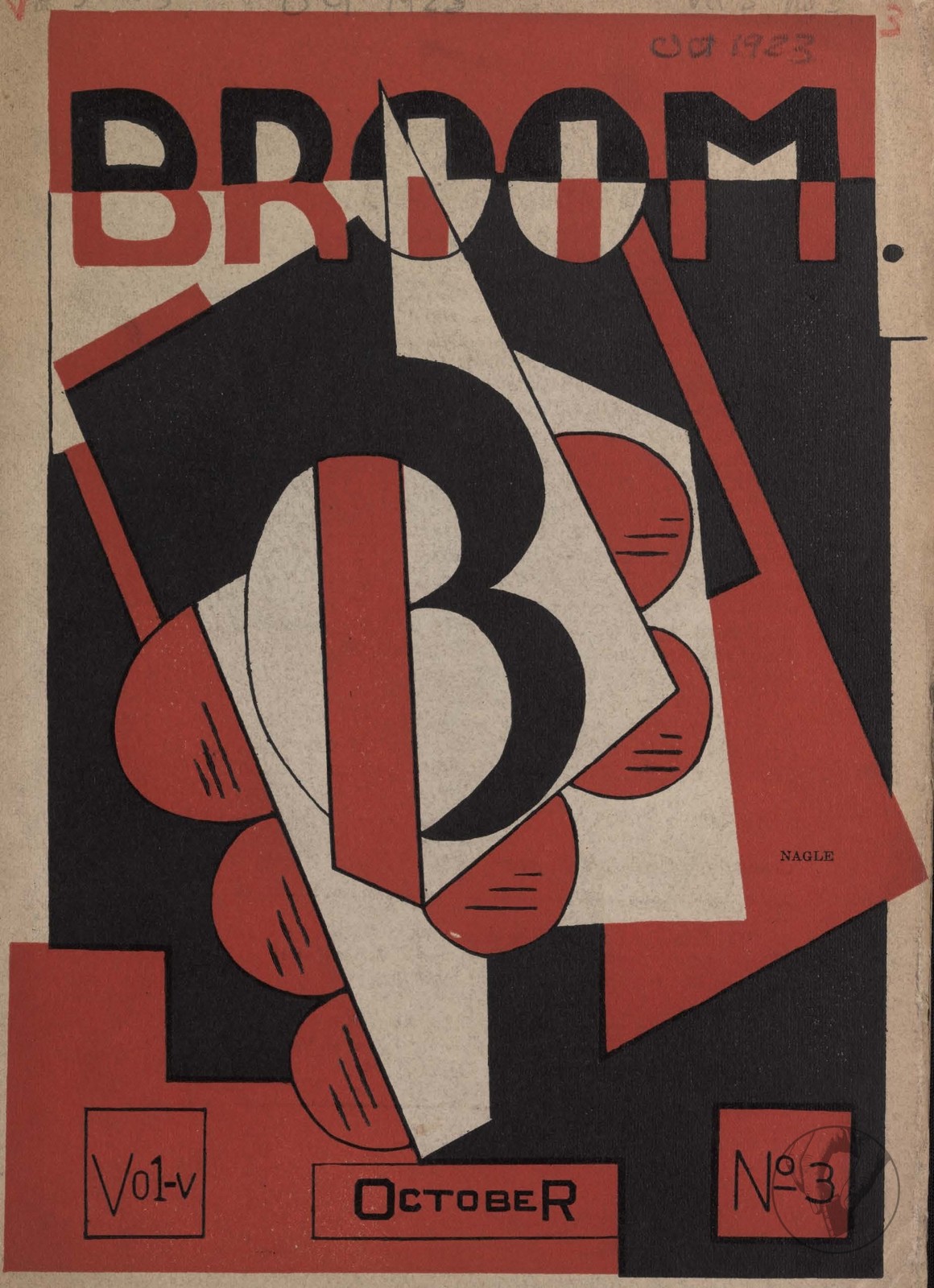
BRDOM $\mathcal{B}$ Vol-v OCTOBER NAGLE No 1923 No 3
Premières pages de l'ouvrage, en accès libre.
BRDOM $\mathcal{B}$ Vol-v OCTOBER NAGLE No 1923 No 3
"SHAKESPEARE AND COMPANY" Sylvia Beach 12, rue de l'Odéon Paris-vi* BROOM AN INTERNATIONAL MAGAZINE OF THE ARTS Editor, HAROLD A. LOEB Associate Editors, SLATER BROWN, MALCOLM COWLEY, MATTHEW JOSEPHSON OCTOBER, 1923 PUBLISHED MONTHLY VOL. 5, No. 3 COVER DESIGN—EDWARD NAGLE --- Page --- STILL LIFE—CHARLES SHEELER . . . . . . . . . (facing) 129 --- A BLACK WREN—JOHN FREEMAN . . . . . . . . . 129 --- FIVE AMERICANS—E. E. CUMMINGS . . . . . . . . 134 --- HENRY FORD—MATTHEW JOSEPHSON . . . . . . . . 137 --- THE PRIEST SPEAKS—WILLIAM GAMALIEL SHEPARD . . . . . . . . 143 --- BUCKS COUNTY BARN—CHARLES SHEELER . . . . . . (facing) 144 --- PORTRAIT OF JOE GOULD—JOSEPH STELLA . . . . . . (facing) 145 --- JOSEPH GOULD: THE MAN—E. N. AND S. B. . . . . . . 145 --- SOCIAL POSITION—JOSEPH GOULD . . . . . . . . . 147 --- ELLSWORTH TO GREAT POND—WINIFRED VIRGINIA JACKSON . . . . . . 150 --- THE POET ASSASSINATED—GUILLAUME APOLLINAIRE . . . . . . 151 --- BUCKS COUNTY BARNS—CHARLES SHEELER . . . . . . (facing) 160, 161 --- “A BOIRE! A BOIRE!”—SLATER BROWN . . . . . . . . 161 --- HOW MANY MILES TO BABYLON—ROBERT GRAVES . . . . . . 164 --- SOTO AND THE NEW WORLD—WILLIAM CARLOS WILLIAMS . . . . . . 167 --- FLOWERS, AFRICAN MUSICAL INSTRUMENT—CHARLES SHEELER . . . . . . (facing) 176, 177 --- SIXTH POEM—WILFRID H. BENDALL . . . . . . . . . 177 --- BOOK REVIEWS . . . . . . . . . 178 --- COMMENT: WEEK END PAINTERS—EDWARD NAGLE . . . . . . 184 --- The Editors of BROOM will be pleased to consider mss. submitted to them, but all mss. must be accompanied by a self-addressed stamped envelope. The Editors cannot be held responsible for mss. lost in transit. BROOM is published monthly at 47 West 34th Street, New York, by The Broom Publishing Company, Inc. Entered as Second Class Matter, June 30, 1923, at the Post Office of New York, N. Y., under the act of March 3, 1879. Copyright, 1923, by the Broom Publishing Company, Inc. $5 A YEAR 50 CENTS THE COPY
We won't attempt the futility of advertising Travels In Arabia Deserta By C. M. DOUGHTY to BROOM readers. With the exception of “Ulysses” by James Joyce, no book written in the last century has been so hard to get or has had such significance in modern letters, so all we will do is pass on the news that at last an edition is ready. We are publishing it in conjunction with Jonathan Cape of London, and the Medici Society; except for the binding, a rich, gold-stamped black buckram, the two volumes in which the work is being issued, are in facsimile of the original Cambridge Edition, which sold at $50 on publication and is almost impossible to buy now. It contains the arrangements and specifications (which meant practically the invention of a new system of punctuation, anticipating many effects used by contemporary writers), which the author insisted upon for his book. The price is $17.50 per set. 750 are being issued in this country, and by September 20th, 420 were subscribed for, although the book had not yet been published. We urge you to place your orders now, with your booksellers or directly with us; we should like to send you a brochure that we have prepared on this work, anyway. CHARLES MONTAGUE DOUGHTY soon after his return from Arabia The garments are those given him by the Great Sherif of Mecca. (Vol. II p. 508.) We fondly believe that wherever reading is regarded not as duty but as a pleasant habit and one of the comforts of civilization. B & L books are well known. O. E. D., BROOM readers know B & L books; but we would like them to have the exhilaration of knowing the complete list; a post card will bring it. HOLIDAY By WALDO FRANK The “White Covers,” as Paris calls the “Nouvelle Revue Francaise” writers, “L’Europe,” “Ma,” all the forces of gay and unflagging advance in artistic Europe have pointed out Waldo Frank, not only as a compeer, but as a master. He is the most uncompromising force in American letters, and in this remarkable book, HOLIDAY, he has crystallized his method, making it his most perfect expression. $2.00. CANE By JEAN TOOMER You have seen parts of this unusual book in BROOM and other portions probably in “Little Review” and other unfashionable magazines. The book is really a stirring event in the year’s literature. $2.00 A BOOK By DJUNA BARNES That almost mythical personality that has loomed so largely and intangibly over modern art in America — Djuna Barnes—has here made itself manifest in a book as individual as its creator. $2.00. BONI & LIVERIGHT GOOD BOOKS 61 WEST 48TH STREET NEW YORK, N.Y. When writing to advertisers please mention BROOM.
Charles Sheeler Still Life
A BLACK WREN The water was cold and freshening as it poured from the brass tap over his fingers and wrists, and he was so occupied with his pleasure that he scarcely noticed his wife passing through the scullery and only heard her voice vaguely, saying, "I'm going out to see about a black wren." He shook the water from his fingers, dried them, and stepped back to his chair repeating her phrase abstractedly, "I'm going out to see about a black wren. . . . A black wren." What did she mean—had she found a black wren, or why did she want to see about it? Its small bright eye—no, she didn't mean that, but a small black bird, black as a rook, sheeny and black, but not languid and heavy as a rook. What did she want with a black wren? The phrase reminded him of another small bird, the brisk and friendly robin, that perched on his spade if he rested—long rests between each thrust and lift—pecked, fluttered, perched nearer, and looked up so kin-like and bright. It wasn't that the birds of the garden and hedge had any special fondness for him; wild things didn't notice or trouble about him. . . . Stay, there was that squirrel, actually a slightly lame squirrel that wasn't nearly as agile as it should have been. He had stumbled almost upon it and it had leaped away (leaping a little awry, he thought) and then looked as if it trusted him not to harm—not to harm it with a cruel thought even. How pretty it looked—no, pathetic more than pretty. He had wanted to stroke the squirrel, to pat it, but suddenly thought that a motion of kindness might seem but as a motion of cruelty, and startle the sly small thing. So he hung still and it disappeared. A black wren, a squirrel: even the gentlest things seemed sad amid their gaiety. The loveliness of limb and motion, of flight and leap, was at the mercy of his hand. Where did the wren come from, where would it hide to die? All these deaths of lovely living things—sorrow in all loveliness. Botticelli's Venus, where was that now? In Maggie's room still, no doubt. She had asked him for it when she was fourteen or fifteen. "I must look at it when I go upstairs. Is it as beautiful as I used to think it, or is it too sad to be lovely now? What a beautiful thing once, yet melancholy. There's too much green in it—it's melancholy as the woods in spring. But melancholy means black—a black wren. . . . Strange!" Green, too, was always melancholy
—the April green, the pallid fresh green of buds and small leaves showing paler yet against the russet husks. The Venus rose from the sea like the pale spring rising from dark winter—a pretty fancy, yet true. It was the old sadness of that poor goddess that made him feel—how? Well, he felt as if he were looking not at Venus but at a crucifix. He couldn’t help it, they were counterparts, twin types blending into one. Venus here, Jesus there, both sad in beauty, one lonely the other martyred. He wasn’t confusing the two and of course one was pagan and the other christian; “but they’re really the same, the same. The body’s crucified in Jesus, and it escapes in Venus, but only for a time. Venus is thinking of the crucifixion—as sad as Jesus himself. She too will be crucified—everything lovely, everything eternal is crucified; else it can’t be eternal.” That was why, if he thought of the one, so often he thought of the other; they didn’t live apart, and one, he supposed, couldn’t live without the other. The loveliness! though he was old-fashioned, he knew, in his adoration. But one couldn’t do without beauty, one couldn’t do without faith; an altar was necessary, and even if Jesus had not lived, and died on the cross, the story would have been the same. Crucify, crucify—yes, everybody had to cry out. That outburst was true—it proved that the crucifixion had happened, just as it was true about Venus. She had lived, of course no one knew when, and she was dying now; she couldn’t rise again until she had died. Jesus was happier now—radiant. Where was the painter of a radiant Jesus? She had never lost that sadness, for a gay Venus was a profanation. Botticelli ought to have painted Jesus and Venus together: he could! It wouldn’t be a bit strange, no stranger than a black wren. An innocent mind— A wonderful, wonderful thing, her body. Mary must be about the same height, the same figure. Her face was different, not pathetic; but it was only a mask, there must be a likeness hidden within it. Not quite the same figure, though, for her shoulders were spare, her arms thin; altogether she must be a little thinner than the Venus. He oughtn’t to be thinking thus of her. “Oughtn’t I? She doesn’t know, and isn’t it a kind of honour? The women who were silent there were doing Jesus honour: thought is the only honour, the purest. Was it wrong to paint the Botticelli Venus, or to look at it? That’s how I look at Mary now.” But the crucifixion of Jesus, of Venus—for once more only that or the prefiguration of it could cause such sadness—but what had this to do with Mary? He had lost the thread. Strange, though, that she should be called Mary. How that Mary must have suffered! Did everything pure
and lovely suffer? Yes, of course, long before age came; and then age as well. Jesus as an old man, Venus an old woman—O what a disgusting thing a man’s mind was. As disgusting was the thought of a black Venus—a black wren. What did Eleanor mean? Black—it was horrible. Black on white snow—but even bears and pigs weren’t quite black: a grizzly gray, looking dark on the snow; pine trees in the distance, ridges of firs, weren’t so black—nature, someone said, abhorred black. A black Venus—O evil, evil! No, grotesque; and he recalled an old music hall song, “I love my coal black Venus.” These loathsome, vulgar things, once-heard never forgotten. Black Venus—the light sliding on a heaving black breast, leaden and smooth, shoulders with little pools of darkness between the black blades, the navel’s blackness, the undimpled knees—horrible, horrible. Yet somewhere he’d heard of Jesus being translated black for the benefit of negroes. Wasn’t that crucifying Him again, with a worse shame than ever? Must everything lovely be defiled, and then killed? When he was a boy—“I remember that Museum, ah yes. How old was I? not more than fifteen. Thirty years ago and more, and it’s but yesterday. That glass case and several small things in it, and the bronze of a naked woman, a little bronze seven inches high. Yes, I was with the Adams, I remember now, and I was ashamed to stand looking at the figure and pretended to be looking at something else—heaven knows what. I was ashamed, for I adored it. Nothing ever so beautiful, a joy to think of even now. O, men lust because they find nothing to love. I remember it all now, and I know. It was the same day, but afterwards, that we walked past the theaters, through Leicester Square, and so on; and those horrible posters of dancing leering girls—horrible. How could I think of my bronze figure then, standing lonely, lovely, silent in the glass case?” Thirty years ago and more, he reminded himself. Such figures had been dug out of Greece, Egypt, Italy, Mexico—adored everywhere. How could men live without adoration? Who made such figures? What lover drew, what artist modeled, what priest perfected them? Out of the earth they came, and their lovers and artists and myriad worshippers—all from the earth. A restless earth, seething with life, sinking into death, with perpetual succession of change and counterchange. Like a sea, heaving and sinking; and straightway his thought fled on to:— Love still hath something of the sea From whence his mother rose.
Jesus walking upon the sea, trampling the storm until it was cowed and fled, and Venus rising tranquil from green waves. Her doves flying out from the cliff-holes, pale doves, gray and pale; and black diminutive birds, black wrens hovering about the edge and shrilling their small sweet notes. The doves fled from Venus to Jesus and one rested a moment on His head and He smiled; then it flew off and circled above Venus, and all the doves fluttered at once. The black wrens had gone—strange birds: he had never heard of them before; evil birds, for all that was black was sinister. Their shrill song was but a mockery—they had gone, but it still sprinkled the air with a faint mocking echo. There was mocking round the Hill, women’s thinner voices mocking Jesus as He hung on the cross, and men’s voices deep as cattle. The women’s eyes were black, their hair was black, their gestures, words, laughter—all black and cruel and mocking. No such mockery tainted the lily-fairness of this mild sad Venus. Sad, but not suffering, in a lilied tranquillity. Invisible lilies oozed their scent around her, wrapped her in their acrid sweetness; they were not lilies that fester smelling far worse than weeds. O but they would fester yet; rankness would subdue sweetness, the Venus lilies would shake down in shrivelled petals. Venus herself, must she perish too? Venus would fester, shrivel up and sink into dust; the flesh could not endure. Only crucifixion could save it—wasn’t that what He meant when He said—— The handle rattled briskly and the door opened. “I don’t know what to do with that hen; she’s eating her eggs again.” He raised his head and loomed vacantly out of his thoughts. “What are you talking about, Eleanor?” She looked at him frowning. “Didn’t I tell you, when you were washing your hands just now, didn’t I tell you I was going to see about that hen, the black hen? I’ve thought a long time she’s been eating her eggs—but you take no notice. Why, it was only two minutes ago.” Two minutes—no, surely hours ago, hours and hours. All this had happened to him since then. “Of course, of course. Only, I’d forgotten—thinking of something else.” He smiled vaguely, as though at his own thoughts; a characteristic smile. But when Mary was sitting with them at tea the gray cloud that had lifted suddenly came upon him again, and his thoughts wandered off—so wild and so foolish that it was too much trouble to watch them. Let them go. His wife was talking and Mary sitting almost
silent. Looking at Mary he was amused to recall how, until now, he had always disliked fair hair and pale eyes. Mary’s was fair, her eyes a little pale. She was thinner than the Venus, her shoulders were spare, but she was the same height and— “Goodness, there’s Cyril again,” said his wife as there came a bump and a crying overhead; and she sprang up and Mary too. Mary stood between the french window and the door as his wife ran upstairs. The same height, the same figure, the same mask. In the hush of his wife’s absence a great gulf opened. Across the gulf he stared at Mary, not seeing her. His thoughts flowed over her, and then as he looked up suddenly and gazed on her face, half illuminated by the falling sun, her consciousness of his gaze increased. She knew his look, and her face and neck flushed unbearably. He saw the flush and knew that it was all over her, head to feet; and he was ashamed and glad. The silence was suspended unbroken, unjarred by either of them, but seemed on the point of breaking by its own strained intensity. She was sinking back into her chair as his wife returned saying what had happened; and as she spoke he could see Mary’s face. A bright berry hung in each cheek, making her fairness wonderful. Berries—stains—what were they reminding him of? As he caught at it a scurry of wings near the panes startled them all and he opened the window to follow the flutter. In a moment he returned saying, “Those pigeons again, the white pigeons, you know.” Mary’s eyes were still averted, but her voice was steady enough whenever she answered Eleanor. The berries still hung in her cheeks, scarcely fainter when she rose to go. He dimmed his thoughts with a powerful effort and looked into her eyes only briefly as he said good-bye. Her hands were already gloved: had the palms, too, a stain, like the stain of her cheeks? The hat came dark over her forehead and he could see nothing there; her feet were covered, save to his thoughts. Was she but mortal flesh, a Venus only? Had the white pigeons flown towards her, baffled only by the window pane? “Good-bye, good-bye,” he was saying, and a moment after watched her through the window—light and firm and a mystery— as she stepped into the road. Then he opened the door murmuring, “I must go up and see if it’s still in Maggie’s room.” As he reached the landing and turned to enter, he caught his breath in a great expectancy. JOHN FREEMAN
FIVE AMERICANS (Sonnets) I. LIZ with breathing as (faithfully) her lownecked dress a little topples and slightly expands one square foot mired in silk wrinkling loth stocking begins queerly to do a few gestures to death, the silent shoulders are both slowly with pinkish ponderous arms bedecked whose white thick wrists deliver promptly to a deep lap enormous mindless hands. and no one knows what (i am sure of this) her blunt unslender, what her big unkeen "Business is rotten" the face yawning said what her mouth thinks of (if it were a kiss) distinct entirely melting sinuous lean . . . whereof this lady in some book had read II. MAME she puts down the handmirror. "Look at" arranging before me a mellifluous idiot grin (with what was nose upwrinkled into nothing earthly, while the slippery eyes drown in surging flesh). A thumblike index down-dragging yanks back skin "see" (i, seeing, ceased to breathe). The plump left fist opening "wisdom." Flicker of gold. "Yep. No gas. Flynn"
the words drizzle untidily from released cheeks “I’ll tell duh wold; some noive all right. Aint much on looks but how dat baby ached.” and when i timidly hinted “novocaine?” the eyes outstart, curl, bloat, are newly baked and swaggering cookies of indignant light III. GERT joggle i think will do it although the glad monosyllable jounce possibly can tell better how the balloons move (as her ghost lurks, a Beau Brummel sticking in its three- cornered always moist mouth)—jazz, for whose twitching lips, between you and me almost succeeds while toddle rings the bell. But if her tall corpsecoloured body seat itself (with the uncouth habitual dull jerk at garters) there’s no sharpest neat word for the thing. Her voice? gruesome: a trull leaps from the lungs “gimme uh swell fite like up ter yknow, Rektuz, Toysday nite; where uh guy get gayn troze uh lobstersalad IV. MARJ “life? Listen” the feline she with radishred legs said (crossing them slowly) “I’m asleep. Yep. Youse is asleep kid and everybody is.” And i hazarded “god” (blushing slightly)—“O damn
This issue of BROOM, an international magazine of the arts, features a diverse collection of literary and visual works. It includes poetry by John Freeman and E. E. Cummings, an essay on Henry Ford by Matthew Josephson, and a piece on Joseph Gould. The visual arts are represented by works from Charles Sheeler and Joseph Stella. The magazine also includes book reviews and commentary on the arts.