Page 1
BROOM. August LUPCATI, 1924 VV LP-0
Premières pages de l'ouvrage, en accès libre.
BROOM. August LUPCATI, 1924 VV LP-0
BROOM AN INTERNATIONAL MAGAZINE OF THE ARTS Editor, HAROLD A. LOEB Associate Editors, SLATER BROWN, MALCOLM COWLEY, MATTHEW JOSEPHSON --- AUGUST, 1923 PUBLISHED MONTHLY VOL. 5, No. 1 --- COVER DESIGN—LURCAT Title --- Author --- Page --- I SHALL NAME HIM EGBERT --- WILLIAM GAMALIEL SHEPARD --- DRAWINGS—JUAN GRIS --- 2, 11 --- SNAPSHOT OF A YOUNG LADY --- MALCOLM COWLEY --- KABNIS—JEAN TOOMER --- INDIANS IN SPRING—JANET LEWIS --- ON BOARD THE MORNING STAR—PIERRE MACORLAN --- WOODCUTS—DARAGNES --- 17, 28 --- THREE POEMS—WILFRID H. BENDALL --- NOTE ON GRIS AND CUBISM—H. A. L. --- DRAWINGS—JUAN GRIS --- 33, 35, 45 --- THE POET ASSASSINATED—GUILLAUME APOLLINAIRE --- SAMMY PLAYS THE PAWN—ROBERT ALDEN SANBORN --- BOOK REVIEWS: Title --- Author --- Page --- NOTATIONS ON THE CAPTAIN’S DOLL --- JEAN TOOMER --- POETS OF THE CATACOMBS --- M. J. --- THE ORISSERS --- CASTLE CONQUER --- A HISTORY OF ART --- COMMENT: Title --- Author --- Page --- BROOM: 1921-1923 --- HAROLD A. LOEB --- TOWARD A PROFESSIONAL PROSE --- MATTHEW JOSEPHSON --- The Editors of BROOM will be pleased to consider mss. submitted to them, but all mss. must be accompanied by a self-addressed stamped envelope. The Editors cannot be held responsible for mss. lost in transit. BROOM is published monthly at 47 West 34th Street, New York, by The Broom Publishing Company, Inc. Second class mail privileges applied for. Copyright, 1923, by The Broom Publishing Company, Inc. --- Business and Advertising Office 47 WEST 34TH STREET NEW YORK $5 A YEAR Editorial Office 49 WEST 12TH STREET NEW YORK 50 CENTS THE COPY
I SHALL NAME HIM EGBERT why Egbert? there was a king named Egbert, my grandmother told me about him. No word now, Oh not one word to cut the links of knowing. I hover, I fall, I shatter and rise and am one and two. I circle the spheres, the comets shy as I passing burn. The bones I own are those of Eve and of a wooly ape and of a handful of dust rutting in the sun. I have trod the course from God’s postern. Now beloved the pushing words that filled and died? “Oh mystery of life, there are no mysteries in life, let the philosopher come, in one lesson he will read the moonbeam and hear the message in a straw’s round horn.” WILLIAM GAMALIEL SHEPARD
Juan Gris Drawing 5.5 $\frac{1}{2}$
SNAPSHOT OF A YOUNG LADY Biggest of its kind in the world. The blue rubberneck bus with a cargo of 25 brides and 25 grooms from Jersey City and points west (plus an unmarried New Yorker) turned hugely from Fifth Avenue into one of the East Sixties, and stopped. “Ladies and Gentlemen, on your left is the residence of Miss Virginia Johnson the heiress to millions who is rapidly becoming famous for her untiring pursuit of Hawkbill the master criminal and her courage in face of his threats although but a slip of a girl she follows him from the gilded clubs of Westchester County to the haunts of Lower West Side gangsters and has been called ‘by a jury of twelve qualified experts the perfect type of American girl for whom billions are earned on Wall Street and spent in Paris and in fact the heroine of every novel of every moving picture. . .’” A window opened in the Johnson mansion and a printed streamer unrolled. It bore the legend: THE VICISSITUDES OF VIRGINIA A Film from the Life Released in all good playhouses May 27 Pale, lovely and courageous a face appeared at the window, with hazel eyes and a kissable pouting mouth under a mound of golden hair. Virginia Johnson. I became conscious of a desire, not entirely unselfish, to aid her at any cost in the pursuit of Hawkbill. “. . . It was her miniature which pioneers hid next to their hearts when crossing the Alleghanies when crossing the Great Valley her portrait and none other which was born tenderly by New Bedford whaling captains round the Cape and round the world and home.” I followed an impulse to leap from the car, rush to her door. I rang obstinately. I pounded on the glass between the iron grills with all my forces. Nobody came, and with a gradual miasma of literature the slow night fell. A blue patrolman watched me. The rubberneck bus had disappeared: at 125th Street it overturned suddenly and all my companions, fifty, without distinction of sex, were killed.
2. “Come!” she said, and tapped me on the shoulder with her white hand. I rose to follow. I was Smith Masterman: why should I follow her? A scientist of repute, a star reporter on Manhattan’s biggest daily, a criminal investigator to whom the mystery of the Kennedy diamonds had recently been entrusted. It was not my only case. I was endeavouring at the same time to unravel the Saltoun murder, which seemed to be linked uncannily with the disappearance of 109 matched diamonds the size of robin’s eggs, that sole and immense fortune of the beautiful Mrs. Robinson Kennedy—Ada, as I had learned to call her. And there was Hawkbill, the master criminal whose nose in the shape of a vulture’s beak had earned him this sobriquet. He baffled my every step. Should I follow this girl—more beautiful than Ada Kennedy had ever been—she would lead me almost certainly into his power. Listen. Is somebody knocking at the door? “Come!” she said again. “I am afraid, Father . . .” Her cheeks went white and red as if the hands of Hawkbill were at her throat already. A tear gathered, there, at a corner of her enormous hazel eyes, under the mound of golden hair. I hesitated no longer. I followed her and should have followed if Hawkbill had been Satan. My room contained a few worn chairs, a jumble of scientific apparatus, a typewriter: companions and tools of my hasty career. I stole a look at them—perhaps the last—and hurried down the stairs into her limousine. It turned northward. She huddles there beside me. A bond of sympathy unites us invisibly as if during all my life I had written about no one else and for no other audience. She whispers, “We shall be too late.” I try to comfort her, but a sense of catastrophe weighs on me so heavily that words refuse to come. Memories jumbled in an old cigar box. We halted before her mansion in the sixties. Walters, the butler, seemed to be waiting and swung the door open before we crossed the sidewalk. I remarked his sideburns, his disingenuous eyes, a spot on his waistcoat which might have been blood. We rushed upstairs. On the way I stopped to examine a sheet of yellow paper, without watermark, torn from the sort of pad which is used in high schools, pinned negligently to a Gobelins tapestry. It contained the rude image of a falcon’s beak. Were we indeed too late?
On the second floor is the Johnson library, or rather the room which people have agreed to call the library on account of its containing the only books in the house: namely, the eleventh edition of the Encyclopedia Britannica, bound volumes of the Atlantic Monthly from 1890 to 1903 and half a dozen novels which Virginia had borrowed from her room-mate at boarding school and forgotten to return. It is from one of these that I quote a vivid if none too accurate account of the Johnson murder: > “At one end of the desk was a telephone. Taylor Johnson was lying on the floor at the end of the desk—perfectly rigid—his face distorted—a ghastly figure. A pet dog ran over, sniffed frantically at his master’s legs and suddenly began to howl dismally. > > “Johnson was dead! > > “‘Help!’ shouted Walters. > > “Others of the servants came rushing in. There was for the moment the greatest excitement and confusion. > > “Suddenly a wild figure in flying garments flitted down the stairs and into the library, dropping beside the dead man without seeming to notice us at all. > > “‘Father!’ shrieked a woman’s voice, heart-broken. ‘Father! Oh—my God—he—he is dead.’ And she fainted. > > “Over her body and over the cold body of the man who for twenty years had controlled the political destinies of New York City, I swore to pursue his murderer, to track him down, to bring him before the bar of justice of the Eternal. > > “Newsboys were crying on the dusky streets and their shouts reached me even there. ‘Extry. Extry. GERMANS INVADE BELGIUM. Extry.’” 3. I never thought her real. They say her mother bore her not as a woman gives birth to a child or a tree to its fruits but rather as a tree might sacrifice the richness of its sap, or even its life, to produce a single perfect and frangible flower. Her birth was aseptic and mechanical. They say her mother never bore her at all. They say her mother before she died fell into a delirium, during whose course she prophesied of her daughter: “Virginia will have every gift, being rich, beautiful and ignorant of evil. Her arms are white as bread. Her hair gleams beyond envy of peroxide. She rides,
shoots, swims with precise gestures and lives before the camera as under God’s eye. “She has many suitors and she accepts none. The world rides horseback to disaster. “If ever she loves she will find love and death and the knowledge of evil, and in the same moment. She dies virgin under the symbol of her name. She is like Indian pipe or maybe dogwood. The world rides horseback to disaster and the old dog has learned to beg for cookies.” 4. She is a spot in the desert lying so still that the buzzards circle over, none of them quite daring to descend. There will be time before sunset, before the coyotes. Who has frightened the buzzards away? He stands above her watching without pity. The knife is poised in his hand. She wakens. Full of the purest horror Virginia looked at him for a moment which stretched backward and forward into time. Her life revolved before her eyes. She could remember a row of Fifth Avenue shops and commencement day at Miss Stoughton’s School on Hudson. Fear dried her mouth, suggesting the taste of Romance Caramels and afterwards the memory of all the candy boxes she had emptied. At the same time she felt the significance of the moment and kept trying to repeat: I have kept the faith, have kept the faith. The knife descended. Is it a dream? A shot rang out. I dragged his body aside. Half-breed Pete had been known for his sullen good-looks, and there were dozens of women in the lonely ranchos who had suffered his fascination. He was considered capable of any infamy, but until he fell under the influence of Hawkbill he had never dared an open crime. The buzzards will return. Virginia had fainted again, but I found it no difficulty to restore her and to force a little nourishment between her blue lips. I led her to the saddled horses, to follow the trail of Hawkbill. Another hundred yards and it was confused hopelessly by the hoofprints of his pursuers. There was one hope left: to climb the mountain. Up a precipitous gully: the horses can hold their footing no longer: abandon them and climb, climb the face of vertiginous cliffs where a stumble would plunge us a thousand feet, where the breaking of this little root would open the doors of space. Virginia never whimpers. Damn these spurs. The sheer rock has imperceptible fissures by the
aid of which we mount higher, faster, till the world opens out, higher, till the sun sets, till we reach the summit and look, over blue foothills and a plain, westward to the Pacific. Small as a fly, a yacht was climbing over its vertical waters. I looked through my telescope and gave it to Virginia without comment. On a pennant which floated from the masthead was painted the design of a falcon’s beak. “Once more, Hawkbill, you escape us, but not for long. “We shall follow you until your death or ours. “By this drop of blood you drew from the white wrist of Virginia, by the spilt blood of the bravest and purest of women, by her murdered father I swear it: “WE SHALL MEET AGAIN.” 5. The storm subsided, the waves rolled back and left me sprawled half-conscious on the beach of Vicissitude Island. It is a volcanic rock surrounded by coral reefs and lying in the South Pacific at a latitude which, on account of the circumstances of my arrival and departure, I was never able to determine. Indeed I doubt whether Vicissitude Island has any fixed location. It moves about in search of shipwrecked sailors. When they have spent a day and a night in the water, swimming more from habit than a definite hope, it looms suddenly before their eyes and they fall on its beach exhausted. It has been known by a multitude of names. Its nature is substantially the same as when Robinson Crusoe discovered it. For vegetation and animal life I must refer you to my monograph on The Fauna and Flora of Vicissitude Island (Schenectady: Inter-ocean Press. $1.65). Its conspicuous features are a large dry cave overlooking the sea, palm trees which supply food, drink and clothing, finally the eggs of turtles which are discovered in the hot sands and afterwards baked in the embers of a fire kindled with the matches I always carry in a waterproof case. My life on its shores was bestial, idyllic and flavoured with the memories of my great predecessors. I kept a journal. Sometimes after a late dinner I grew pleasantly tipsy with cocoanut wine, and at such moments dared to extract a snapshot of Virginia Johnson from its hiding place against my breast. It had been taken during a picnic on her estate at Tarrytown, at a period when we believed, by a guilty
optimism, that Hawkbill had been drowned in the sinking of the Lusitania. Virginia wore a riding habit and was pretending to puff at a cigarette which would never touch her lips. She smiled into the camera. She was beautiful and she might have been mine. I replaced the snapshot against my heart and fell asleep to dream that I was Hawkbill. His every ruse was clear to me, and justified being my own. I had tracked Virginia Johnson across two continents till at last she was in my power, in my arms. If I tracked her down it was to kill, so that the stupid and innocent might suffer and the world be purified by pain. There is no virtue but to be intelligent. The will to die is my only justification for crime. Her eyes are looking up at me with a look which is not surely hate. And the walls fold in, suddenly, confounding us in mutual disaster. A new sun rose. I brooded for weeks over this dream, but finally I became prey to other worries. One morning on the beach I found a long spear of some heavy wood, with its point hardened in the fire. It showed no sign of having been in the water. Another day I saw a paper snake of smoke far out to sea. I lit a fire on the highest promontory and tried to signal, but the steamer, if it was a steamer, disappeared. I did not lose the hope it kindled. Months passed. I was running to the beach one early morning for my swim, when I noticed a black spot lying where the tide had washed it the night before. I rushed towards it. The spot was a woman . . . with golden hair . . . my breath hurts me . . . Virginia. I leaned over, took her wrist gently. The pulse was beating. My lips met hers in the sacrament of a first kiss. Her eyes half opened. And in the same moment we heard the drum of an aeroplane motor overhead. We looked up. The machine was hardly a hundred yards away and on its under wing was the design of a falcon’s beak. For a moment whose possibilities unfolded like paper flowers, we three: Virginia and I and the evil man above, looked one another directly in the face. The savages are approaching in their war canoes. Out of the forest bursts another tribe. Are their arrows poisoned? A machine gun hammers. When I had exhausted the chambers of Virginia’s pearl-handed revolver—all the chambers but two—I whirled the heavy spear above my head. War cries out of a mist. The blood of an enemy is a red alcohol.
6. “Come!” she said, and tapped me on the shoulder with her white hand. I rose to follow. I was Smith Masterman: why should I follow her? A scientist of repute, a star reporter on Manhattan’s biggest daily, a criminal investigator to whom the mystery of the Kennedy diamonds had recently been intrusted. It was not my only case. I was endeavouring at the same time to unravel the Saltoun murder, but Hawkbill baffled me at every step. Should I follow this girl—more beautiful than Ada Kennedy had ever been—she would lead me almost certainly into his power. “Come!” she said again. “I am afraid . . .” Her cheeks went red and white as if the hands of Hawkbill were at her throat already. A tear gathered, there, at a corner of her enormous hazel eyes, under the mound of golden hair. I hesitated no longer. I followed her and should have followed if Hawkbill had been Satan. As we drove northward she explained the situation to me briefly. Hawkbill had forced his way into her house and at the moment was boring through the steel of her safe with an acetylene torch of his own invention. If we hurried we might capture him. Our search was ending in triumph. My arm slipped round her shoulder and she pressed closer. Yet she seemed heavy with a presentiment of evil, as if fear and love had entered her heart at the same time. I tried vainly to comfort her. Walters had swung open the iron grill before we were out of the car. We rushed upstairs, forced the library door. I shall forget no detail, however obscure, of the scene which met our eyes. The door of the safe yawns open. In front of it lies heaped a wealth of gems: pearls, diamonds, rubies such as no man’s brain but one could ever imagine. And that one man is sprawled among them in a cutaway with black-striped trousers of which I remember the not extraordinary pattern. Blood drips from a barely perceptible mark in his forehead. His nose is like a vulture’s beak and death has made it the colour of horn. And strangely his death brings me no joy, only fatigue and a foreboding. When I turn to make a commonplace remark which the circumstance would render ghastly, I see Virginia Johnson herself lying
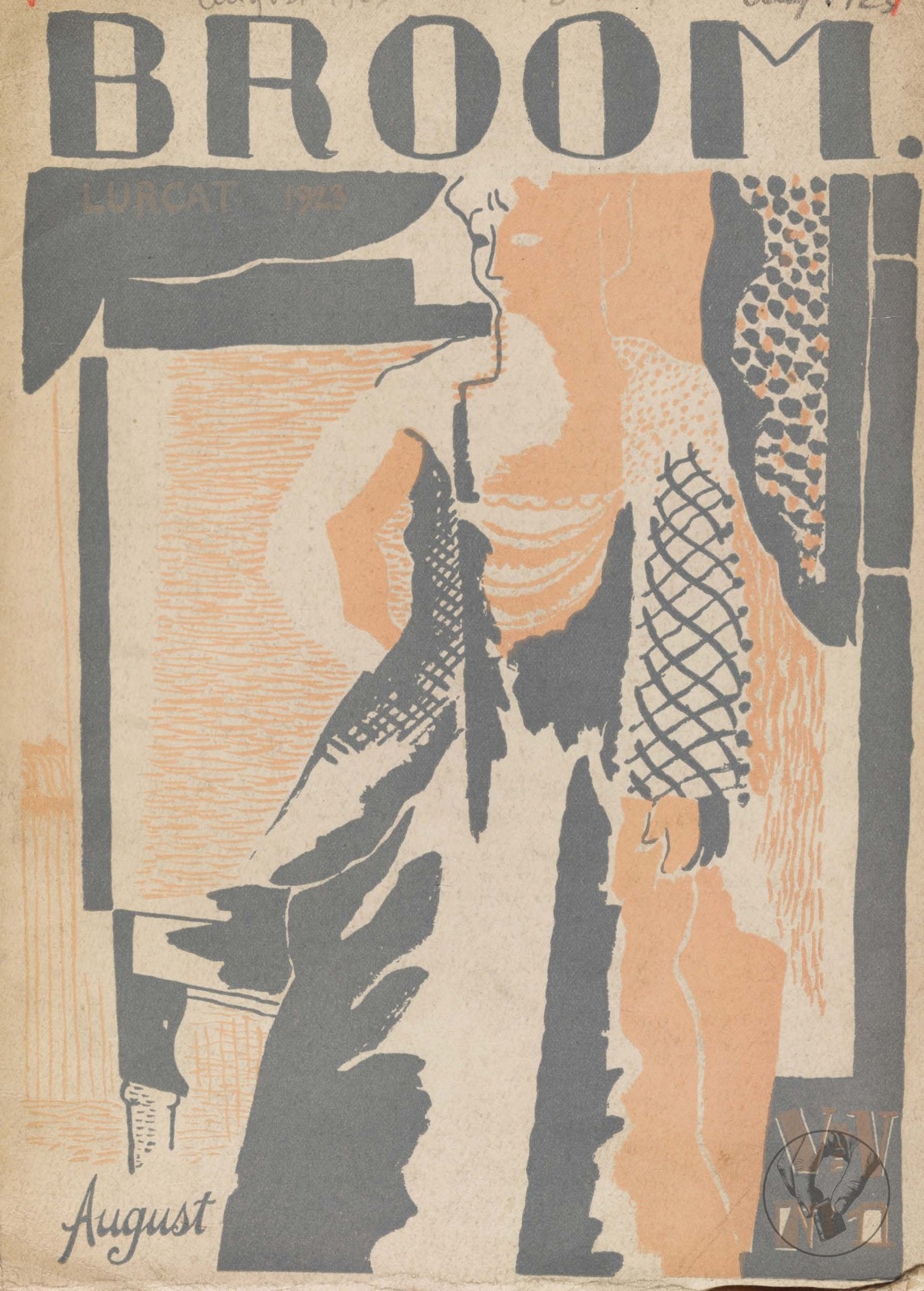
Broom: An International Magazine of the Arts, issue for August 1923. This issue features contributions such as "I Shall Name Him Egbert" by William Gamaliel Shepard, "Snapshot of a Young Lady" by Malcolm Cowley, and "Kabnis" by Jean Toomer. It also includes book reviews and commentary on art and literature, with a focus on modernism and the "Age of the Machine."