Page 1
V. 4 BROOK
Premières pages de l'ouvrage, en accès libre.
V. 4 BROOK
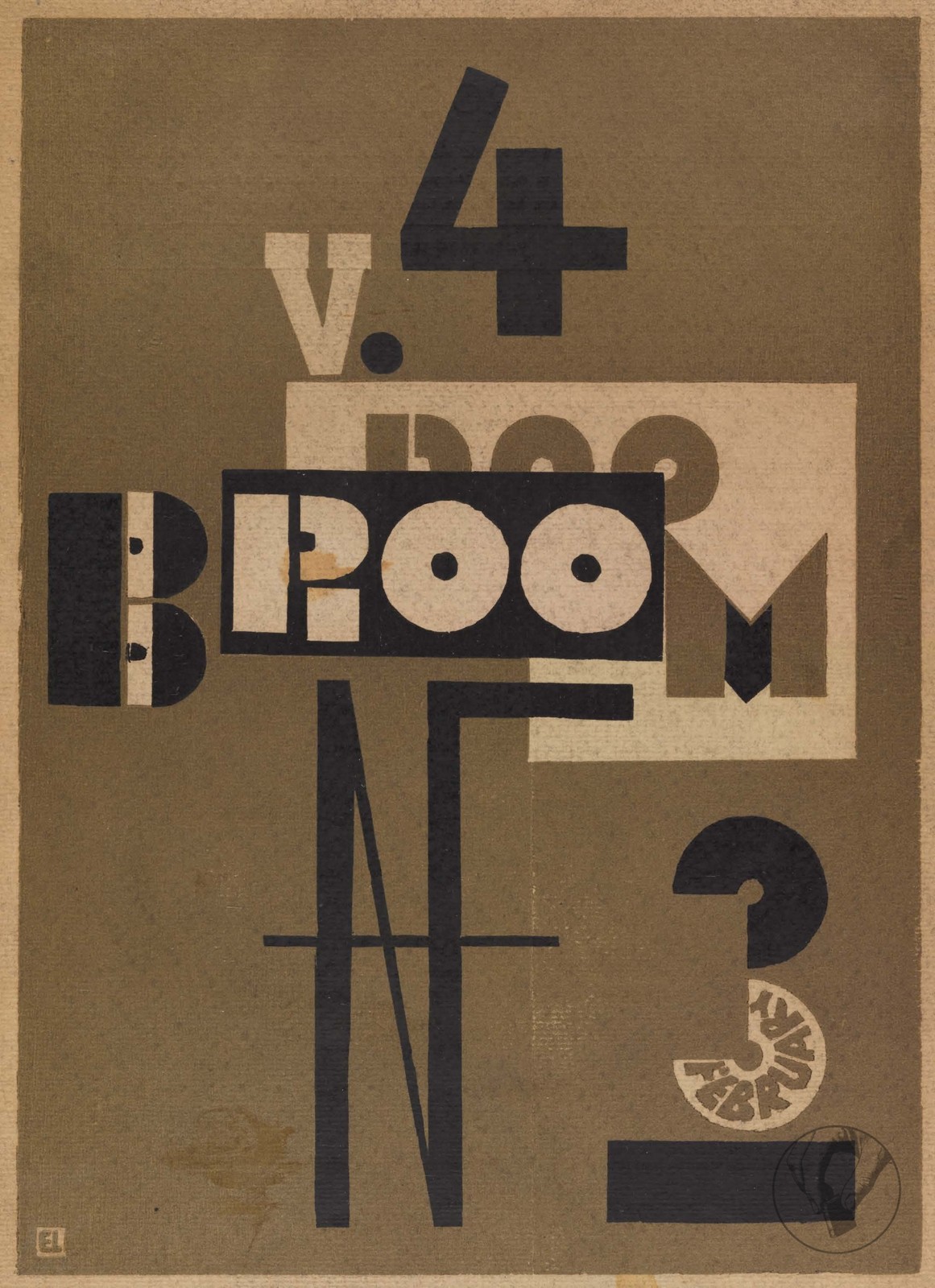
BROOM AN INTERNATIONAL MAGAZINE OF THE ARTS PUBLISHED BY HAROLD A. LOEB. EDITOR, HAROLD A. LOEB. ASSOCIATE EDITOR, MATTHEW JOSEPHSON. AMERICAN EDITOR, LOLA RIDGE. ASSOCIATE ART EDITOR, LADISLAS MEDGYES. --- FEBRUARY, 1923 PUBLISHED MONTHLY VOL. 4, NO. 3 --- Page --- COVER DESIGN (WOODCUT) — LISSITZKY --- TRANSFORMATIONS — RICHARD HUELSENBECK --- POST MORTEM — INFALLIBILITY — PAUL ELDRIDGE --- PERIPHERY (DRAWING) — GEORGE GROSZ --- GEORGE GROSZ — WESTHEIM. --- 165, 167 --- POP AND MOM, BOURGEOIS CHARITY (DRAWINGS) — GEORGE GROSZ --- MORTUARY — MALCOLM COWLEY. --- SUICIDE ON THE BRIDGE (DRAWING) — PAUL KLEE --- THE SONG OF THE WHIP — CARLETON BEALS --- 179, 181 --- MURDER, ACROBATS (DRAWINGS) — PAUL KLEE --- LANDSCAPE — WILLIAM GAMALIEL SHEPHARD. --- 180, 198 --- INDIAN DRAWINGS (WOODCUTS BY L. MEDGYES) --- THE DISCOVERERS — WILLIAM CARLOS WILLIAMS --- THE PIMPS OF DEATH (DRAWING) — GEORGE GROSZ --- THE KID — VSEVOLOD IVANOV --- SATURDAY NIGHT (DRAWING) — GEORGE GROSZ --- A NOTE ON MODERN RUSSIAN ART — LOUIS LOZOWICK --- 204, 205 --- MADMAN DRAWINGS --- BERLIN AND THE BUBBLING RHINE — M. J. --- COMMENT — L. M. --- The Editor of Broom will be pleased to consider mss. submitted to him, but all mss. must be accompanied by a self-addressed, stamped envelope. The Editor cannot hold himself responsible for loss of mss. in transit. Mss. from Europe should be sent to the Berlin office; mss. from America to the New York office. The price of Broom is: For America, fifty cents the copy, and five dollars for a year’s subscription. For Italy, 10 lire the copy, and 100 lire for a year’s subscription. For France, 6 francs the copy, and 60 francs for a year’s subscription. For Great Britain, 2/6 d the copy, and one pound five shillings for a year’s subscription. The contents of this issue are protected by copyright, January, 1922. Infringement of same will be prosecuted. Entered as Second Class matter at the Post Office at New York, N. Y., April 22, 1922 under the Act of March 3, 1879. --- HEADQUARTERS, SCHICKLERSTRASSE 5, BERLIN, GERMANY NEW YORK OFFICE, THREE EAST NINTH STREET.
JANUARY PUBLICATIONS BLACK OXEN By GERTRUDE ATHERTON—has its setting in fashionable and literary New York of today, with amazing flash-backs to the Manhattan of thirty odd years ago. In her “sophisticates” the individual members of some of the most interesting groups in our contemporary life are easily recognizable, and some of their favorite rendezvous are amusingly described. It is the story of a woman born into one of the older New York families, who has lived the greater part of her life in the diplomatic circles of Europe, and the brilliant Lee Clavering, columnist and dramatist. The conflict in the souls of these two intensely interesting characters is an amazing psychological study. With Freudian insight and penetrating truth Mrs. Atherton reveals us to ourselves. ($2.00) SALOME OF THE TENEMENTS By ANZIA YEZIERSKA—author of Hungry Hearts, is the story of an Eastside girl driven by a deathless passion for beauty to burn through the barriers of race, class, and creed. Sonya Vrunsky, the Salome of the New York Tenements, flashes into the lives of two men, Manning, a millionaire philanthropist, and Hellins, Beau Brummell of Fifth Avenue. In the marriage of Sonya to Manning one sees the Oriental and the Anglo-Saxon trying to find a common language, (and this is the theme of the novel) the over-emotional ghetto struggling for its breath in the thin air of Puritan restraint. ($2.00) FLAMING YOUTH By WARNER FABIAN—Warner Fabian, which is the nom de plume of one of the most important and serious-minded novelists in America, sees in youth of today a number of new problems, from which he draws some amazing conclusions, entirely different from those that have been furnished by our younger generation writing about the younger generation. He wonders if youth is not merely a product of its environment, if youth alone, is to blame for all the elemental stimulus it finds in jazz and parties in and out of season. You will find that youth takes pretty good care of itself in Pat, the most sophisticated, and yet at the same time, the most deliciously lovely and innocent of all heroines. One wonders after reading this swift moving and daring novel, what sin is, and what is meant by “the wages of sin.” ($2.00) THE ETERNAL MASQUERADE By H. DENNIS BRADLEY—is a pungent, individualistic criticism of human life, and human problems; a history of clothes, yes, but also an intimate history of those who wear them. ($2.00) THE LONDON TIMES says, “Every woman should read this gay review of modes, materials, and morals.” THE LONDON DAILY NEWS says, “A good many people will be shocked at it, It is impudent, but it is very clever.” HAVE YOU AN EDUCATED HEART? By GELETT BURGESS—Gelett Burgess has a way of being continually quoted. He is a coiner of words that remain in use, such as “goop,” “bromide,” and “blurb,” but only because behind each of them is a real idea. HAVE YOU AN EDUCATED HEART defines and illustrates kindness. It is a whimsical treatise not upon morals, but upon courtesy, which is super-kindness—a decorative virtue. Are you a pretender to friendship, or “have you an educated heart?” ($1.00) BONI & LIVERIGHT publishers • NEW YORK 108 West 40th Street
Books of International Interest BABBITT By Sinclair Lewis Author of “Main Street” “Babbitt is one of the greatest novels I have read for a long time.”—H. G. Wells. “He has made his Babbitt own brother to our Mr. Polly, Uncle Ponderovo, Denry of the Five Towns, and the Forsythe family.” Hugh Walpole. 5th. large printing, $2.00 --- THE GOOSE MAN By Jacob Wassermann Author of “The World’s Illusion” “The Goose Man” is the second of Jacob Wassermann’s novels to be presented to the English reading public. Many Continental critics consider it his greatest work. Into the solid texture of this immense novel he has woven scores of human lives and dramatic situations—the material for a dozen ordinary novels. “The stage which Wassermann sets before us has all the quality of a Rembrandt painting; its golden shadows, its incisive draughtsmanship, its superbly marshalled mass of individuals; each faithfully rendered, each built up from within through relentless psychological insight. The novel stands four-square, firmly integrated in experience, a picture and an interpretation of life. For sheer artistic power, as well as for philosophic significance. ‘The Goose Man’ is among the most vital and important contemporary novels.” International Book Review. “It recalls the personal records of Beethoven, Berlioz and Wagner. It represents the Austrian Master’s reaction to a world brayed in the mortar of the great war.” New Republic. “A world of intolerable beauty.”—N. Y. Tribune. --- SINCE CEZANNE By Clive Bell A series of brilliant essays on modern visual art. “Mr. Bell shines in the highest aesthetic line of current criticism and commands a rarely cultured knowledge of exotic contemporary painters.”—Atlantic Monthly. 3rd. American Edition, $2.50 --- THE REIGN OF THE EVIL ONE By C. F. Ramuz Translated by James Whitall. With an Introduction by Ernest Boyd. A story of a little mountain village, of the peasants at their work, and the conflict between good and evil fought out in their souls. $2.00 --- THE GOOSE MAN—477 Pages — $2.50 Offered with a year’s subscription to BROOK for $5.50 --- AMERICAN POETRY—1922 A Miscellany The hitherto unpublished poems of Robert Frost, Carl Sandburg, Amy Lowell, Vachel Lindsay, Edna St. Vincent Millay, Conrad Alken, Sara Teasdale, Louis Untermeyer and others. “Contains some of the finest poetry ever written by Americans.”—N. Y. Tribune. $1.75 --- GUILTY SOULS By Robert Nichols Author of “Ardours and Endurances” A play by a young English poet that has aroused the admiration of the British public and critics. With a Shavian preface of 70 pages. $1.75 --- ROOTABAGA STORIES By Carl Sandburg Carl Sandburg invents an American folk lore to the delight of everyone who is or who has remained young. “Sublime nonsense, which can carry wit and sarcasm with it and which can climb to the heights of splendid poetry. America keeping abreast of Swift and Guliver.” N. Y. Times. Illustrated by the Petershams. $2.00 --- HARCOURT, BRACE and Company · 1 West 47th. St., NEW YORK --- PLAYWRITING A professional Course in Playwriting is offered under the personal supervision of Theodore Ballou Hinckley, editor of “The Drama,” assisted by famous playwrights, critics, actors and producers Individual Instruction and Criticism THE DRAMA’S course in play writing teaches in detail the technique of the professional play. You will be taken step by step through study courses, books, and practice plays, from the simplest rudiments to the actual completion of plays. Your work will receive the individual attention of Mr. Hindley. His criticisms will be directed toward your specific needs. He will dissect your plot, your characters, and your dialogue, and give you definite, constructive criticism and help. Producers Will Read Your Plays Throughout the entire course, the aim is toward the completion of plays for professional production and not toward mere amateurish effort. Your plays will be analyzed by Mr. Hindley with the idea of production in mind, and plays of real merit will be brought to the attention of producers. If your manuscript has the endorsement of THE DRAMA it will receive a reading by managers. Good Plays Earn Big Royalties Many successful plays have made their authors rich. Lightnin’, The Bat, The Lion and the Mouse, and many others have earned thousands of dollars. The income from The Bat is said to have been more than $6,000 a week. If you have ideas and imagination, you will find the practical dramatic technique and honest and competent criticism of this course of inestimable value to you. You will be taught how the public taste in plays changes, as to subject matter and its development. Because of his long and close connection with professional drama, Mr. Hinckley knows the changing demands of the managers and the public. Limited Enrollment Since the work is so carefully personalized, the enrollment is limited to people of real promise. An enrollment examination will be sent upon request; upon this will be based our decision as to your eligibility. Fill out the coupon and mail it for complete information. Department of Instruction, THE DRAMA CORPORATION, 528 Athenaeum Bldg., Chicago. Please send information regarding your personalized course in play-writing. Name _______________________________ City _______________________________ Street _______________________________ State _______________________________
TRANSFORMATIONS Kakadu and Jamaika live quietly in a remote corner of the great city. They are far off from its big noises and color symphony, and so properly scared that the thought hardly ever comes to them to go out of themselves. It is hard to describe such a marriage, to explain a contract for a bed and a table as they appear in the novels of Balzac in striking glimpses against the background of a metropolis. Kakadu is the son of a doctor who was highly regarded by many comfortable burghers and made weekly trips to the country in a buggy. His mother who had died a few years before of cancer, wrote her name, Driesel, in her maidenhood, and none dared whisper that her father had owned a tavern which bore the forbidding name of "Tivoli," a dreadful resort. Maidservants and waiters with knives would fall into great brawls with the police. All that was, as people said, "the skeleton in the family closet of the Kakadus." Kakadu himself had inherited from his grandfather a passion for drink and several canine instincts. He remained short in stature. Over his very cradle, his parents had planned his career for the Civil Service; their plans miscarried charmingly. Kakadu always contradicted; you always got the opposite of what you expected from him. He came breathing forth opposition. Without any real grounds, people came to regard him as a sinister man. If only they knew how stupid he was. At times he showed a sense of elegance. He knew to impress his first wife with forty varieties of neckties, checkered, solid colored, striped, silken and of plain cloth. By chance Kakadu became a journalist. When he was thirty years old — and the most diverse callings might have gloried in his participation — he met with an accident. He wanted to board a street car. The people almost sat on the roof. They brimmed up out of the doorways and could be heard complaining: "Horrible! Terrible!" Kakadu, who in a more rational moment would have seen that it was impossible to get on, clambered up on the steps of the forward part. The motorman held up the car and threw him off. When he tried to get on at the rear end, someone spat with violence into his face. Kakadu raged, he raged for the first time in his life, so that the bristles stood bolt upright on his fat skin. True to 1*
the old custom of seizing the pen when one is at a loss for what to do, he placed himself in the posture to write. He sent a very nice article to the Kurier. They wrote him that they agreed perfectly with his contentions, and asked him to call on the editors, since there were matters of principle at stake. Despite its patriotic name, the Kurier permitted itself to play the “opposition,” a soft butterish opposition, to be sure, so that no one paid any attention to their attacks unless they were headed “In Protest” — but on the whole a sort of opposition. In fact, the editors trembled at their own daring. Kakadu was graciously received; they scented a kindred soul. Kakadu promised to contribute articles to the Kurier when something arose which was inconsistent with “open covenants.” Thus did the celebrated “muse” awaken in him; his writing table became littered with manuscripts, and the files and indexes crowded each other on his shelves. Before Kakadu had assumed the monstrously important role of championing “open covenants” when he was still poor and wretched in every way, he made the acquaintance of Jamaika. He knew as yet nothing of “art” and did not even know that it belonged to the culture of a people; he knew even less what “culture” meant. However he went his own way, a typical German man-in-the-street, without bothering anyone. Jamaika came to the capital to be an actress. Before a business men’s club she played the role of Romeo in hose. Someone cried out, “Bernhardt, the divine Sarah!” She received a bouquet. Since that triumphant evening, when in the feeble glow of a few lights, she had delighted the sex of some travelling salesmen, she determined to devote herself to a great ideal. And so she said categorically: “My whole life shall be offered up to art!” Indeed, she sacrificed herself; upon falling into the hands of Kakadu, she showed extraordinary emotion. He declaimed from Shakespeare; she found it bewitching. He said, that three books of his were to be printed. She trembled with delight. Shyly she said: “Great man, poet! Quicken me with your spirit!” He did quicken her, since he seduced her without ceremony. It was revealed that she still possessed her innocence . . . Once married — Kakadu became almost a fixture on the Kurier — Jamaika soon lost her rapturous gestures, she showed herself very talented, very calculating and of the quick slyness which all men of middle class succumb to.* She reigned over Kakadu without his knowing it, for the chains did not weigh. His desire for comfort was appeased. He yawned. He felt himself extraordinarily secure. No one noticed that the balance of power had shifted. In fact, one can only describe it as an evolution in favor of the woman. The instincts of both demanded only peace, absolute peace. The atmosphere is tepid and foggy, the gestures are not the manifestations of a will, the boxing of ears is
nothing but reflex movement . . . The legs walk slowly through the rooms; for only one thing could they be aroused, at the possibility of poverty, at the possibility of being forced to work harder in order not to starve. The days followed each other, sleep mingled with awakening, life was a drugged stumbling. The afternoons on which Kakadu was not obliged to spend at the editorial office were always passed in the following manner: the windows were open, at an angle, and a heavy sun fingered the place. Jamaika went through the room, hardly knowing why, listening to the rustle of her underclothes against her flesh. Kakadu however settled himself in an armchair — he must ponder — a history of the world’s literature lay in his lap. It was hard for him to grasp the visions of the past which he needed for his newspaper articles. The cries of children rose above the narrow street, as Jamaika left the house to promenade on the meadow adjoining their house. There was a circus now on the meadow, they were already fastening the roof of the tent on the poles. The head of an elephant could be seen sticking out of his stall. Grooms led horses by. Jamaika noticed a small undersized man in good clothes who was giving orders to an attendant. When he disappeared into the circus, Jamaika waited; she only wanted to see if the man would come out again, and when he did, she went on, but so slowly, that she could easily observe everything that took place in front of the entrance to the circus. The man had seen Jamaika, he followed her, and when she turned about suddenly in order to go home, he said to her: “Pardon me, madam.” She knew how to raise her eyebrows; and she observed the effect of this bit of artistry while the man was fumbling for words. He said: “May I show you the circus? Are you interested in it?” He spoke very quickly in order to keep her from making any objections. “Here you have the elephant stall. For the present only the Indian elephant, Billy, is to be seen. The female, Milly, is probably still on the railroad. They are old animals, madam, but very valuable possessions, indeed.” Jamaika only laughed. She no longer found it “shocking” to converse with a gentleman whom she had not been formally introduced to. Kakadu was sitting at home reading the history of the world’s literature. The name of the little man was Butterweg and it appeared that he was a frog-swallower, the greatest attraction of the circus and a celebrity among artists. Butterweg knew the manners of high society, he talked with a slight foreign accent, and spoke with enthusiasm of travels in Italy. Florence was a lovely city and full of works of art. He said “works of art” with the intonation of a connoisseur, so that it became speedily apparent to his hearer what great
knowledge he had. Jamaika felt herself transported. She kept thinking: "Charming! Charming! What an extraordinary person!" It did not take long for her to respond naively, the obstacles were slight. One felt oneself, after all, with an artist, with a kindred spirit. For Jamaika still nourished her idea of a career on the stage, her rapture for the eternal and the beautiful, for Goethe and Schiller. It was very difficult for them to part. In the sandy arena they tried to run after each other, but Jamaika tripped and fell, her nose striking the hard ground and bleeding profusely. Butterweg made a fuss about her ordered a glass of water and then sat down next to Jamaika by the rail and played the doctor. "Did you hurt yourself?" he kept asking, "You must stick the cotton way up into your nose, dear madam." He gripped Jamaika’s neck and with one hand helped to direct her unhappy efforts. When Jamaika made off, he said softly, "Adieu, my dear lady." She turned very pale — "When will I have the pleasure of seeing you again?" Jamaika shrugged her shoulders, she thought of Kakadu in his armchair, it was very late and she was chiefly interested in avoiding any scenes. And so Butterweg remained standing, hat in hand, not a little perplexed. On the following day, Jamaika promenaded again in the neighborhood of the circus, this time wearing a very seductive costume, where liveried grooms went by leading horses, and the male elephant, Billy, stuck his head out of his stall. The friendship became warm, and even if at first Jamaika was not favorably disposed, Kakadu had a rival who certainly surpassed him in all manly qualities. But Jamaika was only playing. She was playing with the idea of infidelity and with Butterweg who felt himself reduced to a polite intimacy which only aroused his desires immeasurably. He fell so madly in love that he neglected his calling and on the Gala opening night of the circus fell down miserably. At the office of the Kurier Kakadu heard of the fiasco of the frog-swallower. He said to Jamaika: "I have tickets to the circus. If you feel like going, let us go there." Jamaika affected a complete indifference: "I have no interest whatsoever in such silliness. My household is more important to me, and" — here she went to Kakadu, gave him a meaning glance and kissed him full on the mouth — "and so is the comfort of my dear Kakadu. Nothing has thus far disturbed our tranquillity. The accursed clamor of the circus penetrates into our very bedroom!" "Right you are, little mouse," said Kakadu lightly (smacking his lips), "Let us stay at home." He had his boots taken off and buried himself in a history of the world’s literature. From time to time he would try to recite, with a curiously timid face, the poets of another epoch. Jamaika was already abroad on the meadow, she threw all caution to the winds, and inquired immediately at the box-office for Butter-
weg. Butterweg appeared, very downcast, the adverse reviews in the newspapers troubled him deeply. “You may believe it or not, Jamaika, but a man who has the blood of an artist in his veins depends upon the critics. What a disgrace! What will the public think!” Jamaika declared that she had suffered the same experience when she had played great roles on the stage. They spoke of the “fluidity of art.” Butterweg cited innumerable philosophers and Jamaika was stirred by consciousness of her ignorance. Then she suggested, without any sense of the consequences of her words, “How would it be, Mr. Butterweg, if you spoke to my husband personally about this matter. You know, I suppose, that he is a journalist and if you can make clear to him what is at stake, he may he able to help you a great deal.” Butterweg, who scarcely believed that Jamaika meant what she was saying, stuttered, “Why—certainly, that would be fine, it is always best to be frank and open.” Jamaika thought that her relations with Butterweg could be strengthened by this experiment. . . Butterweg, compelled by this plan to hazard all, drew Jamaika into a corner, and like a Saladin, like a shepherd, declared his love to be all powerful, as he fell to his knees and kissed his lady’s hand. She felt the ends of his moustache tickle her hand and began to laugh very hard. He took this as a sign of assent and assuming that he was favored, wound himself tightly about her body and covered her with stormy kisses. Jamaika sank down exhausted against the walls of the tent. But she felt a very pleasant kind of exhaustion and the agitated blood flooded her breasts and choked her breathing. As she approached him again with distorted visage she lowered her head a bit and said: “I love you.” Butterweg sighed. He suspected that this time the newspaper comments would be much more favorable. II. “Kakadu,” said Jamaika, “listen. I just went by the Circus when a man accosted me and presented himself. His name was Butterweg, he was the Frog-swallower of whom you spoke the other day. I said to him: how could he dare to accost me in the street. And did he not know that he was compromising a respectable woman by such behaviour? He apologized profusely and said that he must speak to you about a very important matter and that he was afraid to approach you directly, because he had been told that you were very peculiar in your views, and so he bade me put in a word for him.” Kakadu seemed flattered: “Yes, yes. But what does he want of me. He is the same man who was so widely advertised and then fell down
so badly on the opening night.” “That’s it exactly, my dear Kakadu. He wants to talk over the criticisms with you. He wants to explain to you his art, for he fears that he has been misunderstood.” Kakadu nodded his head, shrugged his shoulders and rubbed his hands, not knowing what to say. “Yes, he can come. Nevertheless, I find it rather strange that he doesn’t approach me directly if he has something to say to me. And then if he thinks he can put anything over on me, he had better know that he is mistaken. Critics cannot be bribed; and he has already shown that his performances are not praiseworthy.” Jamaika went to Butterweg and told him that Kakadu had invited him to have coffee with them. But on the following day, right after lunch, when Butterweg was supposed to come, Kakadu said, “My dear Jamaika, I have been re-considering the whole matter. I should rather not have this man come to my house. It may open the door to troubles which I should rather avoid. I therefore beg you to prevent him from visiting us. And (here his voice betrayed his real emotion) when do you expect to see him again?” Jamaika’s face took on an innocent expression. “I have already told you that he approached me and begged me to put in a word for him. Since that time I have not seen him, and have no further occasion to. What do you take me for? I am a respectable woman. I don’t know when he will come.” Kakadu grumbled: “But that is very unpleasant. I never wanted to see this comedian in my house. They ruin your character, they turn your head, and they are all asses, asses. . .” At this moment Butterweg, unconscious of what was going on, rang the bell. Jamaika went to Kakadu quickly and kissed him, saying: “There he is. Be nice to him, I beg of you. The poor man is in such a bad way. There is no need of your making his life more bitter.” Kakadu sat in his armchair with the mien of a magistrate, as Butterweg entered. The history of the world’s literature lay in his lap and he looked up as if he were being interrupted in his studies. “Am I intruding?” asked Butterweg anxiously. Kakadu tried to give his voice a manly depth: “I have been told by my wife that you wanted to see me on business. Can I be of service to you in any way?” Butterweg stammered something about art and criticism, and Jamaika, fearing that he might miss his mark, interrupted in loud and cheerful tones; “Oh please do not speak so learnedly! All this learning just turns a poor woman’s head. You can hardly believe, my dear Mr. Butterweg, how much my husband studies. Day and night he pores over a history of the world’s literature — think of it, world’s literature! Dear Kakadu, dear little Kakadu! But now we shall have some coffee. Where is the maid? Everything must be ready by now.” Before the might of her persuasiveness the men bowed. When Kakadu saw the steaming coffee and
the cakes he thought no longer of learned poses. Later on — Jamaika sat resting one elbow on her raised knee and smoking — the conversation reverted to artistic things. “But, Mr. Butterweg,” said Kakadu seriously, “I do not quite understand how the people can be raised up to a higher level through your art.” He put this question as if he were addressing a candidate. He spoke as if he had stayed up many nights over this problem. Butterweg replied: “My view is that art is art. We must accept that as our hypothesis, once for all, isn’t that so? (Kakadu shook his head.) Nevertheless, I don’t think we should give too much weight to that fact. I, for instance, act quite otherwise, when I perform in my art.” Kakadu felt conscious of his superiority. “Naturally,” he remarked, “Each man thinks differently, some more deeply and others more superficially.” A controversy arose over the question of artistic inclinations. Butterweg ardently championed the idea that artists are born and not made, while Kakadu was of the opinion that practice makes perfect, that a man could become the greatest of artists by close application. Butterweg said: “As you see me now, so have I been, a frog-swallow from earliest childhood.” “That is not the question,” said Kakadu, “The question is whether the motives which impelled you to swallow frogs were hereditary or acquired.” “I have never given that any thought. All I know is that from my earliest youth it pleased me, to — putting it politely — make my repast of frogs, and I was very easily led to make of this aptitude my life’s profession. The boys who played with me cried out when they saw me swallow the animals at one gulp, but I had already tasted the true, the great sensation which was later to be mine.” Kakadu, however, was worried lest Butterweg persist in error. He said: “How then could you distinguish yourself from artists like Goethe, Schiller, Geibel, Uhland? They too must have experienced this rare feeling, and yet your propensities can scarcely be compared to the performances of these geniuses. Think of Faust, think of the Bride of Messina!” “You can think what you please,” said Butterweg, “but it is just as I say. I feel it in my heart and that is what counts above all. I don’t know the tricks of those gentlemen, but if they have performed anything worth-while then they experienced the same feeling.” Kakadu felt that he was representing culture and all that was holy to culture. “Oh!” he cried pathetically, “My dear sir (taking the history of the world’s literature and lifting it reverently into the air). Oh! My dear sir! Do not speak so loud, that learned people may not laugh at you.” Butterweg gave no heed to this warning. All that was sacred to him was at stake: “That doesn’t matter to me at all!” Kakadu was silent, he looked at Jamaika and frowned heavily. Then Butterweg began again: “I am thinking of going very far in my calling. I shall establish relationships
Broom is an international magazine of the arts published monthly. This issue features contributions on transformations, art, and literature, including works by George Grosz, Paul Klee, and Vsevolod Ivanov. It also includes reviews of new publications and discussions on international culture and American perspectives.