Page 1
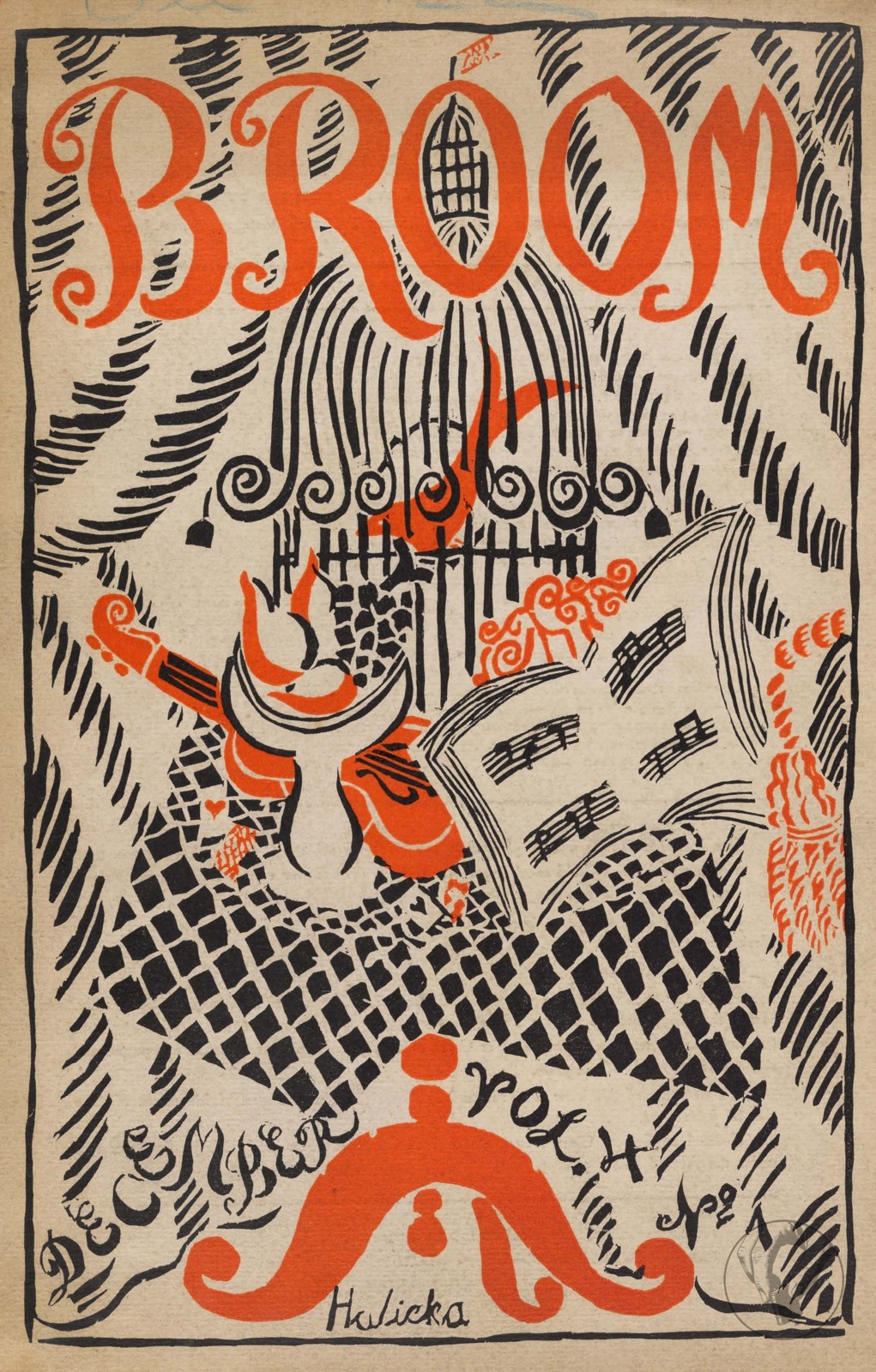
BROOM December 1987 Hulicka
Premières pages de l'ouvrage, en accès libre.
BROOM December 1987 Hulicka
BROOM AN INTERNATIONAL MAGAZINE OF THE ARTS PUBLISHED BY HAROLD A. LOEB. EDITOR, HAROLD A. LOEB. ASSOCIATE EDITOR, MATTHEW JOSEPHSON. AMERICAN EDITOR, LOLA RIDGE. DECEMBER, 1922 APPEARS MONTHLY VOL. 4, NO. 1 Page COVER DESIGN — (WOODCUT) — HALICKA ...
BETWEEN OURSELVES John Cournos, the author of Babel, is generally regarded over here as an English author. As a matter of fact, Cournos is an American citizen whose parents came from Russia many years ago and settled in Philadelphia where young Cournos began his literary adventures by peddling newspapers outside of the Pennsylvania station. From peddling papers to the job of printer’s devil was a quick step, and from printer’s devil to the job of reporter was only a matter of a few years. During these years when he was the principal support of a large family, Cournos saved enough money to make his “grand tour” abroad and finally settled in London where he has lived the last three years, during which time he wrote his trilogy, The Wall, The Mask, and Babel. Such worth while critics as F. Scott Fitzgerald, Rebecca West, Rose Macaulay, Sheila Kaye-Smith, May Sinclair, John Macy, Burton Rascoe, T. R. Smith, etc., think that Babel is a big book, and when Cournos returns to America this autumn, he hopes that the public will already have shown its full agreement with the high opinion of the critics. Few people will believe that an author would spend something like $12.00 rather than have a single comma in one of his books left out. Mr. Liveright, however, is willing to take an affidavit that on the morning of September 4th at the horribly early hour of 3:15 A.M., Ben Hecht telephoned to him from Chicago and took no less than 15 minutes to insist that on page 47 of his new book, Gargoyles, in the sentence reading, “If all women were like you, there would be no bad men,” the omission of a comma after the word you entirely destroyed the rhythm of his prose. Mr. Hecht knew that the book was to go to press the following day and would not trust a telegram to make his meaning clear. In relating this story to several people the only comment which seemed to be forthcoming has been: What is punctuation to Hecht, anyhow? It is not generally known that Stacy Aumonier, the author of Heartbeat, which in a short month has proven to be by far the most popular of his novels which have been published in America, was, before he devoted himself to letters, an artist of no mean ability. At The Savage Club in London, which corresponds more or less to our Players Club in New York, there are a number of Mr. Aumonier’s pictures, and two of his sketches are among the most prized possessions of Miss May Sinclair, who is a next door neighbor of the Aumoniers at St. John’s Wood. Hendrik Van Loon, as everyone knows, is a merry old soul and he is just as generous as he is merry. His publishers have just received a cable from him from Stockholm saying: “Congratulations to everyone in the office on Mankind touching the 63,000 mark! The critics have said it’s a good book, but the love and energy lavished on it by all of you, from the boss down to the shipping clerk, made it 60 instead of 6.” We have just printed 50,000 additional copies of The Story of Mankind and feel that maybe that won’t be enough for the holiday season. Beginning this autumn, instead of continuing the former practice of publishing a number of new titles in The Modern Library in one group each season, one new title will be issued on the 10th of each month. One title each year will be chosen by the booksellers themselves. Mr. Liveright says: “There seems no reason why the reading public shouldn’t look forward with as keen anticipation to the new Modern Library volume on the 10th of each month as the music-loving public does to the new Victor and Columbia records.” The September Modern Library title will be Ancient Man by Hendrik Van Loon with a number of new illustrations by Hank himself. Ludwig Lewisohn, the author of Up Stream one of the finest autobiographies which have been published in America in many years, and which, by the way, is now in its 8th edition and moving stronger up stream every day, is now at work on his new novel, The Hearthstone. If the next 300 pages are as good as the first 50, Lewisohn will score another big success. The Carra edition of the works of George Moore, the first three volumes of which will be published in October, will be prefaced by a 10,000 word introduction which Mr. Moore calls Apologia Pro Scriptis Meis. Gertrude Atherton writes us that she has almost completed the third revision of her new novel which will appear with our imprint early in January. How many writers in these mad dynamic days qualify for that fine definition of genius which consists in taking infinite pains? The books mentioned on this page may be had at any first-class book shop in the United States --- BONI & LIVERIGHT, Publishers 103 West 40th Street NEW YORK
BABBITT By Sinclair Lewis Author of Main Street > “Both the simple and the sophisticated will ask: > Is Babbitt ‘as good’ as Main Street? > There need be no hesitation in answering: > It is better.” Ludwig Lewisohn in The Nation. --- RUBE By G. A. Borgese A novel which has aroused a storm of discussion. The author is undoubtedly one of the most striking figures in the Italian literary life of today. It is not a war novel, but a story of what the young intellectuals everywhere have felt since the war. THE LONDON MERCURY says that “the death of Rube” symbolizes the end of an unhappy and restless generation — and heralds the birth of a new era. Translated by Isaac Goldberg $1.90 --- THE GOOSE MAN By Jacob Wassermann Author of “The World’s Illusion” Jacob Wassermann’s great novels are quietly but steadily creating in the mind of the public a conception of the author’s genius, of his supreme understanding of humanity, of which Europe has long been aware. Continental critics consider “The Goose Man” his greatest novel. It has an immense and colorful background and shows the creative power of this profound student of life. 570 Pages $2.50 --- Four novels that reflect the intellectual life of Today --- NARCISSUS by Evelyn Scott A novel by the author of “The Narrow House”. Here is a novel that expresses in its insight into human nature, the loss of standards, the feverish turbulence of modern existence. Through the revelation of their mental life Mrs. Scott has created a group of characters who are unforgettable. $1.75. --- HARCOURT, BRACE and Co., I W. 47th St., NEW YORK. --- The subscription price of BROOM is $5 per year, but for a limited time only we are making the following special offer: (1) BROOM for a year ($5) and The Goose Man by Jacob Wassermann, author of The World’s Illusion ($2.50). Both for $5.50. (2) BROOM for a year ($5) and Batouala by René Maran, winner of the PRIX GONCOURT ($1.75). Both for $5.00. (3) BROOM for a year ($5) and The Hairy Ape (including Anna Chrystie and The First Man) ($2.00). Both for $5.00. --- BROOM 3 EAST 9th STREET, NEW YORK CITY For the enclosed $__________ please send me Broom for a year and the following book _______________________________ Name _________________________________________________________ Adress ________________________________________________________ ---
SEVENTH STREET Money burns the pocket, pocket hurts, Bootleggers in silken shirts, Balloon ed, zooming Cadillacs, Whizzing, whizzing down the street-car tracks. Seventh Street is a bastard of Prohibition and the War. A crude-boned, soft-skinned wedge of Negro life breathing its loafer air jazz songs and love thrusting unconscious rhythms, black reddish blood, into the white and white-washed wood of Washington. Stale soggy wood of Washington. Wedges rust in soggy wood . . . Split it in two! Again! Again! Shred it! . . . the sun. Wedges are brilliant in the sun; ribbons of wet wood dry and blow away. Black reddish blood. Pouring for crude-boned soft-skinned life, who set you flowing? Blood suckers of the War would spin in a frenzy of dizziness if they drank your blood. Prohibition would put a stop to it. Who set you flowing? White and white-wash disappear in blood. Who set you flowing? Flowing down the smooth asphalt of Seventh Street, in shanties, brick office buildings, theatres, drug stores, restaurants, and cabarets? Eddying on the corners? Swirling like a blood-red smoke up where the buzzards fly in heaven? God would not dare to suck black red blood. A Nigger God! He would duck his head in shame and call for the Judgment Day. Who set you flowing? Money burns the pocket, pocket hurts, Bootleggers in silken shirts, Balloon ed, zooming Cadillacs, Whizzing, whizzing down the street-car tracks. JEAN TOOMER 1*
STAVROGIN'S CONFESSION CHAPTER III The reading lasted about an hour. Tikhon read slowly and perhaps re-read several passages many times. All the time Stavrogin sat silent and motionless. The shade of impatience, absentmindedness and, one might say, delirium which had hovered over his face all morning, vanished almost completely, and was replaced by a calm and by a kind of sincerity, which gave him the appearance of something close to dignity. Tikhon took off his spectacles, paused, and finally looked up at him and began with a certain cautiousness: "And wouldn't you make some corrections in this document?" "Why, I wrote sincerely," said Stavrogin. "Possibly in the style..." "I forgot to warn you," said Stavrogin swiftly and abruptly, with a forward jerk of his whole body, "that all your words will be in vain; I shall not delay carrying out my intention; do not take the trouble to argue with me. I will send it broadcast." "But you did remember to warn me before I began reading." "It's all one," Stavrogin interrupted brusquely, "I repeat: however strong your arguments may be, I won't give up my intention. Note that by this awkward or perhaps shrewd remark, however you may take it, I'm not trying to lead you on to argue with me and persuade me that I should give up my idea." "I could hardly attempt to argue with you, let alone ask you to give up your intention. This idea is a great idea, and a Christian thought could not express itself more amply. Repentance can go no further than the admirable act which you have in mind, if only..." "If only what?" "If only it is really repentance and really a Christian thought." "I was writing sincerely." "It is as though you purposely presented yourself as a coarser man than your heart would dictate..." Tikhon was getting bolder and bolder. Obviously the "document" had made a very strong impression on him.
"Presented? I repeat, I didn't present myself, I did not pose." Tikhon quickly dropped his eyes. "This document comes straight from a heart wounded unto death. Isn't that true?" he said with persistence and with extraordinary fire. "Yes, this is repentance and the natural need for it which has overcome you, and you are on a great road, an incredible road. But it is as though you were already hating and despising in advance all those who will read what you have written, and as though you were challenging them to an encounter. Since you are not ashamed to confess your crime, why are you ashamed of repentance?" "Ashamed?" "Yes, ashamed and afraid." "Afraid?" "Terribly. 'Let them look at me,' you say; and you yourself, how will you look at them? Some of the passages in your narrative are exaggerated by virtue of style; it is as if you were admiring your own psychologizing, and you cling to each detail so as to amaze the reader by a callousness which isn't really in you. What is this, if not the guilty one's proud defiance of his judge?" "But where is the defiance? I eliminated all discussion on my part." Tikhon passed this over in silence. A faint color came into his pale cheeks. "Let's leave this subject," Stavrogin cut him off abruptly. "Allow me, on my side, to put a question to you: we have been talking for some five minutes after this," (he motioned with his head toward the pamphlet) "and you show no signs of disgust or shame... It seems you are not squeamish..." He did not finish. "I shall hide nothing from you: I was horrified to see so much idle energy spent upon abominations. As for the crime itself, many commit it, but live at peace with their consciences, considering that it belongs to their inevitable wild oats. There are old men too who sin likewise, even wantonly and playfully. All these horrors fill the whole world. As for you, you have perceived all the depths of this vileness, a thing which rarely happens so completely." "Am I to understand that you have begun to respect me after these sheets?" Stavrogin grinned crookedly. "To this I shall give you no direct answer. Of course there is not and there cannot be, a greater and more fearful crime than your act against the child."
"Let’s give up this measuring by the yard-stick. Perhaps I do not suffer as much as I wrote here. And perhaps I lied a lot about myself," he added unexpectedly. Tikhon passed this over in silence also. "And this young lady," began Tikhon again, "with whom you broke in Switzerland, where is she at present, if I may take the liberty of asking you?" "Here." Another pause. "Perhaps I lied a good deal to you about myself," Stavrogin repeated insistently. "What if I have defied them by the coarseness of my confession, if you did notice the challenge? I will only force them to hate me more, that’s all. That will only make it easier for me." "That is, their hatred will only rouse hatred in you, and hating, you will feel more comfortable than if you had accepted pity from them." "You’re right. You know," he laughed suddenly, "they’ll probably call me a Jesuit and a pious hypocrite after this document. Ha! Ha! Ha! Isn’t that so?" "Of course, such words will certainly be said. And how soon do you intend to carry out your intention?" "Today, tomorrow, the day after tomorrow, how do I know? Only very soon. You’re right: I believe I will do it suddenly, in a fit of revenge and hatred, at a moment when I hate them most." "Just answer one question, but sincerely, only to me, to me alone," said Tikhon in an entirely different tone of voice. "If someone were to forgive you for this," (Tikhon pointed to the pamphlet) "and not anyone whom you respect or fear, but a stranger, a man whom you will never know, who would forgive you mutely, while reading your terrible confession, would the thought of this make it easier for you, or would it be all the same to you?" "It would be easier," answered Stavrogin in a low voice. "If you were to forgive me, it would make it much easier for me," he added, lowering his eyes. "I will forgive you, if you forgive me also," said Tikhon, in a voice betraying deep emotion. "Bad humility. You know, these monkish formulae are altogether ungraceful. I will tell you the whole truth: I want to have you forgive me. And perhaps to have another man, and even a third, do so too, but let everybody else hate me. But I want this simply that I may bear with humility. . ."
"And you couldn't bear universal pity with the same humility?" "Perhaps not. Why do you ask?" "I feel the depth of your sincerity, and of course, it's my fault that I do not know how to approach people. I always felt it to be my great failing," said Tikhon with warm frankness, looking straight into Stavrogin's eyes. "I ask, because I fear for you," he added. "You have an almost impassable abyss before you." "I shan't endure it, I shan't be able to stand their hatred?" Stavrogin was roused. "Not hatred alone." "What else?" "Their laughter," the words escaped from Tikhon as though with difficulty, in a half-whisper. Stavrogin was taken aback. His face showed his alarm. "I foresaw it," he said. "Do you too find me very ridiculous, after having read my document? Don't let it trouble you, don't be embarrassed. I expected it." "There will be universal horror, and of course, more sham than real. People are only terrified by what directly threatens their personal interests. I do not speak of the pure souls, they will be horrified secretly, and will blame only themselves, but they will be unnoticeable because they will hold their peace. But the laughter will be universal." "I am surprised to see what a bad, what a low opinion you have of people," Stavrogin dropped, with a somewhat embittered air. "And will you believe me, I judge more by myself than by what I know of others," exclaimed Tikhon. "Really? Is it possible that there is something in your soul which rejoices in my misery?" "Who knows? Perhaps there is. Oh, yes, perhaps there is." "Enough. Tell me then, what is there in particular in my manuscript that is ridiculous? I know it myself, but I want to have it pointed out by your finger. And be as cynical as possible, and speak with all the frankness of which you are capable. And let me tell you again that you are an awfully queer fellow." "Even in the very form of this great confession there is something ridiculous. Oh, don't doubt but that you'll conquer," he suddenly exclaimed, almost rapturously. "Even this form," he pointed to the pamphlet again, "will avail, if only you will sincerely accept the blows and the spittle. It was always thus, that the most disgraceful cross became a great glory and
a great power, if only the humility of the act is sincere. It may be that you will be solaced even while alive.” “And so it is in the form alone, perhaps, that you find something ridiculous?” insisted Stavrogin. “In the substance too. The ugliness will kill,” whispered Tikhon, lowering his eyes. “The ugliness? What ugliness?” “Of the crime. There are truly unbeautiful crimes. Crimes, no matter what they are, are the more imposing, the more picturesque, so to speak, the more blood, the more horror there is; but there are shameful, disgraceful crimes which escape the dreadful, so to speak, which are all too ungraceful. . .” Tikhon did not finish his sentence. “That is,” Stavrogin fell in, agitatedly, “you found I cut a very ridiculous figure when I kissed the dirty little girl’s hand. . . . I understand you perfectly. And you fear for me desperately, precisely because this is ugly, disgusting, no, not that, not disgusting, but shameful, ridiculous, and you believe that this is what I’m not likely to endure.” Tikhon was silent. “I understand why you asked whether the young lady from Switzerland is here.” “You aren’t prepared, you are not inured,” whispered Tikhon timidly, dropping his eyes. “You are torn out of your soil, you have no faith.” “Listen, Father Tikhon: I myself want to be able to forgive myself. That’s my chief aim, that’s my whole aim!” Stavrogin said suddenly, with gloomy rapture in his eyes. “I know that only then the vision will vanish. That is why I seek measureless suffering, I seek it myself. Do not frighten me, or I will perish in my viciousness.” This fit of frankness was so unexpected that Tikhon rose to his feet. “If you believe that you yourself can forgive yourself, and that you can attain to that forgiveness in this world by suffering, if you set yourself such a goal with faith, then you have complete faith!” exclaimed Tikhon rapturously. “How then could you say that you don’t believe in God?” Stavrogin did not answer. “God will forgive your unfaith, for you honour the Holy Ghost without knowing it.” “And by the way, will Christ forgive?” asked Stavrogin with a crooked grin, rapidly changing his tone, and there was a slight shade of irony in
his voice. “It is said in Scripture ‘Whoso shall offend one of these little ones,’ remember? According to the Gospels there is no greater crime.”¹ “Simply, you are anxious to avoid a scandal, and you set a trap for me, my good Father Tikhon,” Stavrogin drawled casually and spitefully, half rising. “In short, what you want is to have me become respectable, marry perhaps, and end my life as a member of the local club, visiting the monastery each holiday. A penance, of course, isn’t that so? However, as a searcher of hearts perhaps you have the feeling that no doubt that’s how it will all end, and it’s all a question of having you plead with me insistently for the sake of appearances, because it’s really the only thing that I’m after, isn’t that so?” He laughed brokenly. “No, not that penance, I’m preparing another one,” continued Tikhon with fire, without paying the slightest attention to Stavrogin’s remark and his laughter. “I know an old man, he’s not here, but not far from here either, a monk and hermit, and of such Christian spirit that you and I could hardly understand him. He will heed my entreaties. I will tell him everything about you. Go to him, and become a novice under him for some five or seven years, for as long as you find it necessary. Take a vow and through this great sacrifice you will purchase all that you desire, and even more than you expect, for you cannot appreciate now what you will receive.” Stavrogin listened earnestly. “You bid me become a monk and enter the monastery?” “You do not have to enter the monastery. You do not have to take orders. Simply be a novice, secretly. You can do this living in the world.” “Quit it, Father Tikhon,” Stavrogin interrupted disgustedly, and rose from his chair. Tikhon rose also. “What is the matter with you?” he exclaimed suddenly, staring almost fearfully at Tikhon. Tikhon stood before him, his palms pressed together and thrust forward, and a morbid convulsion, apparently caused by an overwhelming fear, momentarily contorted his features. “What is the matter with you? What is the matter with you?” repeated Stavrogin, running toward him to support him. It seemed to Stavrogin that the man was going to faint. --- ¹ This is the end of the fourteenth galley. There is a gap between it and the beginning of the next galley.
Broom is an international magazine of the arts. This issue features "Babbitt" by Sinclair Lewis, "Rube" by G. A. Borgese, "The Goose Man" by Jacob Wassermann, and "Narcissus" by Evelyn Scott, reflecting contemporary intellectual life. It also includes poetry by Jean Toomer and an excerpt from "Stavrogins Confession."