Page 1
E.PRAMPOLINI. K801 K835 V:5 E.P.
Premières pages de l'ouvrage, en accès libre.
E.PRAMPOLINI. K801 K835 V:5 E.P.
BROOM AN INTERNATIONAL MAGAZINE OF THE ARTS PUBLISHED BY HAROLD A. LOEB. EDITOR, HAROLD A. LOEB. ASSOCIATE EDITOR, EDWARD STORER. AMERICAN EDITOR, LOLA RIDGE. --- OCTOBER, 1922 APPEARS MONTHLY VOL. 3, NO 3. --- COVER DESIGN — ENRICO PRAMPOLINI. Page STRAVROGIN’S CONFESSION — FEODOR DOSTOYEVSKY ...
The Most Important Announcement Made By An American Publisher In Years THE CARRA EDITION OF THE WORKS OF GEORGE MOORE BOOKLOVERS and admirers of GEORGE MOORE have eagerly awaited the announcement of a collected edition of his works. We take great pleasure in announcing that we have completed arrangements for the publication of a definitive subscription edition of his writings, which will be the first unexpurgated and uniform collection of all of his books which he desires to perpetuate. The author has not only written an entirely new and characteristic preface, but has made textual changes, in most cases of considerable importance, in every one of the works reissued in this new edition. Two of these works, Modern Painting and The Brook Kerith, have been entirely rewritten; and there are two new books which will appear for the first time in this edition, In Strict Singleness and Peronnik the Fool, Daphnis and Chloe, etc. The set will include such heretofore privately printed titles as A Story-Teller's Holiday, Avowals and Heloise and Abelard, all of which are now very difficult to obtain, and only at high premiums. New Moore works are likely to be added in the same uniform format from time to time, and the original subscribers to this edition will have the privilege of purchasing them at the first subscription price. The Carra Edition is strictly limited to one thousand numbered sets for sale and twenty-five sets marked A to Y (not for sale). The first volume in each set will be signed by the author. The edition will be printed from special type on pure rag paper and bound uncut with vellum backs and paper board sides. The publishers plan to issue the books in groups of three volumes each, and the first group should be ready by October 1, 1922; the other groups will be published at intervals of two months. The price will be $8.50 per volume, and the publishers reserve the right to advance the price to $10.00 per volume after the first publication day. You are urged to place your subscription at once through your bookseller, or direct to the publishers. A special brochure will be mailed on request. In view of the limited number available, an early subscription is desirable to avoid disappointment. The Intimate Letters Series These volumes are octavo size, printed on English laid paper, with uncut edges, and handsomely bound in library buckram. The editions are strictly limited to 1,500 numbered copies. Each, $4.00. THE GEORGE SAND — GUSTAVE FLAUBERT LETTERS Translated by AIMEE McKENZIE Introduction by STUART P. SHERMAN These frank and affectionate letters, extending from 1866 to 1876, make an extraordinary fascinating volume. George Sand's family life at Nohant, the old bachelor's solitude at Croisset, meetings in Paris, adventures with publishers and theatrical managers, and pungent comment on such friends as Sainte-Beuve, Hugo, Gautier, and Turgenev, are here. ROBERT HENRI Edited by WILLIAM YARROW and LOUIS BOUCHÉ. This first volume in the American Art Library is a superb monograph on one of the foremost American artists, and combines a charming résumé of his life and work with forty full-page reproductions of his paintings on the finest paper obtainable, without lettering, suitable for mounting. The edition is limited to nine hundred and ninety copies. Subscription price, $10.00. (Illustrated brochure on application). BONI & LIVERIGHT 103 WEST 40th St. NEW YORK CITY The Twenty Titles in the CARRA EDITION are: Lewis Seymour and Some Women The Mummer's Wife Muslin Spring Days Esther Waters Evelyn Inness Sister Teresa The Lake and The Untilled Field Avowals and Confessions of a Young Man Memoirs of My Dead Life Ave Salve Vale The Brook Kerith A Story-Teller's Holiday Heloise and Abelard In Strict Singleness Peronnik the Fool, Daphnis and Chloe, etc. Impressions and Opinions Modern Painting
NEW FALL BOOKS THE ADVENTURES OF MAYA THE BEE by WALDEMAR BONSELS Illustrated with head and tail piece in black and white for each chapter and with four full-page colored illustrations by HOMER BOSS. The greatest children’s book since “Alice in Wonderland”. And adults will enjoy it also. Half a million copies already sold in the original. Translated into seventeen languages including the Japanese. $2.50. --- THE NOVEL BY THE NEGRO AUTHOR CROWNED WITH THE PRIX GONCOURT The Whole World is Reading It BATOUALA by RENÉ MARAN BATOUALA is the Iliad of the African Negro. But it is the Iliad of a people who live in our own day. New York Times: “This story of primitive love and hate is developed amid striking scenes of native life in Central Africa. There is a description of a great native dance which reveals René Maran as having a remarkable fund of original and first-hand knowledge of the Negroes of whom he writes. He draws pictures of the African wilderness, creates an atmosphere of vast spaces and silence and mystery which recall W. H. Hudson at his best. And always, even when his Africans are dancing and revelling at their maddest, he succeeds in suggesting the unhappiness that besets them, the sword of Damocles which the white man holds suspended over their heads.” $1.75. Sells 8,000 a day in France. A sensational success in every language into which it has been translated. --- JEREMIAH A dramatic Poem in nine Scenes by STEFAN ZWEIG Romain Rolland, in a long article on this play, says: “Zweig sought his inspiration in the Bible. One figure especially attracted him; that of Jeremiah, the wronged prophet of the peace that blossoms on ruins. JEREMIAH is the most beautiful example that I know of, of the sublime melancholy that sees beyond the bloody drama of today the eternal tragedy of humanity. But there are defeats more fertile than victories and sorrows more resplendent than joys. Zweig’s poem presents them with grandeur.” $2.00. --- Two Important New Books by D. H. LAWRENCE FANTASIA OF THE UNCONSCIOUS This remarkable book is a statement of Lawrence’s philosophy of life. It elaborates further his theory of the Unconscious as set forth in a previous volume, “Psychoanalysis and the Unconscious”. But it is far more than that. It is a discussion in essay form of the human problems of today, the problems dealt with as personal experiences in Mr. Lawrence’s fiction: “The Rainbow”, “Women in Love”, “Aaron’s Rod”, and “The Lost Girl”. Mr. Lawrence has some very original views on the question of education, the bringing up of children, marriage, love and other vital issues of human relationship. He sees the crying need for readjustment in all these relations and he has stated the issues and his solutions of them with the fearlessness of a prophet and with a magical beauty of language. In our opinion it is the most important work that has appeared since the publication of Nietzsche’s “Zarathustra”. $2.00. --- STUDIES IN CLASSIC AMERICAN LITERATURE Contains long essays on Walt Whitman and Hawthorne and studies of Herman Melville, Benjamin Franklin, Richard Henry Dana and other American writers. It is interesting to note that Lawrence rediscovered Herman Melville long before the boom in South Sea Travel books made Melville a writer of contemporary popularity. $3.50. --- THOMAS SELTZER - Publisher - 5 W. 50th St. - NEW YORK
STAVROGIN'S CONFESSION Three unpublished chapters from the novel DEMONS, THE POSSESSED. INTRODUCTORY NOTE On November 12, 1921, a tin box with Dostoyevsky's papers was opened in the building of the Central Archives in Moscow. It contained among other material of great interest, a scrap-book with fifteen proof sheets pasted in, which bore on the first page these lines, written in the hand of the novelist's widow: "In this note-book are several chapters (in proof) from The Possessed, which were not included by Dostoyevsky in the novel, when it was running in Russki Vestnik." As a matter of fact, there are three sub-chapters entitled "Part II, chapter I. At Tiknon's," which form the complete episode of Stavrogin's confession of his crime. Nikolai Vsevolodovich Stavrogin is the enigmatic figure around which the complex action of The Possessed moves. This rich, handsome, young aristocrat is a man unable to find any absolute value and in the end undone by the void which he tries to escape by many roads, including that of sensuality. As a fantastic experiment to which he is impelled by an obscure spiritual perversity, he nominally marries Lebyadkina, a crippled idiot. Shatov and Kirillov, mentioned in this text, were for a time Stavrogin's fanatic disciples, to whom he simultaneously taught two mutually contradictory faiths, presumably in the vain hope of being infected by their ardor. Father Tikhon, whom Stavrogin selects as his confessor, was first conceived by Dostoyevsky as one of the main characters of an unwritten novel which he was planning in 1869-70 and of which only the outline is extant. In The Possessed Tikhon plays but an incidental part. These newly discovered chapters somewhat clarify the plot of the novel from which they were withheld. They might be considered an expansion of certain passages in The Possessed which allude to the crime described in the confession. Thus we find Shatov passionately questioning Nikolai Vseyevolodovich: "Is it true that when you were in Petersburg you belonged to a secret society for practising beastly sensuality? Is it true that you could give lessons to the Marquis de Sade? Is it true that you decoyed and corrupted children?" Why were these chapters omitted from the novel? Madame Dostoyevsky is silent on the subject. The Russian commentator on the text confesses ignorance. The explanation of why they were not included in the work as serially published, would seem to be contained in a letter written to Tolstoy by N. N. Strakhov in 1883, but published thirty years later. The latter was an intimate of Dostoyevsky and forty years ago wrote a biography of his friend
which holds most of what we know concerning the novelist’s life. Strakhov writes: “One scene from The Possessed (rape, etc.) Katkov [editor of the magazine in which the novel was published in 1871-72] refused to print, but Dostoyevsky read it here to many.” The reference is obviously to the chapters which follow below. Rumor has laid the crime which Stavrogin committed at Dostoyevsky’s own door. Without attempting to establish the validity of this accusation, I may mention that the rumor is substantiated by no less an authority than Strakhov himself. The translator has deliberately avoided polishing the style of the narrative, which is sometimes careless and practically always colloquial. A. Y. I. That night Nikolai Vsevolodovich (Stavrogin) did not sleep, and he spent the whole of it sitting on a divan, often staring hard at one point in the corner by the chest of drawers. A lamp was burning in his room all night. About seven o’clock in the morning, he fell asleep in a sitting posture, and when, according to long established custom, Alexey Yegorovich entered the room at nine-thirty sharp, with the morning cup of coffee and woke him up by his appearance, he opened his eyes, seeming disagreeably surprised by the length of his sleep and the lateness of the hour. He drank his coffee quickly, dressed hastily, and hurriedly left the house. To Alexey Yegorovich’s cautious query as to whether there were any orders, he made no reply. Once in the street, he walked looking at the ground in deep thought, only at moments lifting his head and betraying a vague yet intense agitation. At one corner, while he was still near home, a crowd of peasants, some fifty men or more, crossed his path; they walked with dignity, almost silently, in ordered rows. At a small shop where he was forced to wait a while, someone said that these were the “Shpigulin workmen”. He hardly paid any attention to them. Finally, at about half-past ten, he reached the gates of our Bogorodsk Monastery, at the outskirts of the city, by the river. It was only here that he seemed to recall something alarming and troublesome, stopped, thrust his hand into his side-pocket, and grinned. Once past the gates, he inquired of the first servant who came along how to find the arch-priest, Tikhon, who was living in retirement at the monastery. The servant bowed repeatedly and led the way. At the foot of the steps, at the end of the long two-story monastery building, a stout, grizzled monk encountered them, and with dictatorial speed carried off Stavrogin under the eyes of the servant. He led him through a long, narrow corridor, bowing perpetually (although, because of his stoutness, he could not make a low bow, but simply jerked his head frequently and abruptly) and continually inviting him to follow, in spite of the fact that Nikolai Vsevolo-
dovich followed him anyhow. The monk kept on asking questions and talking about Father Archimandrite, but getting no response, he became more and more deferential. Stavrogin noticed that he was known here, although as far as he could recall he had never visited the place since his childhood. When they reached the door at the very end of the corridor, the monk opened it with an authoritative gesture, familiarly inquired of the lay brother who sprang up at their appearance, whether they could come in, and without waiting for his answer threw the door wide open and bowing, let in the “dear” visitor. Upon receiving Stavrogin’s thanks, he vanished precipitately as though he fled. Nikolai Vsevolodovich entered a rather small room, and there appeared almost simultaneously in the doorway of the adjoining room a tall, rather lean man, about fifty-five years old, in a plain house dress which is usually worn under the cassock, looking sickly, with a vague smile and a strange, somewhat shy glance. This was Tikhon, of whom Nikolai Vsevolodovich had first heard from Shatov, and about whom he himself had in the meantime collected some information by the way. The information was varied and contradictory. But one fact stood out, that both the people who loved him and those who did not (and such there were) spoke of him with a certain reticence: those who disliked him, perhaps out of contempt, and his adherents — because of a sense of discretion, as though they wished to hide a weakness of his, possibly something like a saintly folly. Nikolai Vsevolodovich had learned that Tikhon had been living in the monastery for six years and that he was visited by people both from the lowest and the highest classes of society, that even in distant Petersburg he had the most ardent admirers, chiefly women. From one of our respected old men, a man about town who was yet devout, he heard that “this Tikhon is practically insane, and no doubt drinks.” Anticipating upon the course of events, let me add for my own part that this is sheer nonsense, and that if Tikhon suffers from anything it is from a rheumatic pain in his feet which is of long standing, and at times from obscure nervous convulsions. Nikolai Vsevolodovich also discovered that, whether because of weakness of character or an unpardonable absent-mindedness inappropriate to his rank, the retired archpriest failed to command respect in the monastery. It was said that Father Archimandrite, an austere monk, rigid in the performance of his tasks as Father Superior, and furthermore, known for his learning, cherished an animosity against Tikhon, condemning him, not to his face but indirectly, for careless living and all but heresy. The attitude of the monks toward the invalid prelate was also not exactly one of neglect, but rather one of easy familiarity. The two rooms which formed Tikhon’s cell were oddly furnished. Beside awkward, old-fashioned furniture upholstered in worn leather, there were two or three fine pieces: a luxurious, restful armchair, a large desk of excellent make, an exquisitely carved book-case, little tables, what-nots; all, of course, gifts
There was a costly Bokhara rug, and mats alongside it. There were etchings of lay and mythological subjects, and in the corner a large icon-case as well, with icons set in gleaming gold and silver, one of them an ancient piece containing relics. The library too, it was said, was of an all too varied and contradictory description: beside the works of the great saints and Fathers of the Church, there were “theatrical compositions and novels and maybe something much worse.” After the first greetings, uttered for some reason with obvious mutual embarrassment in hasty and indistinct syllables, Tikhon led the visitor to his study, and with the same apparent haste seated him on a divan before a table, while he himself took a seat nearby in a willow armchair. Here, surprisingly enough, Nikolai Vsevolodovich completely lost himself. It seemed as if he were making a violent effort to bring himself to do something extraordinary and irrefutable, and yet almost impossible of execution. For a few moments he let his eyes wander over the room, obviously not noticing what he saw: he grew thoughtful, but perhaps he did not know what he was thinking about. The silence woke him up, and suddenly it seemed to him that Tikhon was dropping his eyes bashfully and with an altogether unnecessary smile. This momentarily aroused in him disgust and rebellion; he wanted to rise and go; in his opinion Tikhon was decidedly drunk, but the latter suddenly lifted his eyes and looked at him with a glance so firm and full of thought and, at the same time, expressing something so unexpected and enigmatic that Stavrogin almost started. And now he had an altogether different suspicion: that Tikhon already knew why he had come, that he had already been informed (although no one in the world could have known the reason) and if he did not speak first, it was because he spared him, fearing his humiliation. “Do you know me?” he asked abruptly. “Did I introduce myself when I came in? Excuse me, I am so absent-minded…” “You did not introduce yourself, but I had the pleasure of seeing you once, some four years ago, here in the monastery… by chance.” Tikhon spoke in a slow, soft, even voice, pronouncing the words clearly and distinctly. “I wasn’t at the monastery four years ago”, retorted Nikolai Vsevolodovich with unnecessary rudeness. “I was here only as a child, before you had come at all.” “Perhaps you have forgotten,” observed Tikhon cautiously and without insistence. “No, I haven’t forgotten. It would be ridiculous if I had” insisted Stavrogin on his part, with excessive emphasis. “Maybe you have only heard about me and formed an opinion about me, and then you imagined that you had seen me yourself.”
Tikhon did not answer. It was only then that Stavrogin noticed that Tikhon’s features were nervously convulsed from time to time, a symptom of a nervous disorder of long standing. “I only see that you are not well today, and perhaps it would be better if I went away.” He even made a motion as if to rise. “Yes, I have been having severe pains in my legs, and I slept little last night.” Tikhon stopped. His guest suddenly fell into a state of vague thoughtfulness. The silence lasted a long time, some two minutes. “Were you watching me?” he asked suddenly, alarmed and suspicious. “I was looking at you, and I remembered the features of your mother. In spite of external unlikeness, there is much internal, spiritual similarity.” “No similarity, particularly spiritual. No similarity whatever” said Nikolai Vsevolodovich, needlessly alarmed and with an over emphasis for which he could not account to himself. “You’re saying this just like that… out of pity for my situation,” he suddenly blurted out. “Bah! Does my mother come to you?” “She does.” “Didn’t know it. Never heard about it from her. Often?” “Almost every month, and oftener.” “Never, never heard about it. Didn’t hear about it.” He seemed to be terribly alarmed by this fact. “And of course she told you that I am insane.” He blurted out again. “No, not just that. Still, I heard that opinion expressed, but by others.” “You must have a good memory if you remember such trifles. And did you hear about the slap?” “I heard something.” “You mean everything. You have plenty of time to listen. And about the duel?” “About the duel, too.” “You don’t need newspapers here. Did Shatov warn you about me?” “No; however, I know Mr. Shatov, but I haven’t seen him for a long time.” “H’m! What’s that map over there? Bah! it’s a map of the last war. What good does that do you?” “I used the map for this text. A most interesting description.” “Show me; yes, fairly good style. However, isn’t this curious stuff for you to be reading?” He drew the volume toward him and glanced at it. It was an ample and skilful exposition of the circumstances of the late war, presented rather from the purely literary than from the military angle. He turned it about and then with a swift, impatient movement threw it aside.
“I certainly don’t know why I have come here,” he said with disgust, looking straight into Tikhon’s eyes as though expecting an answer. “You too seem to be somewhat unwell.” “Yes, perhaps.” And suddenly, yet in such brief and fragmentary words as to be somewhat obscure, he began telling about how he was afflicted, especially at night, by certain strange hallucinations; that he sometimes saw or felt close beside him an evil creature, derisive and rational, “with different faces and different characters, and yet always the same, and I am always enraged.” . . . These disclosures were fantastic and incoherent, and really seemed to come from a mentally deranged person. And yet Nikolai Vsevolodovich spoke with such a strange, unprecedented frankness, with a simplicity of mind so entirely foreign to him that, it seemed, his former self had completely and suddenly disappeared. He was not at all ashamed to show the fear with which the apparition inspired him. But this open mood was momentary, and vanished as quickly as it came. “It’s all nonsense,” he caught himself up swiftly and with awkward self-scorn. “I shall go to a physician.” “No doubt you will,” Tikhon confirmed him. “You speak so confidently. . . Have you known people who had visions like mine?” “Yes, but very rarely. I remember only one case, an army officer, bereft of his spouse, his beloved helpmate. Another case I know only by hearsay. Both men went abroad for treatment. . . And how long have you been suffering?” “About a year, but all this is nonsense. I shall go to see a doctor. It’s all nonsense, frightful nonsense. It’s my own self in various forms, nothing else. As I added this last sentence just now you certainly thought that I still doubt whether it’s myself or whether it’s not really the devil.” Tikhon looked at him interrogatively. “And . . . and do you really see him?” he asked. “That is, putting aside all doubt of it’s being no more than a clearly false and morbid hallucination, do you really see a definite form?” “It is strange that you persist in asking me when I told you plainly that I do.” Again Stavrogin got more and more irritable with each word, “Of course I see him. I see him just as plainly as I see you, and sometimes I see him and I am not certain that I see him, although I do see him. . . And sometimes I do not know who is real, he or I. . . It’s all nonsense. And you, can’t you imagine that it is really the devil?” he added, laughing and passing abruptly into a derisive tone. “It would be more in keeping with your calling.” “It’s more likely to be a disease, although. . .” “Although what?”
“Devils no doubt exist, but opinions about them differ widely.” “Just now you dropped your eyes again,” said Stavrogin with irritable derision. “Because you were ashamed for me, since, while I believe in the devil, pretending I don’t, I am slyly putting a question to you: does he really exist, or not?” Tikhon smiled vaguely. “Well then, let me tell you plainly that I am not at all ashamed, and to make up for my rudeness I shall say simply and frankly: I believe in the devil, I believe canonically, in a personal devil, not in an allegory, and I do not have to pump anybody. That’s all.” He gave a nervous, unnatural laugh. Tikhon looked at him curiously, but with a timid and withal gentle glance. “Do you believe in God?” Nikolai Vsevolodovich blurted out. “I do believe.” “It is said, isn’t it, that if ye have faith and say unto a mountain to remove itself hence, it would do so… However, pardon this nonsense. Still, I am curious to know: can you remove the mountain or can’t you?” “If God commands, I shall remove it,” said Tikhon in a low restrained voice, dropping his eyes again. “Well, but that’s the same as if God Himself removed it.” “No, you—you—will you be able to do it, as a reward for your faith in God?” “Perhaps I will not.” “‘Perhaps’! That’s not bad. Are you still a doubter?” “I doubt, because my faith is imperfect.” “What! You too have imperfect faith?” “Yes… Perhaps my faith is imperfect,” answered Tikhon. “Well, I wouldn’t suppose it, to look at you.” Suddenly he looked him up and down with altogether naive surprise, which did not at all harmonize with the derisive tone of the foregoing question. “Still, you believe that, say with God’s help, you can remove it, and that’s no small matter. At least you wish to believe. And you take the mountain literally. Good principle. I have noticed that the more advanced of our Levites are strongly inclined toward Lutheranism. This is more than the ‘très peu’ of one arch-bishop who was, true enough, at the sword’s point. And of course you are a Christian too.” Stavrogin spoke rapidly, his fluent words now serious, now derisive. “Thy cross, oh Lord, let me not spurn,” Tikhon muttered in a strange, passionate whisper, bowing his head low. “Is it possible to believe in the devil without believing in God?” Stavrogin laughed.
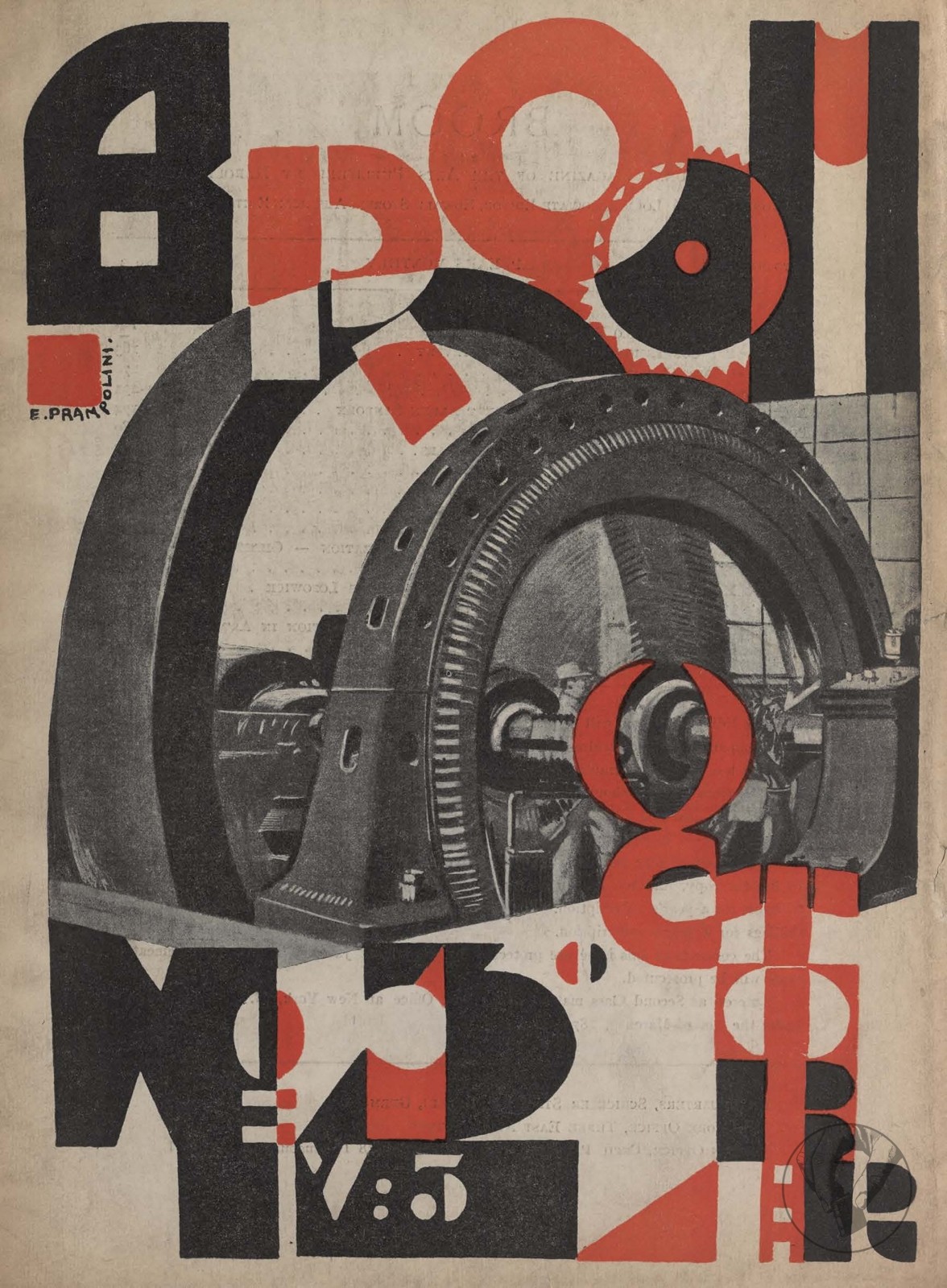
This issue of BROOM, an international magazine of the arts, features a cover design by Enrico Prampolini and a translation of "Stavrogins's Confession," three unpublished chapters from Feodor Dostoyevsky's novel "Demons, The Possessed." The magazine also includes advertisements for new fall books, including "The Adventures of Maya the Bee" by Waldemar Bonsels, "Batouala" by René Maran, "Jeremiah" by Stefan Zweig, and works by D. H. Lawrence. Additionally, there is an announcement for a "Practical Home Study Course in Interior Decoration" and information about advertising on Fifth Avenue buses.