Page 1
DECORATIVE ART 1957-1958 volume 4 THE STUDIO YEAR BOOK OF FURNISHING & DECORATION 520 PICTURES • 18 IN COLOUR
First pages of the volume, freely accessible.
DECORATIVE ART 1957-1958 volume 4 THE STUDIO YEAR BOOK OF FURNISHING & DECORATION 520 PICTURES • 18 IN COLOUR
What are the factors affecting our choice of environment? Is there any connection between function and fashion? What are the trends in home furnishing and decoration; how do they evolve? These are important questions for designer, manufacturer and home lover. In a special feature The Progressive Trend Mr. Jaap Penraat, the distinguished Dutch architect and industrial designer, examines the influences which give rise to changes in design. The international review, which comprises the bulk of this volume, gives a picture of events in the world of design and production for the home, tuned to the needs of our age. Twenty countries are represented by illustrations of new ideas in furniture and furnishing schemes and of new houses, apartments and their decorative accessories, which include textiles, rugs and carpets, wallpapers, light-fittings, ceramics, glass, tableware and silver. While some have been individually designed and made, the great majority are factory-produced articles of high standards of design and workmanship. Many employ new conceptions and techniques. 520 Illustrations—18 in colour 35s net
DECORATIVE ART 1957-58
--- e o r a t ---
i v e a r t VOLUME 47 1957-1958 The Studio Year Book of Furnishing & Decoration Edited by Rathbone Holme & Kathleen Frost The Studio Publications · London & New York
ACKNOWLEDGMENTS The Editors wish to express their sincere thanks to the many architects, designers and manufacturers who have provided photographs and information for inclusion in this volume. Appreciation is also due to our friends and correspondents overseas for their invaluable help, and especially to: Signor A. M. Allemandi, of Milan; Mr Alfred Altherr, of the Schweizerischer Werkbund, Zürich; Mr Louis Benjamin, of Oslo; Mr Stig Bjorkman, of Svenska Hem, Stockholm; Mrs Beryl Guertner, of House & Garden Pty Ltd, Sydney; Mr Norman Hay, of the Canadian National Industrial Design Council, Ottawa; Mr Bryan Holme, of The Studio Publications Inc., New York; Mr Bent Salicath, of Dansk Kunsthaandværk, Copenhagen; Mrs G. L. de Snellman-Jaderholm, of Helsinki; M. Pierre Vago, of Paris; and Miss Carmen Valdes, of Saber Vivir, Buenos Aires. Special acknowledgment is due to Miss Isabelle Jackson, whose meticulous attention to detail involved in the preparation of this volume has been most helpful. --- PUBLISHED IN LONDON BY THE STUDIO LTD, HULTON HOUSE, FLEET STREET, E.C.4 AND IN NEW YORK BY THE STUDIO PUBLICATIONS INC, 432 FOURTH AVENUE PRINTED IN GREAT BRITAIN BY WILLIAM CLOWES AND SONS LIMITED LONDON AND BECCLES
CONTENTS Editors’ Foreword 6 The Progressive Trend by Jaap Penraat, GKF, KIO 8 Houses and Apartments: Sydney—Australia 12 Norco Valley—California 13 Brentwood—California 14 Limberlost Lodge—Worcestershire 15 East Wittering—Sussex 16 Apartment in Vienna 17 Edgbaston—Birmingham 18 Vettakollen—Norway 19 Hjortkær—Denmark 20 Kidderminster—Worcestershire 21 Interiors and Furnishing 22 Textiles, Wallpapers and Carpets 60 Tableware and Silver 78 Glass 96 Lighting 116 Ceramics 122 Index 157
EDITORS’ FOREWORD The passage of time and the experiences which each year bring reveal themselves in changes of domestic habit and environment which are, nevertheless, too gradual on average to allow of any measurement capable of summarising annual trends. There are occasionally, however, moments of accelerated evolution, and they are most likely to occur only when compulsion is strong enough to make changes really necessary. This compulsion is encountered during emergence from a period of austerity, such as most of the world began to experience some ten years ago. With many established social precedents virtually knocked from under its feet, home life was faced with the problem of re-establishing itself amid difficulties caused by increased population, while at the same time seeking methods of reducing menial routine. Additionally, every ego demands style in environment for its personal gratification and, if it is not forthcoming, becomes acutely embarrassed by its lack, particularly when entertaining. Overcrowding is still a serious problem. Menial routine has been greatly helped out by strenuous efforts to electrify housework, and the quest for style is being satisfied by the crystallisation of a mid-century phase of design which has committed the unpardonable sin of adopting a name as ephemeral as night or day. Fortunately its name is the worst thing about it. In most other respects it has a great deal to commend it, and it has saved Britain from an agony of uncertainty as to the emergence of a national style worthy of some place in the chronicles of design achievement. The word ‘contemporary’ has now stuck too firmly to be ousted, but, just as the dispassionate observer can see nothing remarkably different between jitterbug and Rock ’n Roll, so, perhaps, will the subtlest change or development in present furnishing trends offer scope for a happier re-christening. Now that the Mid-Century style has established itself, albeit under the absurd name of ‘contemporary’, it can be predicted that the circumstances which gave rise to its development are such as to keep it alive, at least to the extent of maintaining its derivations, for some years to come. These circumstances contain a strong dose of technology; of production methods which had been geared first of all to the speedy relief of the homeless and then adapted to counter, as far as possible, increases in the cost of labour and materials. Attributes which have emerged from economic pressure are of a technical order and contain possibilities which lend themselves to development by intelligent use of design. Designers have had to make themselves familiar with the potentialities of pressing, forming and prefabricating processes, of moulding and laminating, bending and bonding, and the knowledge gained has done much to increase the versatility of furniture output, while at the same time endowing it with characteristics which are becoming ever more acceptable. The forms cultivated from modern techniques are generally not so revolutionary as the techniques themselves, but they are fitting idioms of our present age and are readily compatible with the conflicting
demands of a fuller life within the shrunken floor space which summarises the trend of so many homes today. This shrinkage has been going on for a long time and is doubtless responsible for most of the miniaturisation to which so much domestic equipment is subject. However, if personal activities are to be given full rein while the space for pursuing them is curtailed, something more than mere miniaturisation is needed. In any case, the human frame is not shrinking, so that furniture to accommodate it cannot be reduced in size below a tolerable minimum, but a great deal can be achieved by designing furniture for flexibility of arrangement as well as for serving multiple functions. Both these factors in design have repercussions on the appearance of furnished rooms. The leisurely look of today is achieved in a far more business-like and less haphazard way than in the past and the discipline that this involves necessarily emphasises certain design and selective requirements which, collectively, provide the basis of what is now called ‘contemporary’. In fact, the ‘casual look’ is far more calculated than would appear on the surface. This discipline provides less scope than ever for a breezy carefree approach to the furnishing of a room—particularly if it involves the combination of legacies from the past with products of today—but it does not necessarily extend to the decorative accessories, fabrics, glass, pottery, or other ornament, which can either enhance or diminish the effect of a decorative scheme. One of the advantages of the phase of interior design we have now attained, is that it is not too rigid in its specification of these decorative accessories. An underlying functional basis makes for simplicity of style, so long as its design continues to obey the principles which brought it into being. It therefore welcomes rather than repels association with the decorative touches, which colourful textiles, rich weaves, sparkling glass and ceramics, and elegant tableware impart. Against the advantages in all this freedom of choice is the danger arising from lack of directive or key theme to bind the overall design together. Discipline here must be self-imposed because the temptation to be led into experiments with multifarious colours, patterns and textures is very difficult to resist in view of the stimulating range of designs available. If it is not resisted, there will be no unifying plan and an irritating ‘clutteration’ is likely to be the outcome. The professional designer works to a theme or a combination of themes which enable him to narrow down his selection of accessories to a limited number of alternatives. The character which emerges from his work by selection of components from within this specific boundary often looks deceptively easy to emulate, for the judgment he has applied may well be hidden by the apparently casual result. Many possible interpretations of ‘Mid-Century’ style are derived from the flexibility of furnishing units. Their comparative neutrality in furnishing schemes lends itself to judicious mixtures. To suggest that the style can only preserve its future identity by remaining static would involve looking for ingredients it does not possess and would be a denial of the dynamic circumstances which have created it. The influences at work in shaping future trends in domestic environment comprise the theme of the feature which follows. In it Mr. Jaap Penraat discusses these influences as seen through the eyes of a Netherlander, but his observations will be found to share much in common with findings from further afield.
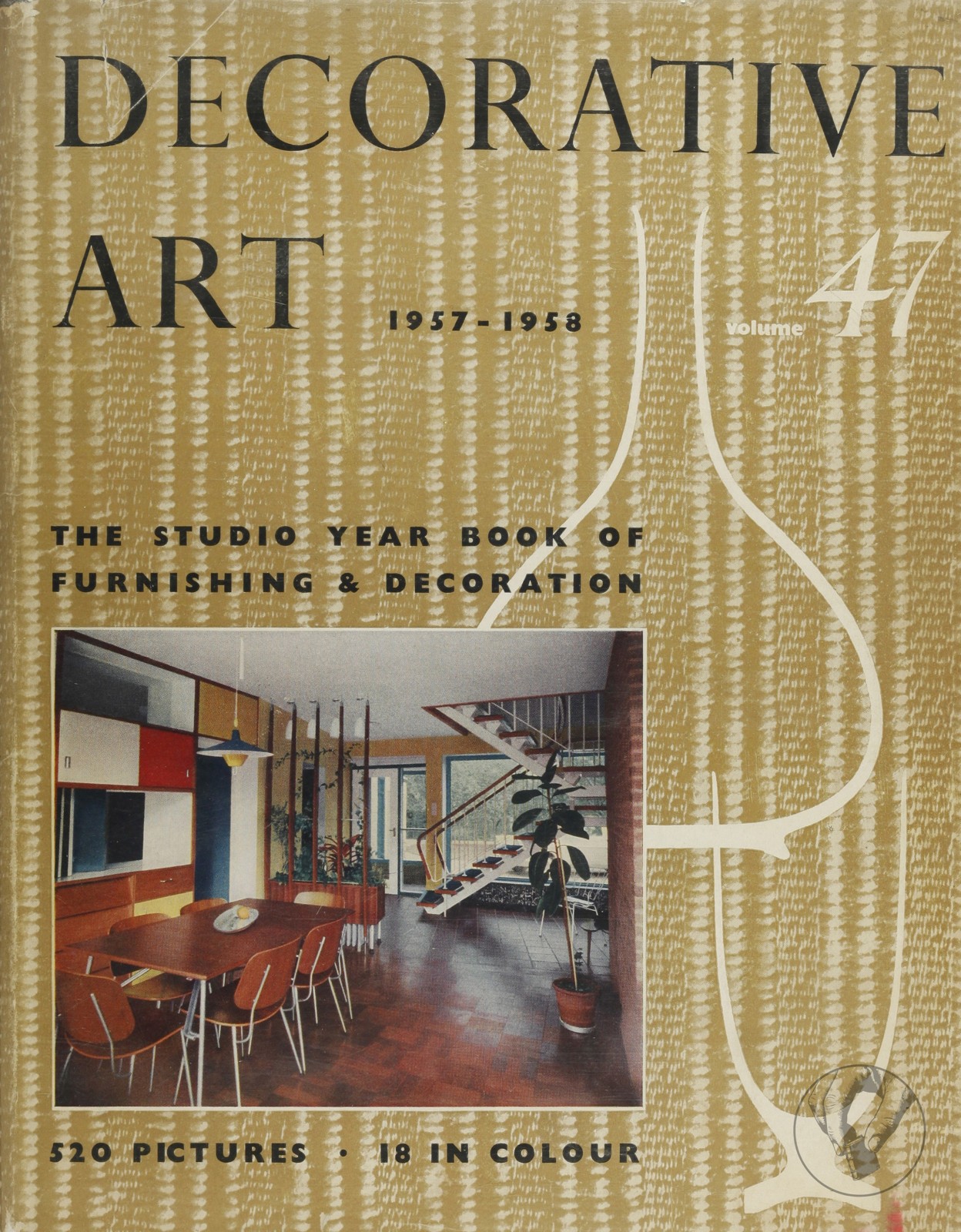
Annual volume 47 of The Studio Year-Book, the series begun in 1906. 156 pages. This volume presents an international review of design and production for the home, featuring new ideas in furniture, furnishing schemes, houses, apartments, and decorative accessories from twenty countries. It includes illustrations of textiles, rugs, carpets, wallpapers, light-fittings, ceramics, glass, tableware, and silver, many of which are factory-produced articles of high standards. The book also examines the progressive trends and influences affecting changes in design, as discussed by Dutch architect and industrial designer Mr. Jaap Penraat.