Page 1
DECORATIVE ART 400 ILLUSTRATIONS OF FURNISHING & DECORATION The Studio Year Book
First pages of the volume, freely accessible.
DECORATIVE ART 400 ILLUSTRATIONS OF FURNISHING & DECORATION The Studio Year Book
DECORATIVE ART is much more than an eagerly awaited work of reference for the specialist: it delights countless home-lovers everywhere who avidly study its illustrations of new ideas by the world’s leading designers of furniture, textiles, glass, lighting, ceramics, tableware, silver and decoration. In addition, in this issue Jean Royère, the well-known Parisian interior decorator, contributes a special examination of the French Idea in Decorative Design. France leads the fashion, whether in furnishing or dress. She has an elegance which none can deny, yet how many of us realize that she has practically no furnishing industry as it is understood in Britain and the United States? This and many other interesting facts Jean Royère brings to light. Four hundred illustrations and fifteen colour plates bring together an epicurean feast of ideas.
DECORATIVE ART 1952-53
DECORATIVE 1932-33 THE STUDIO YEAR BOOK OF FURNISHING & DECORATION
ART Sirena by Margarita Drago EDITORS: RATHBONE HOLME & KATHLEEN M. FROST - THE STUDIO PUBLICATIONS
ACKNOWLEDGMENTS The production of this annual would be impossible without the kind co-operation of the architects, designers and manufacturers whose work is included herein, and the Editors’ sincere thanks are due to them for much help and information. Acknowledgment is also made of the immense amount of work undertaken by special correspondents overseas: - Miss Carmen Valdes (ARGENTINA) - Mr D. W. Buchanan (CANADA) - Mr Sten Moller (DENMARK) - Mrs G. L. de Snellman-Jaderholm (FINLAND) - M Pierre Vago (FRANCE) - The Editor of Domus (ITALY) - Mr Stig Bjorkman (SWEDEN) - Mr Bryan Holme (USA) --- PUBLISHED IN LONDON BY THE STUDIO LTD, 66 CHANDOS PLACE, WC2, AND IN NEW YORK BY THE STUDIO PUBLICATIONS INC, 432 FOURTH AVENUE PRINTED IN GREAT BRITAIN BY W. S. COWELL LTD, AT THE BUTTER MARKET, IPSWICH
CONTENTS Editors’ Foreword --- 6, 16 --- The French Idea in Decorative Design: Jean Royère --- House in Toronto --- The Parisian Apartment --- 18–19 --- House in Wichita Falls, Texas --- 20–21 --- House in Los Angeles, California --- House in Vancouver, British Columbia --- Interiors and Furnishing --- Ceramics --- Textiles --- Glass --- Silver and Tableware --- Lighting --- Decoration ---
IN AN AGE SPINNING WITH THE WHEELS OF MACHINES, dancing to the tune of electronics and bouncing to the detonations of exploding atoms, the home becomes more than ever a shelter, a haven of seclusion and security in which the individual is allowed to be himself. The machine has its place in the house, but its object is to provide a greater measure of leisure and health with which to enjoy the more abstract amenities. It is with these abstract amenities that Decorative Art is largely concerned. From their intrinsic beauty and the harmony of their arrangement are derived the peace and comfort, both spiritual and physical, so essential to the well-being of the individual. Startling changes in interior design from year to year would be undesirable even if they could be found. Yet such is the restless urge and ingenuity of the designer that each year does bring a number of new shapes and arrangements, and sometimes the employment of a new type of material or a new combination of materials. By study and rearrangement of the old in the light of experience, experiment with new ideas and the borrowing of shapes and patterns established in other spheres, constant effort is made to increase aesthetic appeal and amenity. But home is home, a personal expression of the individual who lives in it. The character of the person does not alter or necessarily adapt itself at a rate comparable with the spate of experiment, and each home-maker will study the year’s developments from the angle of his own needs and tastes, while bearing in mind the accommodation and facilities available to him. *** Editors’ Foreword Of all the races on earth, the French are the most outstanding in their sympathy toward and use of the abstract in its widest sense. It is a stimulating feature of their art, adds poetry to the lives of the French people and takes its place as a natural background within the cultured home. At best it is used with wit and discernment in their furniture and interior decoration, sometimes gently, sometimes with considerable force. Because it is an essential part of design, inasmuch as it is the vehicle of personal expression, we have invited that well-known French interior designer, Jean Royère, who has been represented in the furnishing sections of every issue of Decorative Art since the war, to tell us something more about the derivations of French design, which has had such an enormous effect on the Western world for centuries, and about the qualities of contemporary French decoration which still enjoys a world-wide reputation. His contribution, which begins on the facing page, is not merely a eulogy on the French way of doing things. It is a reasoned and critical survey of the growth of French design, its background, its good and bad points. It is also a study of social conditions, economics and customs, an assessment of the characteristically French ideas arising therefrom, and an exposition of the manner in which they find expression today.
The French idea in decorative design BY JEAN ROYÈRE A view from the staircase in Monsieur Ch. G’s chalet at Megère. Architect: H. J. Le Même. The handrail and staircase are of polished oak and the flooring and fireplace of red brick. Wing chair on right of fireplace by Thonet; all other chairs designed by Jacques Vibert. FRENCH interior decoration has now reached a somewhat leisurely phase in the history of its development. The post-war years have failed to introduce any changes comparable with those which took place in the 1920’s and which affected the decorative arts in one decade more than in the two preceding centuries. Such profound and rapid development has demanded a pause for its digestion and maturity, and only now can it be said to have started to settle down. Such a revolution cannot really be understood without reference to the eighteenth century, when French interior decoration soared to its zenith. At that time the influence of Paris was analogous to its present influence in the school of painting. The capital then attracted the best furniture makers, not only from the provinces, but also from abroad, and especially from central Europe.
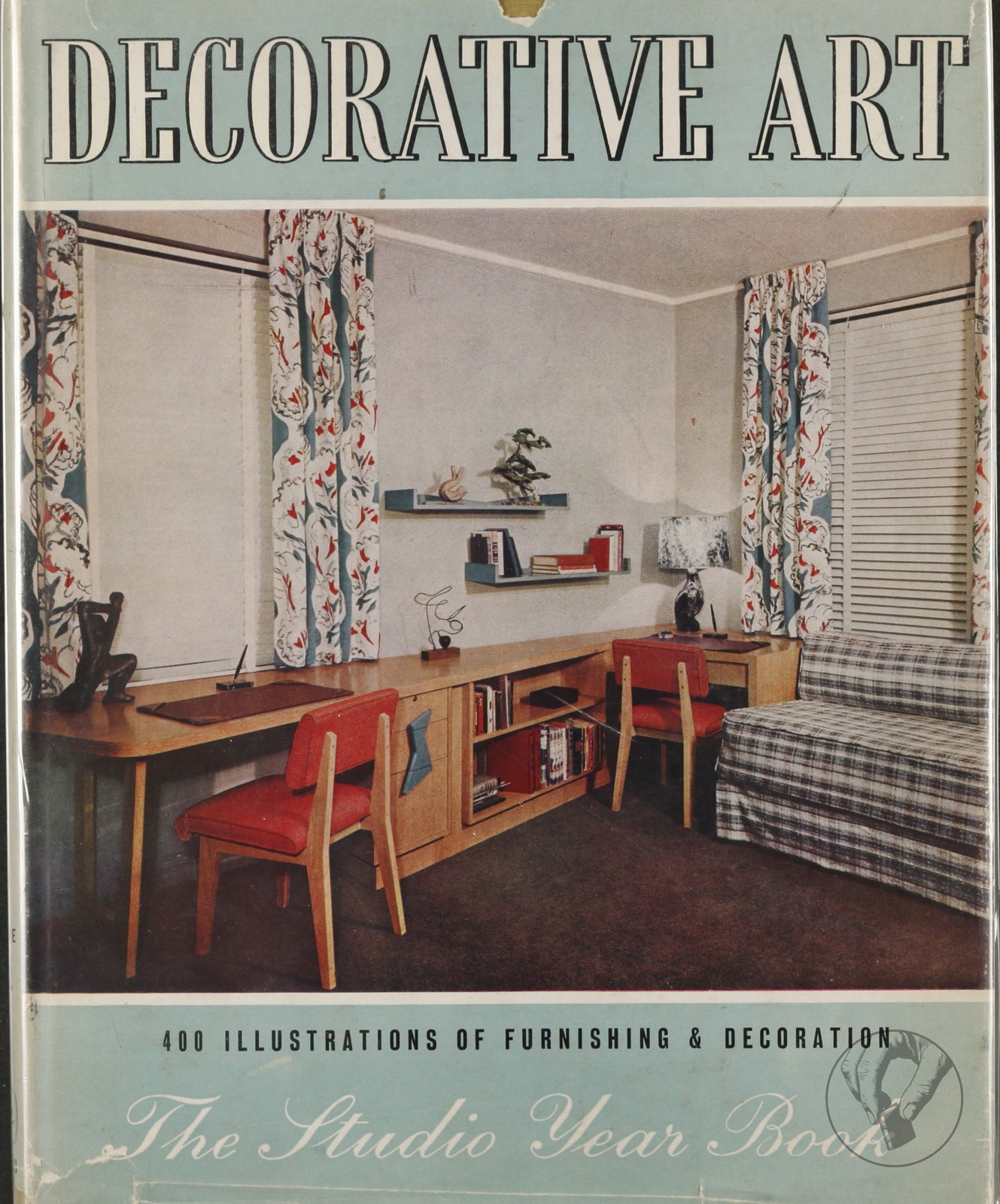
Annual volume 42 of The Studio Year-Book, the series begun in 1906. 156 pages. This issue of The Studio Yearbook, titled "Decorative Art 1952-53", presents 400 illustrations of furnishing and decoration by leading designers. It includes a special examination of the "French Idea in Decorative Design" by Jean Royère, discussing the French approach to furnishing and design. The publication also features fifteen color plates and highlights contributions from international correspondents.