Page 1
DECORATIVE --- ART --- 1943-48 --- The Sketch of the Book
First pages of the volume, freely accessible.
DECORATIVE --- ART --- 1943-48 --- The Sketch of the Book
DECORATIVE ART 1943-1948
Corner in the hall of a Danish house, furnished and arranged by Illums Bolighus A/S, Copenhagen
DECORATIVE ART THE STUDIO YEAR BOOK: 1943–1948 Edited by RATHBONE HOLME and KATHLEEN M. FROST THE STUDIO PUBLICATIONS, LONDON and NEW YORK
Acknowledgments The Editors wish to pay tribute to the designers, architects and manufacturers throughout the world who, despite difficulties unparalleled in the history of our time, have succeeded in developing their ideas to so great an extent in the domestic field. To them, and to those who have granted the loan of photographs and provided invaluable data, we express our grateful thanks. Acknowledgment is also due to our special correspondents overseas: Mr Sydney Ure Smith (Australia), Mr D. W. Buchanan (Canada), Mr Torsten Boheman (Denmark), Mrs G. L. de Snellman-Jaderholm (Finland), M. Pierre Vago (France), the Editor of Domus (Italy), Mr Knut Greve (Norway), Mr Stig Björkman (Sweden), and Mr Bryan Holme (U.S.A.). --- PRINTED IN GREAT BRITAIN BY W. S. COWELL LTD, AT THE BUTTER MARKET, IPSWICH. PUBLISHED IN GREAT BRITAIN BY THE STUDIO LTD, 66 CHANDOS PLACE, LONDON, W.C.2. AND IN NEW YORK BY THE STUDIO PUBLICATIONS INC., 381 FOURTH AVENUE.
Preface by the Editors --- Introduction by Robert W. Symonds L.R.I.B.A. --- Building for Emergency --- Town and Country Houses --- Living Rooms --- Bedrooms and Nurseries --- Dining Rooms --- Kitchen, Dining Recess and Equipment --- Furniture --- Furnishing Fabrics --- Lighting --- Tableware --- Decorative Ceramics --- Silverware --- Glassware --- Contents
$\mathcal{P}$ PREFACE THE LAST (1942-3) issue of DECORATIVE ART, appearing after the lights of Europe had been well and truly blacked out, recorded the close of an era. Its contents were unnaturally restricted by the frontiers of war. Depreciation of conditions and restriction of paper called a halt, before its succeeding issue was due to appear, which has prevailed until the present day. Furthermore, the course of the war had diverted most of the energies of designers in Europe to essential war services and communication between countries became not only difficult, but usually impossible. There remained, then, little scope for the exercise of the decorative arts and still less for reporting them. It was not until the close of the war in 1945 that this state of affairs came to an end, but that end was not marked with a feverish renewal of activity. True, a new era had been ushered in, unexplored, unknown, filling us with the hope that, the menace to our freedom removed and with new tools and materials to our hands, a new millennium had been reached. Concurrent with these aspirations there ran, unfortunately, the false beliefs in more money for less work, social betterment at the cost of the state, improvements in standards of living without personal effort to achieve them. These were regarded as rights to which we were entitled in compensation for past scourging and long trial. Such were the dreams in the early days of the declared peace. So much had been destroyed, so little renewed that Europe had fallen to her knees and it is now taking a long time for her to regain her feet. At the moment we are anxiously searching for means of recovery and are buying the time and strength needed to rebuild. Such a condition allows little beyond the rudimentary necessities, and in these circumstances it is not to Europe that we can look for new experiment in design for gracious living. We must turn to countries farther afield, as will be seen in our illustrations. The work done in the years covered by this issue and the space available to effect this coverage are incompatible, with the inevitable result that omissions must exist. Production in each of the categories into which the illustrations are divided is unequal. Some have a larger representation than others. In one case, namely the bathroom, the section has been omitted altogether due to lack of sufficiently new material. Similarly, but for an altogether different reason, radio and television receivers have been excluded. They constitute a specialized field of production and are comprehensively reviewed in technical magazines. In any case, it is the belief of the editors that, for many reasons, the most satisfactory methods of housing receivers are those which embody them in some feature of the room, rather than those which demand a table or area of floor upon which to place a cabinet, whose chances of combining well with the rest of the furniture are not very great. The standardized house with its built-in fitments can very easily be designed to accommodate built-in radio, television and record-playing apparatus. The trials of urgency and of strict economy at home in European recovery have not, however, been devoid of lessons for the designer. Social conscience has been aroused in connection with the housing of the masses and considerable advance has been made in the provision of amenities for the smallest home. With the aid of new materials and new techniques evolved in war, much progress has been made in this direction and if, in exterior design, the decorative arts have found little opportunity for expression, no review of this kind would be complete without including some report of the work done in this field. In the furnishing and equipment of the home, whatever the frustration and self-denial of the people, the inexorable need for exports has stimulated at least a partial revival in design research. Although European home markets are, more or less, still governed by the need for self-denial, there are signs of a renaissance in the finer points of design and it is encouraging to see a revival of the decorative arts. Evidence of the strength of this revival is to be seen in the fine collection of photographs of textiles, tableware, ceramics, glass and silver, which has grown out of contributions submitted from many
parts of the world and gives evidence of a healthy outlook for the future. One of the tragedies of the last decade is that a new generation is reaching maturity without, in the main, having had much opportunity to enjoy, by using or beholding, exquisite examples of design, craftsmanship or manufacture, with the consequent danger of an acceptance of lower standards. The revival of the decorative arts is therefore of the greatest importance, as is also the speediest possible return of well-designed goods to home markets. If the future of British export trade depends upon quality, it is as vital that this quality should be found in the goods available to her people at home as in products designed for overseas consumption. Among the great advances made in the war was that in connection with the development and use of plastics, which are now put to many different uses both industrially and domestically. At the close of the war there were many opportunists who foresaw great possibilities for exploiting the transparent plastics in particular and they did not wait for the grass to grow under their feet. Unfortunately, some of them did not even pause to discover the most appropriate applications of such materials and home markets were quickly flooded with badly designed and badly made domestic goods at fantastic prices. If it were not for the intrinsic merits of plastic materials, their adaptability, durability, degree of finish, strength and constitution, this exploitation might well have stultified their development for non-industrial purposes. The fascinating properties of synthetic resins have, however, remained irresistible and, although a stigma prevails in their use for certain decorative purposes, due no doubt to their synthesis, if used intelligently there are many applications for which it would be very hard to find an adequate substitute. But in any case the production of plastic goods for use in the home demands the skilled co-operation of the trained designer. It is abundantly evident to-day that the vital needs of the world can only be met by the widespread use of machine production. Full knowledge of the characteristics and potentialities of productive machinery is therefore a prime requisite of the designer for industry. Growing recognition of this fact by the industrial designer and of the importance of the designer by producers is most encouraging. The day of the large, individually designed home is passing and that of the ‘custom-built’ home for every man is approaching. With this trend toward standardization, statistical research into the average requirements of families of different sizes is resulting in homes of really practical proportions, with emphasis on practical needs and on making a house as easy to run as possible. Particular attention is given to the most economical use of space for storage, to the heat-insulating properties of walls and the most efficient forms of heating, to orderliness and the installation of comprehensive equipment in the kitchen; in short, to the indispensable basic properties of a comfortable home, the background against which the individual can exercise his own discretion in the disposition of his personal belongings. Although the world’s needs cannot be met by the individually built objects which come from a craftsman’s hands, the craftsman’s skill is still the most instrumental criterion by which other standards are judged. Every machine-made object is derived from a hand-built prototype and the craftsman’s logical place to-day is in the prototype department. The revival of DECORATIVE ART is a landmark in the reversion from war to peace. If, however, there are openings yet to be filled in the field of domestic production and if the peoples of Europe must still send their best goods abroad, at least a start has been made towards a happier goal. The Editors
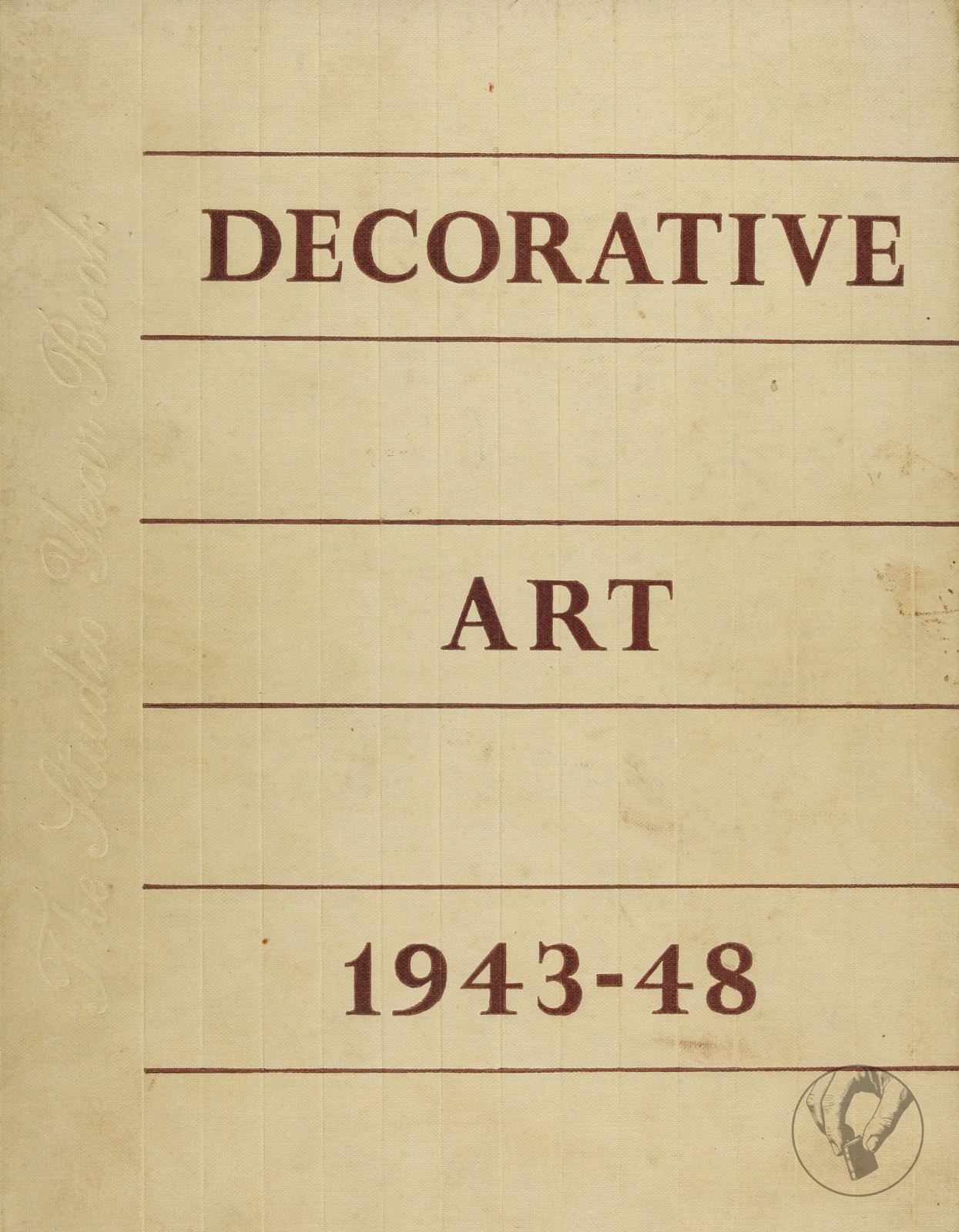
Annual volume 38 of The Studio Year-Book, the series begun in 1906. 152 pages. This volume of The Studio Yearbook, published between 1943 and 1948, showcases developments in the domestic field. It highlights the achievements of designers, architects, and manufacturers worldwide, despite significant global challenges. The book also acknowledges contributions from special correspondents across various countries.