Page 1
revue de l'art actuel cinquième série numéro 5 mai-juin 1958 EIMAIS SURAY
First pages of the volume, freely accessible.
revue de l'art actuel cinquième série numéro 5 mai-juin 1958 EIMAIS SURAY
Galerie Le Gendre 31 rue Guénégaud, Paris 6, Danton 20-76 du 3 au 30 juin Doucet gouaches et collages Chavignier sculptures en permanence : peintures de Francis Bott, Camille, Pierre Clerc Corneille, Sugai sculptures de Chavignier --- Galerie 12 ancienne galerie de Berri Raymonde Cazenave 12 rue de Berri, Paris 8 Elysées 14-56 Mane-Katz œuvres récentes du 30 mai au 20 juin --- Galerie Internationale d’Art Contemporain 253 rue Saint-Honoré, Paris 1 Opé. 32-29 Mathieu Six grandes toilesen hommage à l’Ordre du Temple du 10 juin au 14 juillet ---
Iris Clert 3 rue des Beaux-Arts, Paris 6, Danton 44-76 the most advanced art gallery in the world en Première Mondiale : Concert pour 7 peintures de Tinguely du 6 au 14 juin --- Galerie René Drouin 5 rue Visconti, Paris 6, Danton 20-99 Fautrier gouaches et dessins 1928-1958 à partir du 20 juin Cuixart --- Galerie Jacques Dubourg 126 Boulevard Haussmann, Paris Nicolas de Staël collages du 17 juin au 3 juillet --- Galerie Jordan 34 faubourg Saint-Honoré, Paris 8, Anjou 27-50 Fautrier Hartung Kandinsky Tobey Wols Atlan Arnal Banc Matta Poliakoff Tsongos Zack juin
Berggruen et Cie 70 rue de l'Université, Paris 7 Matisse dessins - sculptures inédites Galerie La Roue 16 rue Grégoire-de-Tours, Paris 6, Odéon 46-70 Chaminade peintures du 13 au 29 juin --- Revue internationale d'art moderne QUADRUM la grande revue internationale d'art moderne publiée au Palais des Beaux-Arts de Bruxelles. Quadrum 4 Extrait du sommaire : C. G. Argan : La crisi di valori Adrian Stokes : Form in art La 3ème Biennale de Sao Paulo L. Kochnitzky : Marc Tobey R. V. Gindertael : Bissière M. Bilke : Servranckx Fitzsimmons : Jean Dubuffet A. Ehrenzweig : Victor Pasmore’s Architectural Constructions G. Mazzariol: Cronaca di un Linguaggio, E. Vedova F. Mathey : Le vitrail moderne en France H. Seiler : Vier West-deutsche Privatsammlungen Documentation : Jeunes artistes, miscellanea, livres, expositions etc... 15 planches en couleurs, plus de 150 reprod. en noir --- Unique au Monde Le seul Répertoire International : Musées avec leurs Directeurs et Départements Antiquaires, Galeries d’Art, Métiers d’Art Editions d’Art, Librairies Anciennes et d’Art Hôtels des Ventes Bibliothèques et Archives Publiques Académies d’Art, etc. DU MONDE ENTIER. Une documentation unique sur l’Art : 70.000 adresses par ordre alphabétique, par pays, avec spécialités et 1.000 illustrations --- Annuaire International des Beaux-Arts Internationales Kunstadressbuch / Anuario Internacional de las Artes International Directory of Arts Edition 1958-1959 En vente : à partir de l’été 1958 chez les libraires Prix en souscription : 3.000 francs — Après publication : 4.000 francs International Directory of Arts, 6 Dessauer Str., Berlin-S.W. 61, Allemagne
Kootz Gallery 1018 Madison avenue, New York sole american agent for Sugai --- Galerie A.P.I.A.W. Salle de l’Emulation, 16 place du 20 août, Liège peinture de Selchow du 19 au 31 juillet --- Galerie Bellechasse 266 Bd St-Germain, Paris 7, Invalides 20-39 Jean-Jacques Morvan “La mer” gouaches et peintures exposition prolongée jusqu’au 25 juin --- Galerie Ariel 1 avenue de Messine, Paris 8, Car. 13-09 Doucet jusqu’au 21 juin en permanence : Atlan, Bitran, Bissière, Childs, Compard, Deyrolle, Doucet, Gillet, Goetz, Hartung, Manessier, Maryan, Pichette, Pignon, Poliakoff, Schneider, Singier, Soulages Tal-Coat, Vieira da Silva, Zao Wou-ki. sculptures de Anthoons. --- European and American Modern Master Rose Fried Gallery 40 east 68 st, New York --- Galerie Apollinaire Via Brera Milano 4, Tel. 862831 peinture italienne et étrangère d’avant-garde en exclusivité pour l’Italie : Fautrier, Hartung, Schneider, Bryen, Licini, Soldati, Meloni Helman, Laubiès, Bellegarde, Feito, Koenig, Dugue, Brüning, Hundertwasser, Berrocal (sculpteur)
Cimaise revue de l'art actuel 34 rue du Four, Paris 6 Directeur : J.R. Arnaud Secrétaire général : John Koenig Rédaction : G. Boudaille, M. Ragon, P. Restany Herta Wescher La rédaction reçoit sur rendez-vous Abonnement (6 numéros) 1.600 frs - Par avion : 2.800 frs 34, rue du Four, Paris 6, téléphone Littré 40-26 C.C.P. Paris 5542.39 Diffusion : Allemagne : Librairie Hanna Weber, H.-J. Niepel, Dusseldorf 1, Grabenstrasse 11 Argentine : Editorial Victor Leru, Cangallo 2233, Buenos-Aires Autriche : Arnulf Neuwirth, Paracelsusgasse 8, Vienne 3 Belgique : Jean Milo, 28 rue de l’Arbre Bénit, Bruxelles C.C.P. Jean Milo, Bruxelles 1591.50 Italie : Le Noci, Via Brera 4, Milan Danemark : Meiners Kunstforlag, Peder Skramsgade 5, Copenhagen Grande-Bretagne : Alec Tiranti Ltd, 72 Charlotte Street, London W 1 Japon : Meiji-Shobo, Surugadai, Kanda Tokyo Norvège : J.W. Cappelen, Sortimentebokhandel, Oslo Suède : Eric H. Olson, Upplandsgatan 3, Stockholm, 10 23 77 Suisse : E. Genton, « L’Entr’acte », rue du Lion d’or 4, Lausanne, C.C.P. II 144-56 U.S.A. : Wittenborn and Co, 1018 Madison Ave, New-York 21 --- H. Couignoux 24 rue de Charenton, Paris 12, Dorian 63-04 Fournitures générales pour les arts arrangements spéciaux pour les lecteurs de Cimaise --- Sommaire L’Art actuel au Japon Couverture de Sugai Textes anglais 7 Japan and Us by Michel Ragon The Adventure of Art in Japan’s Four Islands by Shinichi Segui 10 The concept of the sign in Calligraphy by Shiryu Morita Textes français 11 Le Japon et Nous par Michel Ragon 12 L’aventure de l’art abstrait dans les quatre îles du Japon par Shinichi Segui 22 La conception du signe dans la calligraphie par Shiryu Morita 26 Que viennent chercher à Paris les peintres japonais ? par Georges Boudaille 30 Japan made in Paris par Pierre Restany 31 Le printemps à New York by Dore Ashton 34 Les expositions par Georges Boudaille, René Déroudille, Michel Ragon, Pierre Restany, Hugo Weber, Herta Wescher Textes anglais 44 Japan made in Paris by Pierre Restany 45 Why do Japanese painters come to Paris ? by Georges Boudaille 46 New York by Dore Ashton --- Robert David siège social : 31 faubourg Montmartre, Paris 9 Téléphone Danton 16-26 Photographe spécialiste pour photos de tableaux, dessins, objets d’art
English translation by J. F. Koenig Japan and Us (p. 11) by Michel Ragon A new fad for Japan is taking birth and the exhibition of Japanese Art Through the Centuries at the Musée d’Art Moderne in Paris will only help to bring about (this time for the right reasons) a new European and American infatuation for Japan. After Georges Salles and Bernard Dorival went to Tokyo to present a selection of the masterpieces of the Louvre, after Jean Leymarie went there for the Engraving Biennial where Georges Adam won the honors, after Alechinsky went to bring us back a fine film on calligraphy that I have already written about, I also went for a stay in Japan last summer, during which I presented a show “The New School of Paris” at the Bridgestone Museum. Michel Tapié was not far behind, bringing a Mathieu show, and a few months later Soulages, coming through from the States, received his National Education Prize in Tokyo. Soon Atlan will leave also for the Far East for a show there. Thus we see that the exchanges between Japan and France are becoming more and more numerous. Thus we thought it would be useful to present to our readers some information on present-day modern art in Japan, about which little is written, for usually interest is directed towards the traditional art of Japan. But what struck me in Japan was this: that it was certain that the ancient traditional Japanese art seemed strangely modern to me, whereas what was considered as being modern art in Japan seemed rather old to me. For that matter, in traditional Japanese painting, we are astounded to find this taste for the sign and the spot, the freedom in each trace of the brush, the sense of space, that are the characteristics of the avant-garde abstract art in Europe and the United States. It’s the same for architecture. Whereas in former times the european house was a closed house, with thick walls and grills at the windows like a fortress, today it opens out toward the outdoors, and lets nature penetrate into the interior. And the arrangement of this interior, with the clumsy furniture of old times taken out, that uses instead sliding doors, storage-room in the walls, and low tables—all of this is close to the traditional Japanese house. On the other hand it is strange to notice that this present day interest in Japan, in Europe as well as in the United States, is a puristic reaction against the different baroque trends that went from the Modern-Style of 1900 to the Arts Décoratifs of 1925, which were, nonetheless, the results of an earlier European craze for Japan. This earlier craze, that took place after the Goncourt brothers’ studies on the wood engravings of Hokusai and Outamaro, along with Mallarmé’s hai-kais and Loti’s novels, and Monet’s and Van Gogh’s Impressionism—this Japanism of the popular 18th Century engravings and porcelaine, brought about a noodle style and vegetable decorations. Thus it is significant to see that the present exhibition of Japanese Art at the Musée National d’Art Moderne has neither wood engravings nor porcelaine. The second European Japanism is completely contradictory to the first, and the purist art of Japan that delights us today, helps us to escape from the baroque style inherited from Japan, that pleased our grandparents so much. But our aim here is especially to speak of present-day art in Japan, and no one is better qualified to make a general study of this problem than Shinichi Segui, an art critic in his thirties, one of the best-known of his generation, the author of several critical works among which is “Twentieth Century Art”; also a delegate to the AICA Congress in Florence in 1957, the same year having presented the exhibition of the Japanese Painters in Paris at the Cercle Volney, during his visit here. In Kyoto, I also asked Shiryu Morita for an article on calligraphy. Japanese abstract calligraphy for that matter took form in 1949-50 under Morita’s impulsion, and today there are four different tendencies, among which is Bokujin (the India ink men) of which Morita is a member. He is also the editor of the review Bokubi. We must immediately underline the fact that in Japan painters and calligraphers are two distinctly different things. And the calligraphers, as well as the painters, are divided into two schools: the traditionalists who are attached to the usual form of the characters, and the so-called “abstract” modern calligraphers who want to invent new signs. Formerly, calligraphy was directed moreso towards the sign, whereas today it goes toward the spot, although these two things still remain the characteristics of calligraphy. It is still done with the solidified India ink, and on the same paper that serves for the translucent partitions. Color is never used. Morita told me that since the war modern calligraphy is a reaction against the degradation of traditional calligraphy. For him, it is a return to the real tradition that created signs. It is also an expression of the men who were liberated after the war from the feudal system. Morita was surprised to hear that we found certain relations between the informal painters and the calligraphers. For the calligraphers find a support in the ancient laws that they have split asunder, whereas he finds no basis in the works of the european informal painters. In return, we must say that if European and American painters were influenced by calligraphy, calligraphy in Japan only became abstract after group expositions in the Far East took place, where among others were to be found Hartung, Soulages, and Schneider. We must not forget that calligraphy is still an unknown art in Europe, just as flower arrangement, the art of stones, and the geishas. One fact that surprised me considerably in Tokyo was the absence of an abstract art gallery, and the few abstract works to be found in the other galleries. The avant-garde artists only show in the salons, grouped together by tendencies. This comes from the fact that whereas the group exhibitions draw in crowds of visitors, the galleries see only a few amateurs, and the collectors of abstract art are very rare, in contradiction to what we might think. To end this introduction, I would like to thank again the art critic and translator Shuji Takashina, who was so kind in helping us in the realization of this special number on Present-day Art in Japan. Michel Ragon The Adventure of Art in Japan’s four Islands (p. 12) by Shinichi Segui Perhaps our European and American friends will be surprised when I tell them that in our four Japanese islands, we have around thirty thousand artists, one-third of whom are avant-garde; that we have three large newspapers, each printed at more than three million copies a day; and also that we have four art reviews that consecrate a third of their space to avant-garde art, each of them selling at least ten thousand copies; that the Japanese section of the International Association of Art Critics is made up of about forty members, of whom about a third, also, defend contemporary art. This proportion of a third is significant when you consider the present situation of art in our country. This clearly shows that avant-garde art is far from being misappreciated in Japan. This is rather encouraging, for I saw many countries during my visit in Europe in 1947, that were far less interested in modern art. However, many of the people who are interested in these new artistic movements do not try to incorporate them into their ordinary life. The collectors of modern works of art are rarer in Japan than in other countries that nonetheless have fewer avant-garde artists. Even less numerous are the museums and galleries for modern art; only two small museums, organized since the war, show modern work. This contradictory situation is very harassing for our artists. Also, the art critics are not satisfied with the space given to them by the newspapers and magazines. Certainly, this same problem is to be found in other countries, but it is particularly striking and serious in Japan. We mustn’t attribute this situation to the ignorance of the public. I think that we must always believe that the public is the best judge.
To defend new ideas always brings about difficulties. But one mustn’t discredit the public because of these difficulties. We must take an anti-nihilistic opinion. Also, we must destroy this myth of the poor artist struggling bravely against hunger and cold in an attic. It is thus better to search in the interior of the artistic world and the artists for the causes of this contradictory situation. It seems to me that one of the reasons for these difficulties is that the idea of an avant-garde art is something very new in Japan and has only a short history. Everyone knows that the technique of oil painting was introduced to Japan less than a century ago. The history of modern art in Japan is made up of mutual influences and a sometimes rather violent opposition between the new occidental technique and the traditional painting, centuries old but far from being dead. There is no doubt that this co-existence of the two entirely different techniques is one of the causes of this contradiction that gives us so much trouble. In Japan, there is a certain confusion concerning art. We consider anything painted with oil as occidental painting, and anything done with fish glue or india ink as Japanese painting. This phenomenon will be perhaps difficult for French people to understand, since they did not consider the colored lithographs introduced into France from England at the end of the 19th century as English paintings. But the laws of cultural relations in the compact world of Europe are not valid when we consider the relations between the West and the Far East. The concept of Beauty, nourished within us over a long period of years, although perhaps on a subconscious level, has caused us to be reticent, or even suspicious, about the new european technique. Certainly, today, we have begun to understand these different types of painting on the same basis, with common standards, and with the ability of recognizing the absurdity of a superficial distinction between western and Japanese painting. I hope that in the near future, we will find a critical basis that is solid and concise, and valid for the two different styles of painting. But in the use of the new technique in Japan is still to be found the old concept of Beauty. The first masters in our history of modern art were more or less influenced by Courbet or the Fauves, coming through the Impressionists, and having much trouble with the contradiction that existed between the new technique and the old concept of beauty. Some of them only imitated western painting, and others violently reacted against it. We must remark that French art has influenced the art of other countries to a considerable degree since the 17th century, and that many countries that today have an original style of national painting, in the beginning either had to assimilate french art or react against it. In 1948, I saw in many modern art museums of different countries, certain works had the same characteristics as those of our painters. But in Japan, where oil painting was unknown a century ago, the influence of French art was greater and more decisive. If we try to explain this situation, certain European countries who are in a similar situation as ours, such as Germany and he Scandinavian countries, come to mind. Although the “Secession” movement was only a local variation of French impressionism, and the beginning of the Expressionist movement was only a variation of Fauvism and Cubism, Germany succeeded in creating, between 1920 and 1930, an original art that was based on the development of the traditions of the country. And we would be wrong in trying to qualify these movements as being simply local. The first original painter in the history of modern art in Japan was Tetsugorō Yorozu (1885-1927). He was one of the rare renovators who was opposed to Impressionism, being deeply marked in the beginning by Fauvism. From here, he went on to a Cubist conception, analyzing the object before reconstructing it on the canvas. His “Leaning Upright Figure” of 1917, is the first example in Japanese Cubism that has no link with either Picasso or Braque. Unfortunately, his effort was not understood at the time, and he was unable to follow up this interesting endeavour. Towards the end of his life, he went back to traditional painting, and did many things in an eclectic style. He surrendered, when faced with the effort of a problem that is difficult for a single artist, even if he is a genius, to solve. If we search for the seed of modern art at the beginning of the century, we find Seiji Tōgō who showed a futuristic “woman with a parasol” at the Nika Salon. In fact, one of the first of the avant-garde movements to be introduced into Japan at the beginning of the century was Futurism. This movement, already known in 1911 and 1912 in Japan, caused much enthusiasm among the young painters. This enthusiasm brought about the birth, in 1920, of a Futurist group, centered around Tōgō; en 1922, of the “Action” group of Tai Kambara, and in 1923, of the Constructivist “Mavo” group, organized by Tomoyoshi Murayama. In 1924, these three groups united into a single unit under the name of Sanka-kai. Thus the first avant-garde movement was born. After two Salons, and a small group show, Sanka-kai went through an internal crisis, that brought about the departure of the communist artists. They grouped together in the “Association of the Artists of the Plastic Arts” in 1925. This separation took place under the influence of Russian avant-garde art. This group had a spirit close to Futurism and Constructivism; Expressionism and the German “Neue Sachlichkeit” movement also influenced them. But when Russia took a position against avant-garde art, this group went back to a naturalistic style. What we must specially remark is our rather unusual historical situation in that the first avant-garde movements such as futurism, constructivism, expressionism and the “Neue Sachlichkeit” were introduced into Japan almost at the same time as Post-Impressionism, represented by Van Gogh, Gauguin and Cézanne. In 1926, the partisans of Post-Impressionism joined together, in a Fauvist group opposing themselves to the avant-garde movements; they later became the Dokuritsu-Bijutsu Kyokai (Association of Independent Artists) in 1930. This association, that still exists, brought about a strong anti-avant-garde current. Thus, our first avant-garde artists had to fight against Fauvism on the right and the naturalistic Communists on the left. But their efforts were not in vain. Another new generation came to replace them. Already, in 1925, a year after André Breton’s Surrealist Manifesto, a new movement began to cause a certain impression in Japan. Certain young poets published magazines, among which the most important was that of the “Poem and Poetic Theory” group, born in 1927. One of the members of the group, the poet Shūzō Takiguchi, translated André Breton’s “Surrealism and Painting” in 1930. Takiguchi also began to write art criticisms, and several surrealist groups sprang up. What we must especially notice was that certain surrealist painters broke away from the Fauvist Dokuritsu-Bijutsuka-Kyobai group in order to form the “Shinzōkei” (Neoplastic) group. In 1931, the “Paris-Tokyo Art Nouveau Exposition” took place, and works of Miro, Ernst, Masson, and others were shown along side of Japanese artists. In 1937, an International Surrealist Show was organized by four directors: Paul Eluard from France, Roland Penrose from England, and Shuzo Takiguchi and Sansei Yamanaka from Japan. Already in 1936, an avant-garde artist’s club was founded, that became, in 1938, the Bijutsu-Bunka-Kyokai (Cultural and Artistic Association), that grouped together Surrealist painters such as Ichiro Fukuzawa, Itoku Tagaya, Tadashi Sugimata. On the other hand, already in 1925, the beginnings of abstract art could be found in the works of the engraver Koshiro Onchi. He had seen, through Kandinsky’s works, that art was concerned only with the autonomous functions of the plastic elements, and he did his first abstract works with a series of engravings entitled “Lyrical.” We must not forget either that
Kigai Kawaguchi had studied in Paris with André Lhote; Nagao Yamaguchi had studied especially Picasso, Léger and Klee; Kazuo Sakata had been a pupil of Léger. All three of them after their return to Japan, between 1927 to 1933, had already begun to show their works. In 1934, certain young artists that had become acquainted with abstract art in France joined together in a group called “Shinjidai” (The New Period), that became in 1937, with the addition of several other groups, the Jiyū-Bijutsu-Kyokai (the Association of Free Artists). The best-known among them were: Masanari Murai, Tatsuoki Naniwada, Saburo Hasegawa. These surrealist and abstract painters organized shows, published manifests, brought out art books and reviews. They frightened the old-fashioned artists and gave a shock to the public. But in 1941, when the Nippo-Chinese war developed into a war with the United States, these painters were forced into silence by military oppression. The last explosion in the short history of avant-garde art before the war was Taro Okamoto’s one-man show in 1940. Okamoto had participated in the movement “Abstraction-Création” from 1932 to 1937, and had created many fine works. The war in Europe forced him to return to Japan, where he showed his paintings. But shortly after his show, he was called into the Army, and sent to the front by certain militarists that had been irritated by this manifestation. The five years that followed this show were completely empty of any avant-garde activity. Most of the artists were mobilized. The others were reduced to silence. In 1945, when the detestable war was over, they came back to their studios, as tired as travelers who are forced to cross a long dark valley. And in their studios, there were neither canvases nor colors. The museums and galleries were closed. Another year went by before they found the courage and the means to take up their brushes again. And then they found that the artists with old-fashioned ideas had become far more powerful than they were before the war, and so the way was even more difficult. But in spite of these difficult conditions, the avant-garde artist courageously began to work again. Okamoto, who had been in many battles in China, showed a canvas called “Dawn” in 1948. This showed fantastic personages wildly dancing in the midst of a forest, all in violent and vivid colors, giving us an image of our present existence. A short while before this canvas was shown, Masaki Suematsu, who had remained in France during the war, brought news of the activity of the French artists during and after the war. The news of the Salon de Mai that was founded in 1943, and the Salon des Réalités Nouvelles, founded in 1946, enheartened us to a considerable degree. Then in 1951, we had the Salon de Mai and the Picasso show in Japan. The same year, the 4th Independent Show in Tokyo, where many European painters sent their works, gave us confidence in our solidarity. All of these different manifestations really contributed very much to encourage us. Besides the artists that I have already named, many others began to take the same position, and in a third of the thirty different Salons, the avant-garde tendency began to win over the traditional painting. In 1952, the Japan Art Club took birth, uniting almost all of the avant-garde artists. We have a International Biennial in Tokyo since 1952, and in 1957 took place the first International Engraving Biennial. In 1956, for the first time since the war, we had a International Show of Today’s Painting. We all desire communication with other countries. But the more we desire this, the more we realize that we must break away from foreign influences, and in realizing that, many painters have succeeded in creating really original works. This can be seen since 1951 in the Japanese entries in the Biennials at Sao Paulo and Venice, or at the Carnegie Institute. We often hear our foreign friends give us the following advice: “Your art is much too occidentalized. You must keep attached to your traditions.” I don’t think that such advice is worthless for some of our artists. But if “tradition” means a taste that some Europeans and Americans have for “japanism,” when they think of Japanese art, then this advice is not at all interesting for most of our artists. What we can call “Japanism” must be abandoned completely by the real avant-garde artist, who has the task of developing his people’s culture on an international level. For the notion of avant-garde is neither historical nor esthetic, in that it does not take into consideration the best elements of traditional art. What we must respect the most is today’s reality. If we want to attach ourselves to something that no long has any relation with reality, it is like talking to a madman. It has no meaning. I would rather hear this kind of advice: “Learn what you have to learn from Europe in a disengaged fashion. Resist tradition in a like manner, and stay the same while you developing a new tradition.” At the beginning of the century, Germany gave us intelligent advice. The definition that Professor Wilhelm Worringer had for our art in his book “Abstraktion und Einfühlung—Oriental and Occidental Art” (1908) is as significant for the Japanese as the fact that here was to be found the theoretical basis for occidental abstract art. He says that “Japanese art is not something that with the primitive peoples is anterior to knowledge, but something that goes beyond knowledge,” and he finds in our art “the abstract form based on something that is arbitrary and seemingly accidental.” This formula is classical, but merits being examined. From a certain point of view, it is completely true, and Worringer is right in situating our art aside from the two categories of abstract art in Europe, where there is an organic tendency on one side, and a geometric one on the other. We had forgotten Professor Worringer’s classical formula for a long time. Or at least, we didn’t consider it as being important. But in our avant-garde art, it isn’t by chance that the art that is considered as being the most European among the different tendencies, has reached, after a long period of effort and research, the same conclusions as those in Worringer’s formula. For it is precisely avant-garde art that must courageously counteract tradition, and through this becoming the true successor of tradition. This classical formula: “The abstract form that is based on something that is arbitrary and seemingly accidental,” must be carefully examined. It admirably states the characteristics of our original contemporary artists. However, Professor Worringer didn’t perceive that in spite of these characteristics, we have a very original kind of geometry. Not a geometry of a Euclidian type; it is of a more vital order, that has, underneath its informal appearance, an exact form. We even find it in a completely intuitive art: calligraphy. Now I would like to speak of a certain number of abstract painters who keep relatively close to traditional forms. Nagao Yamaguchi’s works brings to mind Zen art; Kazuichi Tsudaka’s, calligraphy; Minoru Kawabata, Sumi (India ink) painting; and Hisashi Konno’s sculpture is close to Haniwa, which is the primitive sculpture of Japan. But if in these works we can only distinguish spots and aggressive lines, we haven’t observed well. Their original style of composition, with continuous and interrupted elements, is a more direct expression of life than mere abstraction, and clearly shows the existence of an order that cannot be classified with European art. Then there are those who are closer to a European style of art. The paintings of Masanori Murai, Masaki Suematsu, Taizo Yoshinaka, Tatsuoki Naniwada, Aiko Saito, etc., have perhaps something in common with artists such as Léger, Mondrian, Klee, and Bazaine. They are, so to speak, geometrical abstract artists, as opposed to the painters already mentioned. They analyze different objects, or destroy them, working towards a composition that is either static or dynamic, but achieved only through form and color. And in spite of this we can find certain images in their paintings. You might say that they already had these images in their minds when they began. But this is
not so. Contrary to the first group of artists, they have created works that go farther than geometry, in spite of their intention to be geometrical. You may reply that maybe they create puzzles moreso than paintings. Not at all. It is precisely in the fact that these two characteristics co-exist while refusing one another, that we can see the peculiarities of our geometry, that is to say our concept of space. In fact, we have never known the grave antagonism that existed in Europe between organic and geometric abstraction. This is something exceptional that can be found in our abstract art. In our kind of life, Mondrian and Klee can amiably be seated at the same table. Some examples of our geometric sculpture illustrate this situation clearly. The sculptures of Takanari Nagai or Tsutomu Hiroi are made of mechanical materials, but are far from being simply mechanical. We have already compared two radically contrasted groups. But the originality of our clearly expressionistic type of abstraction can be clearly seen when we examine the works of certain artists belonging to a third group, that has at the same time the characteristics of the two former groups. For painting we have Tadashi Sugimata, Kinuko Emi, Tadahiro Ono, Kojin Toneyama, etc, and for sculpture, especially Ryokichi Mukai. In avant-garde art in general, we can see in Japan, just as everywhere else in the world, a tendency away from Surrealism, and towards Abstraction; however, we still have a few artists who contrive to give a new aspect of reality by certain ideas of surrealist origin. In painting we have Ichiro Fukuzawa, Taro Okamoto, Itoku Tagaya, and for sculpture, Takeshiro Mori and Kakuzo Tatehata. Although they do not consider themselves as surrealists, they have created fantastic objects of a tendency that has been abandoned, or was unknown to the surrealists. This extremely general classification into four schools is of course made to simplify matters; in reality, there are at least ten different schools. The groups that exist at the present time are not very important, and each group is made up of all of the different tendencies, and confusion reigns. What matters is the individual artist, each with his own originality and strength. What the different artists worthy of attention seem to be striving for today is the creation of a new sense of space. They want to situate in reality the sign of their inner world, or an object, be it organic or abstract, that corresponds to it. The problem is not with the sign nor in the object. Almost all the different possibilities have already been found. But these artists endeavor moreso to situate the sign or the object in reality. They well realize that this is not an easy task, but the difficulty itself seems to encourage them. Here we would like to recall a rather curious fact; that among the new notions of space recently invented by different European and American artists, several had already been discovered, centuries ago by our ancestors: infinite space, topographical vision, the sign, the power of the gesture in painting, etc. Time has given us this paradox: in spite of the youthfulness of our modern movement, from a certain point of view, already we are mature, and at the same time, old. But every nation at a turning point in their history comes up against the same kind of contradiction, and when we have solved this contradiction, we will have succeeded in creating a truly universal art. Shinichi Segui The concept of the sign in Calligraphy by Shiryu Morita (p. 22) At the end of last August, I had the pleasure of conversing with Mr. Ragon, in Kyoto, on diverse subjects. I was very impressed in listening to Mr. Ragon, and I was able to tell him something about calligraphy, and certain things concerning it. However, seeing that it is impossible to discuss a subject in a satisfactory manner during a conversation, I would like to take one aspect of this subject for my article in Cimaise, hoping that another time I may discuss other problems. I would first like to take up the question of the sign, for it seems to me that it is up to us, the calligraphers, to talk of the meaning of signs in calligraphy, that has made use of these signs (that is to say, characters) for thousands of years, especially now that the question of the sign is brought up frequently all over the world. The Chinese characters that we use have conventional meanings, sounds and forms. If we write a certain character at a certain moment, it is because we found the expression by ourselves, and we understood what we meant. And this conscious action must bear in mind the literary motif because of the meaning, the auricular motive through the sound, the direction of the movement guided by the conventional process of writing, and finally the visual motif because of the conventional form. We must grasp all of this immediately. This is how a calligrapher chooses the character that he will write. However, the word or character always has a symbolic function. To find one’s self by the choice of a word or a character that we are to write, means that we entrust ourselves completely to this word instead of letting ourselves be dominated by the character (or the word). Thus the character that is chosen by the calligrapher symbolizes him, and he projects himself completely into this character, giving it more meaning than it has ordinarily, making it his motif. We can say the same thing about the sound of the character. It is not the sound that expresses the calligrapher, but the calligrapher that expresses himself through the sound. The character’s form does not express what I am; it is I who project myself completely into this form. So the first step is the choice of the character (or the acquisition of the sign) and calligraphical inspiration. However, in our everyday life, it is not an easy thing to crystallize this vague thing, that takes birth within us, into a character. Often it takes several months. If you have chosen a character, you have symbolized your being by the meaning, the sound, and the form of this character, you have explained it, and found yourself at least to a degree where your being can be expressed by a word. But we do not begin our work immediately at this stage, for we must plunge deep into our life by means of this meaning, this sound, and this form of the character that we have chosen. In other words, we must try to reach into the life that was anterior to this life that could be expressed by this word. By “anterior,” we don’t mean “before” as a relation of time, but something much deeper. Even at such a profound level of life, life at a given moment is not in the general current of things, but is moreso a special state, such as it can be conveyed by the word or the character that we have chosen. Thus there is no dissent between this life and the chosen word or character, that will co-exist with life on a profound level. We might even say that life continues to exist because of the form of this character, for the two become a unit. There is no longer any distinction between he who chose and what was chosen. Thus, the character is no longer an ordinary character, but has become life itself. The character, with its meaning, its pronunciation, and its form, is no longer something external nor something to be considered in an objective manner. It’s life itself, with its meanings, its pronunciation, its form, and it must be lived subjectively. In other words, the external aspects of the character with its meaning, its sound, its form, is completely refused. This negation of the character or of the sign is the second step of our calligraphical work. However, I must explain myself a bit here, for I have distinguished these two steps one from the other not only to tell you of my difficult experience, but also to help you to understand better. These two stages are moreso a question of category than a question of time; they must be the two faces of the same thing. For example, when we express ourselves by the meaning of the certain character, which means that we have acquired a sign, this sign is no longer the one that exists externally. Its meaning having disappeared, the only thing (see p. 44)
Le Japon et nous par Michel Ragon Une nouvelle mode du Japon est en train de naître et l'exposition « L'Art japonais à travers les siècles », au Musée National d'Art Moderne de Paris, ne sera pas sans aider (cette fois-ci à juste titre) à l'engouement des Européens et Américains pour le Japon. Après Georges Salles et Bernard Dorival, qui étaient allés à Tokyo présenter une sélection des chefs-d'œuvre du Musée du Louvre, après Jean Leymarie qui s'y rendit pour la Biennale de Gravure dont Georges Adam fut le lauréat, après Aléchinsky qui en rapporta un très bon film sur la calligraphie, dont nous avons déjà parlé, j'ai fait moi-même un séjour au Japon l'été dernier, présentant au Musée Bridgestone une exposition : « La Nouvelle Ecole de Paris ». Michel Tapié ne devait pas tarder à y venir pour présenter une exposition de Mathieu et, quelques mois plus tard, Soulages, en revenant des Etats-Unis, recevait à Tokyo son Prix de l'Education Nationale. Bientôt, Atlan va partir à son tour pour l'Extrême-Orient et y exposer ses œuvres. Les échanges entre le Japon et la France se font donc de plus en plus nombreux. Il nous a paru utile de présenter à nos lecteurs l'art moderne actuel du Japon, dont on ne parle que très peu, tellement est grande notre attention pour l'art japonais du passé. Il est certain qu'au Japon, ce qui m'a le plus frappé, c'est que l'art ancien japonais traditionnel m'a paru étrangement moderne, alors que l'art considéré au Japon comme moderne m'a paru plutôt ancien. En effet, dans la peinture traditionnelle japonaise, on trouve avec étonnement ce goût du signe et de la tache, cette liberté de tracé du pinceau, ce sens de l'espace, qui sont autant de caractéristiques de l'art abstrait actuellement d'avant-garde en Europe et aux Etats-Unis. Il en est de même pour l'architecture. Alors qu'autrefois la maison européenne était une maison fermée, avec des murs épais et des barreaux aux fenêtres, comme une forteresse, elle s'ouvre aujourd'hui sur la nature, tend à laisser pénétrer la nature dans la maison. Et l'aménagement intérieur de cette maison, qui s'efforce de supprimer les meubles encombrants d'autrefois, qui use de portes coulissantes, de placards, de tables basses, se rencontre encore ici avec la maison traditionnelle japonaise. Il est singulier d'ailleurs de constater que cette mode actuelle du Japon, autant aux Etats-Unis qu'en Europe, est une réaction puriste contre les baroquismes qui allèrent du modern' style 1900 aux arts décoratifs 1925 et que ceux-ci furent le résultat du premier japonisme européen. Car ce premier japonisme européen, né avec les études des Goncourt sur les bois gravés de Hokousai et de Outamaro, avec les haï-kai de Mallarmé et les romans de Loti, avec l'impressionnisme de Monet et de Van Gogh, ce japonisme des gravures populaires du xviie siècle et des porcelaines, avait abouti au style nouille et aux végétalisations décoratives. Il est très significatif que l'actuelle exposition d'art japonais au Musée National d'Art Moderne ne comporte ni bois gravés ni porcelaines. Le second japonisme européen est bien une contradiction du premier et le Japon puriste, qui nous ravit aujourd'hui, nous aide à nous délivrer du baroquisme hérité du Japon qui avait tant plu à nos grands-parents. Mais notre propos est de parler surtout ici de l'art actuel au Japon et nul n'était mieux qualifié pour faire l'étude d'ensemble sur ce problème que Shinichi Segui, critique d'art d'une trentaine d'années, et l'un des plus en vue de sa génération, auteur de plusieurs ouvrages critiques dont l'un sur « L'Art du xxe siècle », délégué de l'AICA au Congrès de 1957 à Florence, présentateur de l'Exposition des Peintres japonais de Paris au Cercle Volney, en 1957, lors de son séjour à Paris. J'avais également demandé à Kyoto un article sur la calligraphie à Siryu Morita. L'abstraction calligraphique japonaise est en effet née au Japon en 1949-1950 sous l'impulsion de Siryu Morita et elle groupe aujourd'hui quatre tendances différentes dont Bokujin (« Les Hommes de l'encre de Chine ») dont Morita est membre. Morita est encore l'éditeur de la revue Bokubi. Il faut tout de suite souligner que les calligraphes et les peintres sont au Japon deux choses nettement séparées. Les calligraphes, tout comme les peintres, se divisent en deux écoles : les traditionalistes qui s'attachent à la forme usuelle des caractères, les modernes dits abstraits qui veulent inventer des signes. La calligraphie a été plus orientée autrefois vers le signe et elle va plutôt aujourd'hui dans la direction de la tache, bien que ces deux choses restent caractéristiques de la calligraphie. La calligraphie est toujours faite à l'encre de Chine solidifiée en bâton et sur le même papier qui sert pour les cloisons transparentes. Elle n'emploie jamais de couleurs. La calligraphie moderne, depuis la guerre, me disait Morita, est une réaction contre la dégradation de la calligraphie traditionnelle. C'est, pour lui, un retour à la vraie tradition qui créait des signes. C'est aussi une expression de l'homme libéré après la guerre du système féodal. Morita s'étonnait que l'on puisse trouver des rapports entre les peintres informels et les calli- (suite page 25)
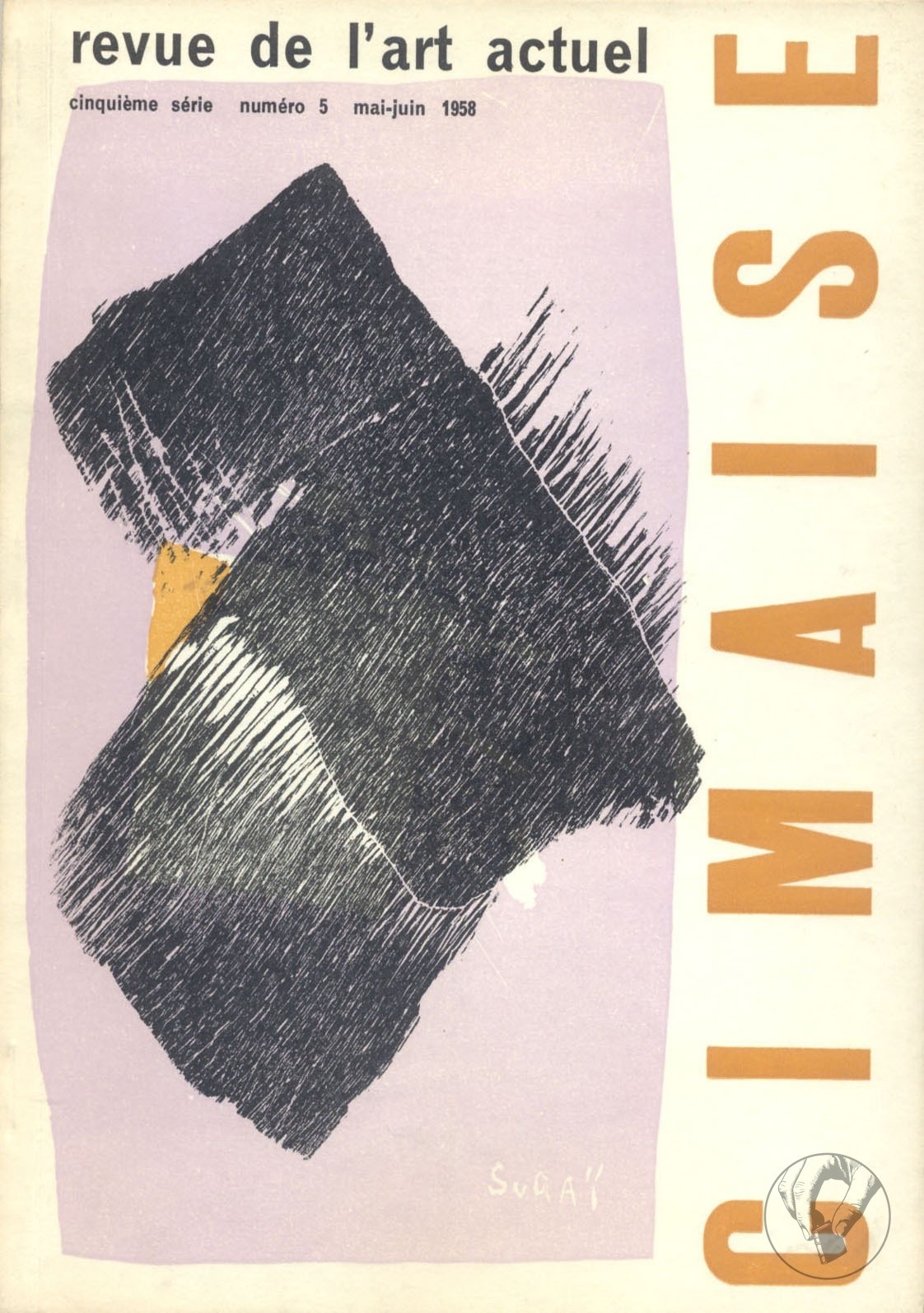
Cette publication de la revue d'art actuel "Cimaise" présente un numéro consacré à l'art contemporain japonais. Elle explore les échanges artistiques entre le Japon et l'Europe, comparant l'art traditionnel japonais, jugé étrangement moderne, à l'art moderne japonais, perçu comme plus conventionnel. Le numéro contient des textes en français et en anglais sur des artistes et des expositions, ainsi que des critiques d'expositions à Paris et New York.