Page 1
revue de l'art actuel cinquième série numéro 3 : janvier-février 1958 SIMAIS J. Dubuffet
First pages of the volume, freely accessible.
revue de l'art actuel cinquième série numéro 3 : janvier-février 1958 SIMAIS J. Dubuffet
Galerie de France 3 rue du Faubourg Saint-Honoré, Paris 8, Anjou 69-37 Anna-Eva Bergman peintures récentes février Pignon mars --- Galerie Louise Leiris 47 rue Monceau, Paris 8, tél. Lab. 57-35 Fernand Léger dessins et gouaches, 1909-1955 du 19 février au 22 mars tous les jours ouvrables, sauf le lundi de 10 à 12 h. et de 14 h. 30 à 18 h.
Galerie André Schoeller Jr. 31 rue de Miromesnil, Anjou 16-08 --- Pierre-Humbert du 6 au 31 mars --- Galerie Arnaud 34 rue du Four, Paris 6, Littré 40-26 --- James Guitet du 13 février au 5 mars en permanence : peintures de Barré, H.-A. Bertrand, Carrade, Coppel, Downing, Feito, Fichet, Gauthier, Guitet, Koenig, Panafieu, Flavio Tanaka sculptures de Marta Pan
Galerie Le Gendre 31 rue Guénégaud, Paris 6, Danton 20-76 --- Pierre Clerc du 7 au 29 mars en préparation exposition de gouaches de Corneille --- Galerie Arnaud 34 rue du Four, Paris 6, Littré 40-26 --- Berggruen et Cie 70 rue de l’Université, Paris 7 Picasso Klee Léger --- Minna Citron du 20 mars au 9 avril --- Drian Gallery 7 porchester, P.L.Marble Arch. Londres W.E. 2 exhibition: Baz, Brenson, Clemente, Clough, Jadot, Nalecz, Pink, Reid, Brothers Rich, Sjoholm, Van Haardt, Zangs ---
Arthur Tooth & Sons Ltd. (Established 1842) 31 Bruton street, London W.1. Mayfair 2920 Cables: Invocation. London Specialists in Paintings by old and modern Masters for Public Galleries and Private Collectors Canaletto, Guardi, Gainsborough, Constable, Delacroix, Corot The Impressionists, the post-Impressionists de Stael, Buffet, Riopelle Exhibition Jean Dubuffet 29th april, 23rd may 1958 --- Galerie 22 J.P.Wilhelm. Düsseldorf, Kaiserstr. 22 février-mars Fautrier peintures et gouaches catalogue sur demande --- José de Rivera represented by Grace Borgenicht Gallery 1018 Madison Avenue, New York --- Galleria Apollinaire Via Brera 4, Milano, Tel. 862821 février Fautrier mars-avril Soldati Schneider Meloni en permanence: Soldati, Fautrier, Licini, Hartung, Schneider, Meloni, Bryen, Helman, Laubiès, Bellegarde Brüning, Halpern
Cimaise revue de l'art actuel 34 rue du Four, Paris 6 Directeur : J.R. Arnaud Secrétaire général : John Koenig Rédaction : G. Boudaille, M. Ragon, P. Restany Herta Wescher La rédaction reçoit sur rendez-vous Abonnement (6 numéros) 1.600 frs - Par avion : 2.800 frs 34, rue du Four, Paris 6, téléphone Littré 40-26 C.C.P. Paris 5542.39 Diffusion : Allemagne : Librairie Hanna Weber, H.-J. Niepel, Dusseldorf 1, Grabenstrasse 11 Argentine : Editorial Victor Leru, Cangallo 2233, Buenos-Aires Autriche : Arnulf Neuwirth, Paracelsusgasse 8, Vienne 3 Belgique : Jean Milo, 28 rue de l’Arbre Bénit, Bruxelles C.C.P. Jean Milo, Bruxelles 1591.50 Italie : Le Noci, Via Brera 4, Milan Danemark : Meiners Kunstforlag, Peder Skramsgade 5, Copenhagen Grande-Bretagne : Alec Tiranti Ltd, 72 Charlotte Street, London W 1 Japon : Meiji-Shobo, Surugadai, Kanda Tokyo Norvège : J.W. Cappelen, Sortimentebokhandel, Oslo Suède : Eric H. Olson, Upplandsgatan 3, Stockholm, 10 23 77 Suisse : E. Genton, « L’Entr’acte », rue du Lion d’or 4, Lausanne, C.C.P. II 144-56 U.S.A. : Wittenborn and Co, 1018 Madison Ave, New-York 21 --- Ravel Peintures Jacques Massol 12 rue de la Boétie Paris 8 Aquarelles Lucien Durand 21 rue Mazarine Paris 6 --- Sommaire Couverture de Jean Dubuffet Textes anglais 7 Jean Dubuffet by Michel Ragon 9 Rushing waters and dried-up springs by Herta Wescher Textes français 11 Jean Dubuffet par Michel Ragon 23 Eaux vives et sources taries par Herta Wescher Visites d’ateliers 32 Don Fink par Herta Wescher 34 Delahaye par Pierre Restany 36 Lettre de New York par Dore Ashton 38 Les expositions par Georges Boudaille, René Déroudille, Michel Ragon, Pierre Restany, Herta Wescher Textes anglais 45 Delahaye by Pierre Restany 46 Don Fink by Herta Wescher From New York by Dore Ashton --- Galerie Hautefeuille 3 rue Hautefeuille, Paris 6* Abner du 21 mars au 17 avril --- Galerie Gérard Mourgue 9 avenue de l’Opéra, Paris, Opéra 52-07 Argov du 28 février au 14 mars
English translation by J. F. Koenig Dubuffet (p. 11) by Michel Ragon To try to make a complete study of Jean Dubuffet’s work in a few pages is quite impossible. This painter (but this word is improper for Dubuffet. It designates a specialization, whereas Dubuffet is at the same time writer, handyman, poet and sculptor. We had better say: this man) or rather this man-painter is so diverse, so inventive, he flies off simultaneously in such contradictory directions, that already in his work there is the work of a dozen “normal” artists. You don’t know from which side you should approach him. He’s been classed with the “brutes” and he comes up with highly-finished, joyous, and pleasant paintings. It was thought that he had fled expressionism going to a certain kind of textural abstraction, and he presents us with a painting of monstrous, slammed-on, hot-dang-it figuration. His production is, moreso, so considerable since fourteen years now, that it defies a rapid analysis. His anthological exposition at the Cercle Volney in March 1954, that brought together oil paintings, drawings, distemper painting, colored crayons, India ink, gouaches, lithos, water-colors, etc., the earliest of them going back to 1942, already gave us a catalogue of 193 works. These included the “Paris Views”, the “Thick-Pastes” (Mirobolus, Macadam and Co.), portraits (Handsomers than they think) to the “Beaten Batters” and “Momentary Places”, coming through the series of the Sahara, where Dubuffet went to work three times, the “Grotesque Landscapes”, the famous “Ladies’ Bodies”, the “Cavaliers”, the “Soils and Lots”, the “Stones for Philosophical Exercises”, the “Land-scaped Tables”, the “Inhabited Heavens”, the “Only slightly corporeal personages”. When you realize the fact that each of these titles designates a whole series, which is in itself a style and a discovery that many artists would be quite willing to repeat or adorn until the end of their days, or even after, if God willed it, you will understand the difficulty to speak of Dubuffet in a short space. Quadrum asked Fitzsimmons to write 7 pages on Dubuffet. He wasn’t finished before 50. I will hence begin to talk of Dubuffet’s work where Fitzsimmons left off, in the summer of 1957. From the 5th of September until the 15th of December 1957, in a little more than three months, Jean Dubuffet did 71 paintings. And it’s from these 71 completely new works, that have never been shown nor reproduced, that we will study his work. Since 1955, Jean Dubuffet lives principally in Vence, where he came because of his wife’s health. It was hence in Vence that I was able to examine, and discuss with the painter these recent works, all of them brought together in his studio before they were divided up between his dealers: Pierre Matisse in New York, and Facchetti and Cordier in Paris. When Dubuffet lent me a little school-boy’s copy-book in which all of these 71 works were meticulously counted up, by their style, with their titles, I was immediately astonished by the fecundity of the painter and his frank manner of admitting it. For painters today have moreso a complex about their fecundity. They would rather appear as sterile. The one who lays the least. The present-day policy of the dealers consists in presenting their painters as hens who lay golden eggs, who lay them infrequently and with difficulty, one egg each trimester at most, which explains the high price of each egg. Dubuffet, who doesn’t do anything like anybody else, who doesn’t show in any salon, doesn’t try for any prize, doesn’t participate in any group, works alone, in the same way that Georges Limbour spoke of him in 1942. Dubuffet was 40 year old at this time. He had sold his wine business, and ate up the sum while living just as he liked. You could find him at home, playing the accordeon in his wife’s company, or painting just anything that came into his head. Dubuffet had already tried out the career of painter several times before. This time, he painted without any illusions, as a “neurasthenic maniac”, which allowed him to dare anything. Limbour urged him to show, brought Paulhan around, who brought in turn Drouin. The show at Drouin’s in 1944 presented these works of 1942. Although he wanted to remain in this spirit of an amateur, things, he says, became commercial. But he has kept the idea that art is a delinquency, and finds it astounding that nations can support these opium eaters and erotomanias. Dubuffet tries to create an art with the means of a common man. It is thus that he has taken examples from the soldier that draws on the barracks walls, the child, simple people, those “who work things out in their hat” as he says—which are more commonly called the mentally ill—and primitive folk art. His book, the Prospectus aux amateurs de tout genre, edited by Gallimard in 1946, is for this reason important in order to understand his art. At the same time, it is an astounding work, with a very particular style. His way of writing is for that matter in complete agreement with his way of painting. His manner of talking, his behaviour, his very physical features, unite strangely with his unusual works. Dubuffet lives to such a degree in the world that he has created that you cannot make out the boundary line. Another of his texts, of capital importance, is his preface to the catalog of the large exposition of Art Brut, that took place in October of 1949. Here he defines his position against the intellectuals and cultural art, and claims that the professional artist loses all of his spontaneity and ingenuity, and that a charm is broken just as with the professional sportsman or the professional sweetheart. Ideas, he says, are a means of knowledge, but art is a means of clairvoyance. And he shouts his war-cry: “Long live the imbecile!” Let’s be clear. Dubuffet is not an imbecile. He is a professional artist and intellectual. So, how can we explain this to you? A friend, the poet Jean l’Anselme, under Dubuffet’s influence, began ten years ago to write with his left hand in order to render his thought clumsy, to disintellectualize it. An intellectual way of going at it, certainly, but which brought him back to the fountainhead. L’Anselme today writes his poems with his right hand, but in the naivistic style that his experience with his left hand gave him. Dubuffet is a cultivated man, extremely intelligent, who decerebralized himself in the same manner by making himself paint like those who don’t know how to paint. He has also written like those who don’t know how to write, little books whose titles are already quite something: Ler dla campane (Kuntree er) 1948, Plu Kifekler moinkon nivoua (Moritz elir lezyusy) 1950, Labonjam abeber (Alz olwummen) 1950. Of this sensational collection of Art Brut (Raw Art) that I personally consider as something that had an important role in my development as an art critic, never missing a single one of the shows in the basement of the Galerie Drouin in the Place Vendôme at first, or later in the Pavillon Gallimard from 1948 on, there only remains at Dubuffet’s some albums full of photos. The original pieces today make up the Museum of Art Brut on Long Island, N.Y., at the home of the american painter, Ossorio, who showed previously at Facchetti’s, and about whom Jean Dubuffet wrote a book in 1951. The painters and sculptors of art brut, most of them mental patients, were taken as examples and “stimulants” by Dubuffet. * The recent works of Dubuffet can be separated into seven principal categories. Some of them continue old series, others are innovations. First we will study those that have precedents in his work. The graffiti show us personnages “drawn like children do” engraved into the medium. They are related to the traditional calligraphy of the mannikins crudely drawn on walls, the obsessed drawings of the urinals, the signs found in all public places. Aren’t they the Altamira of the “vulgar” man of the 20th century? It is without a doubt that Dubuffet remained in a field of experience close to the “vulgar public”, from his first
paintings in 1943 until his show at Nina Dausset’s, in February 1950, for Jean Paulhan’s book: “La Métromanie ou les dessous de la capitale” (Métromania, or the Underground of the Capital), that is haunted by the subway and its fauna. The crowds of the subway are, for that matter, strangely dubuffetian. They allow us to perceive how much Mirobolus, Macadam, et Co are much nearer to our human condition than the Hermes of Praxiteles. His 5 Tables make use again of an old idea. The Museum of Modern Art in New York possesses a “Work Table” of 1951. Dubuffet comes back to this theme in 1952, at the same period as the “stones”. Dubuffet’s tables are pretext-tables. His table (of serenity) is a magnificent, hallucinating picture, like a mirror that shows no image. His “Bare Table” is moreso an animal’s rear (Dubuffet no longer paints cows since his Cow series three years ago, but some of these tables become cow-tables). There is also a “Bestial Table”, a “Venerable Table”, a (melting) “Table of Offerings”. The painter uses the word table in its metaphysical sense, and it’s this that gives an alarming impression to some of them. They remain ambiguous, something between the Communion Table, the sacrificial table, the logarithm table, the table of contents, the Tables of the Law, and the cleared table. His 15 Varied Paintings represent personages such as the “Old sagacious dotard”, figurative paintings close to those shown in previous years at Drouin’s in the Place Vendôme, but painted differently. We should notice, for that matter, that Dubuffet no longer introduces unusual materials into his paintings, but tries to obtain the same effects of his previous period without making use of thick matter. Just at the moment when a thick medium became à la mode, Dubuffet (who, with Fautrier, was one of the first to scandalize people, with his “thick paste” paintings, in 1945) paints today with oil-paints, mixed with nothing else, in an almost applied manner, which on the whole is classic. He no longer puts on the paint with his fingers, but uses a spatula, broad brushes, housepainter’s brushes. For certain of his meticulous paintings, such as his Soils, he even uses a tiny brush. Among the 15 Varied Paintings, we find certain groups of heads, like those that always seemed to me to have certain analogies with romanesque art, and a “Grilled Beef” which shows the “henormous” (in Jarry’s meaning), gargantuish side that seizes hold of Dubuffet from time to time, for he sways perpetually between a violently expressionistic figuration and a completely “purist” type of abstraction. I really mean a purist abstraction, at least in the way that we mean today, and Dubuffet never went so far in this direction as in his very recent Texturologies. These 16 Texturologies were done as topographies, which are a type of assembled pictures. For these assemblages, be they paintings on paper or on canvas, Dubuffet begins by painting these textural paintings, then he cuts them up, imagining compositions by bringing together the different elements of numerous cut-up paintings. But the painter perceived that certain textures had a certain plastic value in themselves, and he kept sixteen of them to which he gave the titles: “Profuse Serenity”, “Wet City Sidewalk”, “The mechanism for erasing traces”, “Gray Sidewalk”, etc. Imagine the gravel before your door, the bare sand, the beaten earth, and you will have an idea of these paintings from which all anecdotic figuration is excluded. They are really paintings where nothing takes place. Rare are the abstract painters who have gone as far in their abandon of all “figuration”. And it’s just because of the fact that these soils that have been taken as models are, as Dubuffet says, “uninteresting, completely un-picturesque, that we can use them in order to transport our imagination into high metaphysical spheres”. Dubuffet, in recent years, is for that matter haunted by the idea of painting the things that are the most difficult to “represent”: the rushing mountain brooks, the waves of the sea, dust... In his important “Traité des Empreintes” published in the review Les Lettres Nouvelles in April 1957, Dubuffet writes: “It’s a kind of vice: I have always liked to begin working with the most common of materials, those that you don’t think of using in the beginning because they are too vulgar and familiar, and not good for anything (1). I like to proclaim that my art is a rehabilitation of disparaged goods. Thus for these elements, that because of being so ordinary no one no longer sees them, I have a far greater interest. The voices of dust, the soul of dust interest me much more than the flower, the tree, or the horse, for I feel them far more strange.” Dubuffet would like to realize a “fine opera of the soil”. He has thought about this for quite some time now. Already in 1945, he experimented with lithographic structures in order to illustrate Guillevic’s poem “Les Murs” (The Walls), published in 1950. The “Sols et Terrains” (“Soils and Lots”) of 1950-1953 link up with the “Pierres d’exercices philosophiques” (Stones of philosophical exercise). At Vence, he was highly impressed by the little uncultivated gardens, the stones, and the walls, and is letting himself go towards a metaphysics of gardens, just like his metaphysics of tables. 5 Soil paintings bring us back to the painter’s present idea of trying to come to effects of pure paint, where drawing would have no place. Incessantly he comes back to this idea in his conversation of making a painting with very little, hardly any drawing, hardly any colors, hardly any elements. This also has to do with his “portraits” and his “landscapes”. The 25 other recent works are Assemblages of oil paintings on paper (topographies, and various portraits, personages, etc...) and Assemblage Pictures among which are to be found two Doors that must specially be mentioned, for the Doors, just as the Tables, risk becoming one of Dubuffet’s themes. One of these doors is very naturalistic, but it seems to be placed upon a throne. It is probable that these dors will also become ambiguous and become the door to happiness, and the door to death, etc. Why assemblages and not collages? Simply because we have to do with two different procedures. Collages are pictures made from heteroclite elements: newspapers, bus tickets, different kinds of paper, sometimes a bit of paint... Dubuffet’s collages are pieces of Dubuffet’s paintings assembled together. We can well remember his beautiful show at the Galerie Rive Droite, in April-May 1957, made up of 38 paintings of “assemblage pictures” and 15 “assemblage of impressions” in India ink. He already wanted, at that time, to have a show of only impressions, not cut up, just as he takes the risk today of showing his texturologies just as they are. In the same idea of assemblage, we must mention another successful venture of Dubuffet, with his butterfly wings, that formed personages as precious as rare gems. *** Up until now, I had often written about Jean Dubuffet’s work, but I had never conversed with him. Thus I profited in the rare good fortune that allowed be to spend two days with him, at Vence, to ask him certain questions. I had written that I didn’t consider Dubuffet as being completely detached from the history of art, as his friends and his enemies claimed. It seemed to me that Dubuffet’s art was linked with romanesque art and german expressionism. “The romanesque painters and sculptors”, said Dubuffet, “came about as a reaction against roman mannerism. They had, in fact, that same state of being that within me reacts against present-day mannerism, the same tendency towards a search for an innocent, magical art. The same wind blew, undoubtedly, through the works of Goya, Manet, Cézanne, Van Gogh. In each period, one must renew the equation.” “And German expressionism?” (1) The “Petites Statues de la Vie Précaire” took birth from the same preoccupations. Shown at the Galerie Rive Gauche in 1954, there were 44 works made up from newspaper, steel wool, clinkers, sponges, talc stone, grapevine roots, tow, charcoal, stones, lava...
“Kokoschka, of whom I saw a show in Munich after the war, amazed me. All of Soutine is to be found here.” “What do you think about Ensor?” “Undoubtedly he had a similar idea, but he didn’t follow it through. He only went half-day.” “On the other hand, there seems to me to be closer contacts between your first works and those of Rouault?” “Rouault was working in the same direction. But today, I find him boring. On the other hand, I am more interested by Chagall, and specially without any reserves for Klee and Kokoschka. Klee was also very interested in folk-art and children’s paintings, by graffiti and drawings of the insane. He certainly knew of the book consecrated to the work of the mentally ill compiled by Dr. Prinzhorn, a german doctor who collected drawings and sculptures by the insane. I went to see his collection in Heidelberg, after the war. Everyone has taken something from it (Dali, Max Ernst, etc.). This book also struck me, and led me on to something else.” “You have lived in the States; who are the American painters that interested you most?” “Only three: Pollock, Ossorio, and Ivan Le Lorraine Albright. The latter lives alone, comfortably stopped away from this century. They always thought in the States that I mentioned him in order to be original, but I was sincerely very enthusiastic about this work and this man.” “And the Pacific School?” “It doesn’t exist. It’s pure invention. There is only Tobey who works out on the West Coast, just like me on the Riviera. It’s just as false as if it were that with me, there was a Riviera School.” “What do you think of informal art, that came from yours, Fautrier’s and Wols’ work?” “It interests me, but I find it paltry, with its clouds of smoke, and not very deeply felt. It’s a new mannerism. Everything that becomes a joint movement seems suspicious to me.” “Don’t you believe however that it is the disciples and the snobs who create the pictorial social system, and who propagate, in doing this, the work of the real creators?” “Yes, but how Matisse would seem marvelous to us if he didn’t have so many imitators! And Picasso! And even Klee whom I admire so much!” The diversity of the experiences, the expressions, the techniques, the “figurations” cause Dubuffet’s work to be an exceptional phenomenon. Today, it is undoubtedly sufficiently accepted that Dubuffet is one of the major artists of our time, that it is useless to insist upon this fact. He is one of the rare creators who is turn by turn hieratic (classical) and baroque, going from one to the other without any transition. Whereas others have a tendency towards cultivating their present period, refining it, and slumbering in the intellectual (and commercial) comfort of a patented style, Dubuffet ceaselessly calls his work into question. When asked why he does this, he replies with the modesty and politeness that is constant with him: “It’s because I am unstable and anxious.” If he constantly changes his “manner”, it’s to keep his art from going dry. He likes his paintings with heavy and earthy matter, done in relief and thickness. But he likes as well the paintings made with layers of thin glazes, transparent and smooth as mirrors. In 1954, he executed 34 lacquer paintings, among which were to be found the Cows, an animal beloved by the painter, who makes a sort of ridiculous puppet out of them. In the same way, he goes from ocher and brown tones to colors as vivid as precious gems. Laziness, negligence, precipitous haste—these are the virtues and the directives logics that Dubuffet generally imposes on his paintings on the “Whipped Batter” type. To reverse the procedures of art causes one to constantly be on the edge of catastrophy. Thus Dubuffet paints with an impression of dizziness. He says: “I am always on the borderline of filthiness, of the squalid, of daubing, and of a little miracle.” And it’s this “little miracle” (just like Cézanne’s “little feeling”) that makes up all of the art, the great art of Jean Dubuffet. Michel Ragon Rushing waters and dried-up springs by Herta Wescher (p. 23) Since the big exhibition of Cubism in 1953, at the Musée d’Art Moderne, that showed, in a striking manner the primordial role of this movement in art evolution of the years before the first world war, others shows in the galleries have followed one after the another, showing us many secondary artists who worked along side the great masters. The last one that we have seen was Survage, who has just had a well- merited show at the Galerie de l’Institut, that is particularly interested by this type of historical recollection. A fine still-life of 1913 clearly showed that it belonged to the Cubism of the time, adopting its principle of a composition of superposed planes, and at the same time bringing a personal note by the animated contours of accumulated objects. This independence that seems to come from a profound attachment to the everyday world, was maintained in his later canvasses: landscapes with cottages and primitive trees, assembled together like toys, and forming a spacious setting around little silhouetted personnages. Specially attractive are the numerous watercolors of 1920-1921, painted with supple lines and tinged with subtle colors: works of an intimate charm that have rightly been recalled to us. The ensemble of all of these cubist shows has, however, clearly shown that in spite of its historical interest, this movement has lost all of its topical interest. Since this time, art has taken a different direction, and the young generation of today shows an indifference towards these ancestors that is almost indecent. They are hardly more grateful towards the non-figurative forerunners, except for a few. The unlimited autonomy that art has gained since the last war seems to obsess artists’ minds, and does not allow them to look backward. In the nervous haste of the creative thrust, the different periods can be counted off moreso with the years rather than with the decades, and only the works of the period between the two wars, that show themselves as the direct preliminary works of today’s tendencies gain admiration that often seems exaggerated. So it is not surprising to see the survivors of this “first generation”, their executors and their legal advocates oppose themselves to this quarantine. Recently, we have seen a coordinated movement taking place to rehabilitate them, through shows that recalled their avant-garde role, or by shows giving witness of the continuity of their work. Since we have found here many painters of very different tendencies, we had the opportunity of verifying, among the various currents that were at the origin of the evolution of the art of today, those that have kept their importance and those that have faded away. Sonia Delaunay was right to have exhibited her and her husband’s early works, that show the daring departure of their painting. Seeing that Robert Delaunay’s important exhibit was still fresh in our minds, it was quite normal that the Galerie Bing showed us more of Sonia’s work than that of her husband; but the small selection of his things included several fine works such as the ravishing little “Circular Forms, Sun” from 1913, an early drawing of the Eiffel Tower, and a very lively sketch of “Foothall”, done in Portugal. The evolution of the two Delaunays took place with a mutual inspiration and a mutual enthusiasm for breaking down the barriers of all the traditions. The parallelism of their mutual directions begins already with the works of 1909: Sonia’s embroidery of leaves, and Robert’s “Begonias” have the same internal movement that is based on the rather ornamental cursive lines. In 1912, the brilliant colors give a sudden lyricism to their painting. Refracted light decomposes the forms, drawing them into a rhythmic rotation. The compositions are still based on real subjects, Robert with
his structures of windows and the Tower, Sonia interpreting the more spontaneous impulses of street scenes; dancing lights, the swarming crowds, the brightly-lit windows becoming “electric prisms” with palpitating forms. The abstract transposition becomes the most curious with the autoportraits of 1915-1916, where, through the refractive lenses, the face is only shown in circles and colored disks. During the couple’s stay in Portugal, during the first war, the subjects in nature took on renewed importance, perhaps due to the fact that the warm colors of the country lent themselves easily to pictorial metamorphoses. But their temperaments were different: Robert’s still-lifes emit a virile vitality, whereas Sonia’s sketch of the Market at Mihn’o shows us moreso a reserved poetry. Her figurines and drawings for the “simultaneous dresses” of the following year, on the contrary, manifest the inventive freshness of the artist, who, from this time on, intends to impose a new style on fashion as well as for the surroundings of everyday life. Her recent works, that completed the show, showed her faithfulness to their principles that had been established once and for all. With the same colored elements, she still finds new solutions, sometimes founded on the concentration of the forms in the middle of the flat background, sometimes on the multiple movements of the circles and spirals. If these experiments no longer interest the spectator as much as the artist, their point of departure, that one may attribute either to Robert or to both of them, may serve as a model for many of today’s artists, to show them how allow themselves to let the transforming agents of the visible world react on their abstract imagination. Colette Allendy’s idea of presenting the work of Gorin of 1921-1927 was much less inspired, showing the artist passing from one movement to another, from a post-Cubism tinged with Braque to a Purism of Ozenfant and Jeanneret, and on to a neoplasticism that is pure Mondrian. Of course, there is an internal consistency in this development. After the first “imaginary landscapes”, the need for a formal discipline shows itself in still lifes of closed and tight compositions, that sometimes have an intensely somber scale of color. Then, the volumes flatten out and the plane areas fit themselves together into a geometric order, opposing themselves to any spatial prolongation. A bit farther on, the contours are retracted into straight lines, and in 1927, Gorin makes his first clearly rectangular composition. Unfortunately, this show did not present us with any of the works created since this time, of the same puritanistic style, but enriched with diagonals and sometimes elevated from the background in mural reliefs: constantly renewed and delicate variations of the neoplastic ideal, of which he has become one of the most active propagators. From the same year of 1927 come the few old canvasses that Charchoune included in his show at the Galerie Chaudun; they were remarkable little still-lifes, where fruit and objects were ranged beside one another, stripped of all their concrete substance, and becoming strictly elements of matter and textures. Charchoune, who arrived in Paris in 1912 from his native Russia, has passed through other stages, both cubist and dadaist, but it is only his present-day painting that counts for him, a painting created from musical inspiration. As he says himself, he is in nowise a musician who is capable of making out the particularities of the mode or structure of the pieces that he hears, and trying to find their pictorial synonyms. He goes to concerts regularly, for they bring him to a state of enchantment that suggests images of colors to him. These images may be very different, even for different auditions of a same symphony. To the canvasses of multicolored, warm, or strident tones others are opposed that are monochromatic, with subtle nuances of beige or white: it is these latter that seem to me the most sonorous. Sometimes the strict framework of horizontals and verticals support powerful striking chords, sometimes melodious voices are written in very stylized arabesque lines, acknowledged by the artist as being highly decorative. If the great classic masters such as Bach and Beethoven are his favorites, and he borrows their constructive forces from them, the romantic musicians can also marvel him, his compositions becoming full symbolic forms. By a personal decision, Charchoune goes back to certain tendencies of “art nouveau”, which in Russia (see Tchurlianis) and elsewhere preceded abstract art, making up a specific movement that the musicalists around Valensi still pursue with a determined symbolical goal. Around this time, Kandinsky also began with an “art nouveau” type of painting impregnated at first by the decorative spirit of russian folk art, and later adapted, in Munich, to the “Jugendstill” typical of this city. But from this groundwork, he soon undertook the necessary step towards a liberated art that was to profoundly mark the art evolution of this century. By far the most eminent of all the russian painters who have left their country, he only established himself in Paris thirty years after Sonia Delaunay, Survage and Charchoune, and his influence on the Paris School only began to be really important a few years after his death, in 1944. Today, the young generation, that has set aside all of the formal pictorial problems in order to try out all of the unlimited possibilities of expression of nonfigurative art, is conscious of the initiative action that Kandinsky made along this line. In the two expositions, at the Musée d’Art Moderne and at the Galerie Maeght, it is the works done between 1910 and 1914 that show themselves as being closest to us. Specially in the watercolors, that mark the passage towards purely abstract painting, where the form explodes, the lines rush about, the colors burst forth: here we have the true source of the informal art of today. And the power of the large canvasses that follow, running over with volcanic force but held in by his creative will, has infrequently found an equal even to our day. The outside world that is transformed in these highly original improvisations marks them with a vital imprint that in no ways repulses the young painters who are again ready to accept all of the possible inspirations coming from the outside world in order to fecundate their abstract imagination. The canvasses of the Guggenheim Museum, shown at the Musée d’Art Moderne allow us to follow Kandinsky’s evolution during these decisive years. In the beginnings, we find landscapes where mountains, trees, and human figures still subsist through a few decided contours, but the colors finally invade and gain the whole, sweeping off the lines in their frenzy. Once Kandinsky has conquered his liberty, he progresses on, clarifying his compositions, untangling the zig-zags, circling the spots of color, precising the relations between the different elements, and ending up with canvasses and watercolors full of sonorous and dramatic harmonies. At the Bauhaus, he felt the need to define as exactly as possible the significant values of the forms and colors, and put a brake on his exalted expression, and the balance becomes more static. The geometric elements, however, that dominate this period, are always clothed with a strange poetry, and opposed to all calculated thought. The fairy-tale atmosphere is heightened even more when, later, the multitudinous motifs of oriental mythology glide in among the abstract form. But with the years, Kandinsky’s élan becomes more temperate, and in the works of the last period of Paris, a refined subtleness replaces the initial vehemence. The fiery symphonies of yesteryear are transformed into chamber music, played on the pure string instruments, with neither wood nor brass instruments. Kandinsky creates compositions in all of the modes, insisting on the ensemble of the voices, on the laws of counterpoint, on the brilliance of the melodies. The watercolors and gouaches of Nina Kandinsky’s collection that were shown at the Galerie Maeght were striking with their inexhaustible richness, covering the walls of the gallery like the leaves of a big picture-book, holding back the surprises of each page. The clear and rodered spirit that is shown in some of the works masked by mysterious veils in others; the pleasing and gracious colors found in the former ceding to the chatoyant nuances of the transparent textures of the latter. In these intimate works, that are the fruit of the utmost concentration, each line, each touch is measured, but nothing is
Jean Dubuffet par Michel Ragon Vouloir faire une étude complète de l'œuvre de Jean Dubuffet, en quelques pages, est impossible. Ce peintre (comme ce mot sonne mal pour Dubuffet. Il désigne trop une spécialisation, alors que Dubuffet est en même temps écrivain, bricoleur, poète, sculpteur. Il vaudrait mieux dire : cet homme...), cet homme-peintre est si divers, si inventif, il part en même temps dans des directions parfois si contradictoires, qu'il y a dans cette œuvre déjà l'œuvre d'une dizaine d'artistes « normaux ». On ne sait par quel bout le prendre. On le classe dans la « brutalité » et il nous arrive avec des tableaux figolés, joyeux et jolis. On pense qu'il a fui l'expressionnisme pour une certaine abstraction de textures et il nous présente un tableau d'une figuration monstrueuse, empâtée, cornegidouillesque. Sa production est, de plus, si considérable depuis quatorze ans, qu'elle défie l'analyse rapide. Son exposition anthologique au Cercle Volney, en mars 1954, qui réunissait des peintures à l'huile, dessins, peintures à la colle, crayons de couleurs, encre de Chine, gouaches, lithos, aquarelles, dont les premières remontaient à 1942, recensait au catalogue cent quatre-vingt-treize œuvres. Celles-ci allaient des « Vues de Paris », des Hautes-Pâtes (Mirobolus, Macadam et Co.), de portraits (« Plus beaux qu'ils croient »), aux Pâtes battues et « Lieux momentanés », en passant par les séries du Sahara où Dubuffet alla travailler à trois reprises, les « Paysages grotesques », les fameux « Corps de Dames », les « Chevaliers », les « Sols et terrains », les « Pierres d'exercices philosophiques », les « Tables paysagées », les « Ciels habités », les « Personnages peu corporels ». Quand on songe que chacun de ces titres désigne une série, qui est déjà un style en soi et une trouvaille, dont beaucoup d'artistes se contenteraient de répéter ou d'agrémenter la chose jusqu'à la fin de leurs jours, et même après si Dieu veut, on comprendra la difficulté de parler de Dubuffet en se comprimant. Quadrum avait demandé sept pages à Fitzsimmons, sur Dubuffet. Il n'a pas pu s'arrêter avant la cinquantième. Je reprendrai donc l'œuvre de Dubuffet où Fitzsimmons s'arrête, l'été 1957. Du 5 septembre au 15 décembre 1957, c'est-à-dire en un peu plus de trois mois, Jean Dubuffet a réalisé soixante et onze peintures. C'est à partir de ces soixante et onze œuvres nouvelles, inédites (non encore exposées, ni reproduites) que nous allons étudier l'œuvre de Dubuffet. Depuis 1955, Jean Dubuffet vit principalement à Venice où il fut amené à s'installer en raison de la santé de sa femme. C'est donc à Venice que j'ai pu examiner, et discuter avec le peintre, de ses œuvres récentes toutes réunies dans son atelier avant d'être partagées entre ses marchands : Pierre Matisse à New-York, Facchetti et Cordier à Paris. Lorsque Dubuffet m'a prêté un petit cahier-écotier sur lequel étaient méticuleusement recensées ces soixante et onze œuvres, par genre, avec les titres, j'ai été tout d'abord étonné par la fécondité du peintre et la franchise avec laquelle il l'avouait. Car les peintres ont plutôt, aujourd'hui, un complexe de la fécondité. Ils veulent paraître stériles. C'est à qui pondra le moins. La politique actuelle des marchands de tableaux consiste à présenter leurs peintres comme des poules aux œufs d'or, dont la ponte est incertaine et difficile, un œuf par trimestre, au plus, ce qui explique le prix élevé de l'œuf. Dubuffet, qui ne fait rien comme les autres, qui n'expose dans aucun salon, ne veut concourir à aucun prix, participer à aucun groupe, travaille isolé, dans le même état d'esprit que nous le montre Georges Limbour, en 1942. Dubuffet avait alors quarante ans. Il avait vendu son commerce de vins, et mangeait le fonds en vivant à sa guise. On le trouvait chez lui, jouant de l'accordéon en compagnie de sa femme ou peignant tout ce qui lui passait par la tête. Dubuffet avait essayé de commencer une carrière de peintre à plusieurs reprises. Cette fois-ci, il peignait sans espoir, en « maniaque neurasthénique », ce qui lui permettait de tout oser. Limbour l'incita à exposer, lui amena Paulhan, qui lui amena Drouin. L'exposition chez Drouin, place Vendôme, en 1944, présentait ces œuvres de 1942. Bien que voulant rester dans cet état d'esprit d'un amateur, les choses, dit-il, se sont commercialisées. Mais il conserve la notion que l'art est un délit et trouve incroyable que des nations puissent appointer des fumeurs d'opiums et des érotomanes. Dubuffet cherche à faire un art avec les moyens d'un homme du commun. Aussi, a-t-il pris pour modèles le militaire qui dessine sur les murs d'une caserne, l'enfant, les gens simples, ceux « qui travaillent du chapeau » comme il dit et que l'on nomme plus officiellement les malades mentaux, les primitifs populaires. Son livre : Prospectus aux amateurs de tout genre (Gallimard, 1946) est, à ce titre, important pour la compréhension de son art. C'est en même temps un ouvrage étonnant, d'un style très particulier. L'écriture de Dubuffet est, en effet, en parfait accord avec son œuvre peinte. La manière dont l'homme parle, son comportement, son physique même, font étrangement un tout avec l'œuvre insolite. Dubuffet vit à un tel point dans le monde qu'il a créé que l'on ne voit pas de ligne de partage. Un
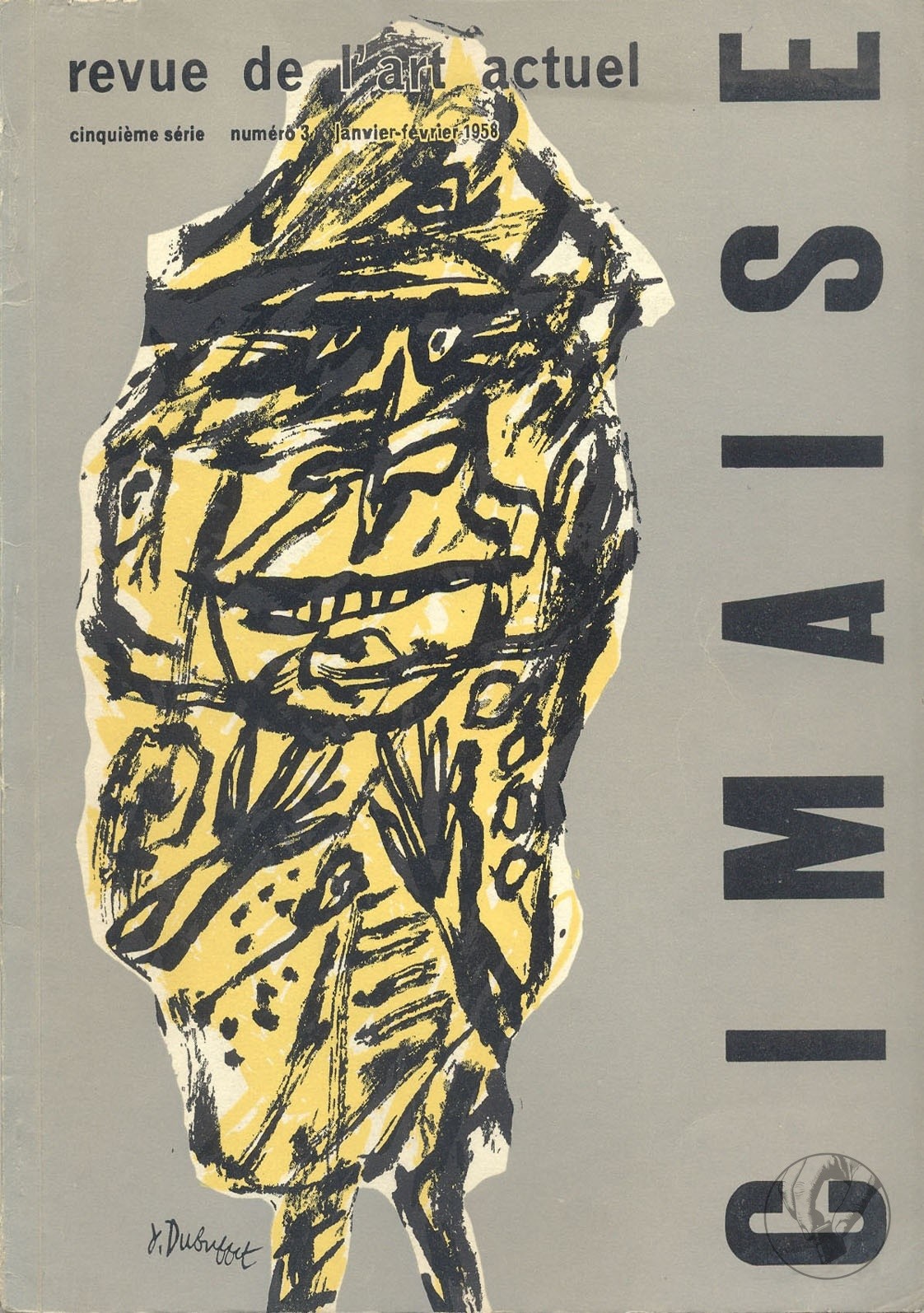
Cette publication de la revue de l'art actuel, numéro 3 de la cinquième série, couvre la période de janvier-février 1958. Elle présente des articles sur l'artiste Jean Dubuffet, avec des textes de Michel Ragon et Herta Wescher, ainsi que des critiques d'expositions et des visites d'ateliers. La revue détaille également les expositions en cours et à venir dans diverses galeries à Paris et à l'étranger.