Page 1
BROM V. I F. D. A. NVIER
First pages of the volume, freely accessible.
BROM V. I F. D. A. NVIER
BROOM AN INTERNATIONAL MAGAZINE OF THE ARTS PUBLISHED BY AMERICANS IN ITALY EDITORS, HAROLD A. LOEB, ALFRED KREYMBORG — ASSOCIATE EDITOR, GIUSEPPE PREZZOLINI JANUARY, 1922 VOL. I, No. 3. Page --- COVER DESIGN (WOODCUT) — FERNAND LEGER --- SNAKES, MONGOOSES, SNAKE-CHARMERS AND THE LIKE — MARIANNE MOORE --- TRAGIC MASK — GORDON CRAIG --- DEDICATED TO THE ENEMY — GORDON CRAIG --- MASK FOR SEA-CAPTAIN — GORDON CRAIG --- PROSE POEMS — JOHN GOULD FLETCHER --- IF YOU HAD THREE HUSBANDS — GERTRUDE STEIN --- TWO PAINTINGS — RAOUL DUFY --- LADY OF SORROWS — SHIRLEY L. SEIFERT. --- STILL LIFE — ARDENGO SOFFICI --- CHATEAU DE SOUPIR: 1917 — MALCOLM COWLEY --- SOMETHING TELLS — DAVID ROSENTHAL --- THE JACK OF DIAMONDS — ELIE EHRENBOURG (TRANS. BY H. A. L.) --- TWO DRAWINGS OF CHARLIE CHAPLIN — FERNAND LEGER --- GIOVANNI PAPINI — GIUSEPPE PREZZOLINI (TRANS. BY DOROTHY KREYMBORG) --- CARICATURE OF PAPINI — SOFFICI AND CARRA --- CLOISONNÉ — GRACE HAZARD CONKLING --- TWO POEMS — HILDA CONKLING --- CANDY CIGAR AND STATIONARY — WALDO FRANK --- TWO POEMS — ALFRED KREYMBORG --- PAINTING — JUAN GRIS --- PROFOUND TODAY — BLAISE CENDRARS (TRANS. BY H. A. L.) --- PROTEUS — PAUL CLAUDEL (TRANS. BY JOHN STRONG NEWBERRY) --- TRINKETS — WILLIAM SAPHER --- DRAWING — WILLIAM GROPPER --- BROOMIDES --- POEM — JOHN GOULD FLETCHER --- The Editors of Broom will be pleased to consider mss. submitted to them, but all mss. must be accompanied by a self-addressed, stamped *envelope. The Editors cannot hold themselves responsible for loss of mss. in transit. Mss. from Europe should be sent to the Rome office; mss. from America to the New York office. The price of Broom is: For America, fifty cents the copy, and five dollars for a year’s subscription. For Italy, 10 lire the copy, and 100 lire for a year’s subscription. For France, 6 francs the copy, and 60 francs for a year’s subscription. For Great Britain, 3/6 the copy, and one pound and fifteen shillings for a year’s subscription. The contents of this issue are protected by copyright, January, 1922. Infringement of same will be prosecuted. HEADQUARTERS, 18, TRINITÀ DEI MONTI, ROME (6), ITALY. NEW YORK OFFICE, THREE EAST NINTH STREET. LONDON OFFICE, CECIL PALMER, OAKLEY HOUSE, 15-18 Bloomsbury St., W. C. I.
SNAKES, MONGOOSES, SNAKE-CHARMERS AND THE LIKE. I have a friend who would give a price for those long fingers all of one length — those hideous bird's claws, for that rich looking snake and the mongoose —. products of the country in which everything is hard work, the country of the grass-getter, the torch-bearer, the dog-servant, the message-bearer, the holy-man. Engrossed in this distinguished worm nearly as wild and as fierce as the day it was captured, he gazes as if incapable of looking at anything with a view to analysis. "The slight snake rippling quickly through the grass, the leisurely tortoise with its pied back, the chameleon passing from twig to stone, from stone to straw," lit his imagination at one time; his admiration now converges upon this: thick, not heavy, it stands up from its travelling-basket, the essentially Greek, the plastic animal, all of a piece from nose to tail; one is compelled to look at it as at the shadows of the Alps imprisoning in their folds like flies in amber, the rhythms of the skating-rink. This animal to which from the earliest times, importance has attached, fine as its worshippers have said — for what was it invented? To show that when intelligence in its pure form has embarked on a train of thought which is unproductive, it will come back? We do not know; the only positive thing about it is its shape, but why protest? The passion for setting people right is in itself an afflictive disease. Distaste which takes no credit to itself is best. MARIANNE MOORE.
GORDON CRAIG. Tragic mask.
DEDICATED TO THE ENEMY. With a prayer that they will be stronger more malicious and anyhow funnier than they have been in the past. I. Have I made a mistake...? I mean am I playing the game...? To begin with, is it Hockey — Polo — Cricket — Politics, or is it Theatres? Which of these Games have we come here to play? I must say that I was of the opinion that the Game was Theatres. And I am forced to add that I even took Theatres to be a game as good as the best, and to be played according to the best rules of the Tradition. These rules, as we all know or can find out, date far back and are not the invention of any one city. The conditions under which this game is played are sometimes poor — it rains or it shines — but if it is not always fair weather it is not always foul — and if it is really Theatres that we are playing I think everyone who cares about Sport will agree with me that it’s just as easy to play the game fairly and squarely — even if since time immemorial it has been played by some nations, groups — even groups (small groups) in our nation — in anything but a fair and square manner. It is a game — it is a sport — this playing at Theatres. I know you’ll all admit so much.... The first point I am doubtful about is whether it’s Theatres that our Stage folk are playing at to-day or something else — and then whether I and they are both playing the game straight. If I am, they are not; if they are, then I am not. Who is umpire? There seems to be but one, and that is the Public. Yet the Public does not act as umpire at the decent game of cricket. One expert, skilled and watchful, careful and just, decides. I suppose then that it is the Critics who act as umpire in our game. Mr. Lamb, Mr. Hazlitt of old; Mr. Shaw, Mr. Beerbohm but just lately, and now Mr. Walkley, Mr. Pitt Robbins, and presumably Mr. Archer forever. Now I never knew anyone less fitted to be an umpire in the Theatre game than Mr. Archer.
A very remarkable man, a scholar, qualified for any post in the Government service, worthy, I am told, even to be ambassador, this extraordinary figure does not really know what is to be known about the Theatre... and is therefore utterly disqualified to give the lead to Dramatic Criticism. To whom then can I put the query “How’s that, umpire?” when I see that our umpire has no notion of what’s what? And if, even in so humble a place as that of umpire we find the wrong man, then, at the crucial moment, when the field cries “How’s that, umpire?” what harm may not happen to the old game?... a chaotic state may result... trickery licensed. Of Mr. Archer’s opinions I will not speak. They are as good as another man’s... in matters of state, in matters of Carnegie and other trusts I hear they are infallible. It is his facts, his dates, I am concerned with. What was, and when it was, is what Mr. Archer should know... and doesn’t know. When he wrote that old libel “The Fashionable Tragedian”, he proved what a diplomat he might have become, but he ticketed himself once and forever as no critic... A critic must be impartial; must not take sides. It’s the thing, the game itself, he is to think of; and to think of that — to discern, to judge, a critic must know. He may not be able to write plays (I hear Mr. Archer writes admirable plays); he may not be able to act, to design, or to direct; but he must know how it’s done... what its difficulties... and what is the history of the craft of playmaking, acting, mise-en-scène, décors, lighting, costume, and the history of the different developments which have taken place in our Theatrical Art in Italy, in France, in Germany, Spain, Russia, and eight or ten other parts of our globe. He must know this of modern developments not merely from hearsay... he must have seen and heard and recorded for himself. But he must not dream that the facts recorded of the years 1866 to 1916 is all that he need to know: nor those facts culled from the usual text books, for the usual text books are trash. They repeat the same old fibs with the same young flourish. The same actors’ names are mentioned over and over again... the same references made to the same celebrated actresses... and meantime some of the most interesting performers’ names are utterly forgotten... and some of the greatest. Theatres such as Covent Garden, Drury Lane, the Opera House, Paris, and the Wagner Theatre in Bayreuth have volumes written on them.... all very proper this; but the story of the Theatres of the world does not begin and end in that sort of thing. We hear in Magazines and in Books of Inigo Jones, De Louth erbourgh, Clarkson Stanfield, Telbin, Planché, Hottenroth, Racinet, Craven; and that’s all very right and proper too; but again, the story of the Scenic craft does not begin with Inigo Jones and end with Craven. It does not even end with Bakst, Craig, or Appia. It may even begin with them. The umpire must say.
And so as I am one in this Game of Theatres and the umpire’s presumably somewhere about, I, on behalf of my own particular friends… and I count some of the most brilliant and all of the most profound players as my friends… ask, is this the noble old game of Theatres that we are playing — and am I, and are they, playing it fairly and squarely? I would illustrate my point. A great master of scenography and a young one are both friends of mine. We see none of the work of the first in a Theatre of Europe to-day because he has an objection to being pelted by ignorance with the eggs and oranges supplied by intrigue… Now then, umpire… what are you doing that you say nothing when you see foul play in our sport? The second brings his work to the Theatre and receives exaggerated praise for what is bad in it, and no understanding at all for what are sure signs of a possible development. The work of these two men is ignorantly received; … at the same time the work of four of their imitators is hailed as epoch-making marvels. … How’s that, umpire?… And how long is that to be, umpire? For if I am playing at Theatres, and if I and my friends are playing the game, I expect the rest of the field to be told it is to respect the rules of the game or clear out. But who is to bring the rogues to order? No one can do this but the Critics. And so I hope that our English Critics will not think that the old text books of past ages and hearsay about this age, is enough to qualify even an Ambassador to be Dramatic Critic… to be umpire in the Game of Theatres. II. This was written and in the Publishers’ hands before I became aware of a very queer thing — a very queer thing indeed — as you shall hear. Telling you about it demands a little patience from us both — you and myself — for to tell you I must talk a little of myself… a thing we generally avoid in our books. Now for the queer thing. It appears that I am held to be anti-English! That is the whisper which a certain gang keeps up, and, when caught whispering, comes out with it honestly… “honest, honest Iago”… “so are they all, all honourable — Iagos.” I am “decrying England” because I think and say that the state of its
Theatre to-day is preposterous. I who hate to see England displaying the worst theatrical art instead of the best — you who hate that too — I in agreement with you. Are we all anti-English then? And here the spot is touched. For I understand from certain unprejudiced quarters... from those who ought to know... that in some respects I represent the best in theatrical art. There we have it. The whispering then is “political” ... Theatrical political — the ancient comic business, nothing but that — a malicious clique’s cackle. Were I a writer such as Beerbohm, a painter such as Pryde, or a musician, there would be really absolutely no need for me to take the slightest note of what the enemy does or says. But unfortunately this enemy knows that by chatter and lies it can prevent me from getting my Theatre, and thus prevent me from doing my work. I’ll fight that. I’d prefer that the Press and others should do the fighting while I get on with my work; but as no one takes up the cudgels it’s left to me to go hell for leather on my own. Any old lie to cheat England out of the best so that the tenth best may have a chance... I would like you to understand me that I myself think pretty well of myself as an artist of the theatre — so thinks every artist of himself if he be worth his salt, so don’t apologize for me. The old artists knew their worth — the new ones do so too. The artists in the Theatre of England are not many, because something nowadays enslaves the mind to such an extent that it has no place nor time to grow in them. Something cramps and withers it... and backbiting is rampant. The mind of the great dramatist is radiant and free — great actors must have like minds: the eye of the great dramatist sees and does not shirk seeing truth — the great actors must see the same. Yet how can the mind, the eye, or the mind’s eye see anything when the man is willing to accept personal comfort in exchange for freedom of mind? All that we have here (in London especially), all comforts and luxuries like cosy houses — rooms — glorious food — perfect transport in tubes, in buses, in motors — perfect organization so far as externals are concerned — bric-à-brac galore to indulge our “collecting” instincts — our pre-war fads and fancies catered to with the utmost care — our tobacconists too good for words — the shops overflowing with creature-comforts of every kind... how can all this but act as a narcotic on us at an hour when what we want to do is dependent on
great sacrifices — (not a newspaper phrase, but a reality) — and when what we must do and would willingly do if we were free is strangled by self-indulgence. . . We hear on all sides the catch-phrases about having nothing . . . no servants, no money, no this, no that ; whereas in England we have everything. Let us go to where those people dwell who really have nothing, and learn how preferable it is when great things have to be achieved. By “nothing” I mean of course — and understand me clearly — nothing for themselves but bare necessities . . . and everything for their work . . . their great ideas . . . their cause . . . their labours. For while a man does not need all these coddling personal comforts. . . servants three or even two, silver, fine linen, and the hundred and one unnecessary creature comforts, he does need (we all need) the necessities, the luxuries of his labour ; . . . machines, tools, materials, and the means to labour like giants . giant means. And then, after all those necessities for which millions should be set aside by the State, or given by those who have it if a State is too poor. . . and if we deserved well after our labours, I for one would not decry the little luxuries we might then have won a right to desire and surplus wages to pay for. But nowadays everyone has all these things before his work has begun, and all for being a patient ass — patient ass is, I think, William Blake’s phrase for us. It’s of artists and craftsmen I speak, and chiefly of those artists and craftsmen in our trade — the Theatrical one. A fine trade too — a good job — a great old game — but one which should be played fairly and squarely. III. To play a game would seem to us all awfully easy : . . . a game of draughts, — hockey, — football, — cricket, — any happy sport. But, there are rules. One of these is so simple that every sportsman observes it. It is the first natural and ancient rule of “Don’t cheat.” For if you cheat you are not playing the game. And this explains how it is that so few people are really playing the game. The rule is to win the game fairly or to lose it; and it is between these two tasks, that of playing fair or losing, that many of us come to stop playing games altogether. The difficulties are nothing. — One sole thing stops the game ; . . . when those against whom one plays take out a licence to cheat. A large minority of those playing the Theatrical game are actually allowed to hold such a licence.
--- GORDON CRAIG. Mask for a sea captain.
That licence is called “commercialism”. Commercialism in the Arts is the licence sold by rogues to rogues, and which cheats the nation. The English People are fond of Sport, games of Sport, because nothing gives them the grand feeling so much as to play fair and to see fair play. To play the game well — to keep the rules — not to cheat, trip or sneak, is to play fair. The Theatre is my game, and I shall play it fair. That’s why I will lend no ear to those people who from a natural, if exaggerated, anxiety lest I lose the game, come to me with agitated doubts and fears as to my powers, and more or less beg me to put tin-tacks on the course — dope the other fellows — and bribe the umpire’s wife. I had better tell you without any more ado that I do not intend to do as they kindly suggest. It appears that every “Napoleon” does this, every great statesman, every great financier; in short, every great public figure. It appears so, for a few of my friends say so. I believe they exaggerate. I believe they are a little over-anxious, and I think, as I said, I will play fair right through. Let us look at the friendly arguments. 1st. You need money to realize your ideas. 2nd. You need the whole Press of Europe. 3rd. You need to advertise on a stupendous scale. “Cadam soap”, says one to me, “is the success of the age; — it’s a good soap — but it took great sums of money to advertise it — and advertisement is all.” “How should I obtain this petty cash?” say I, “tell me.” And then I hear strange things as they unveil their innermost thoughts… I hear what it is that would entitle me to the licence to cheat. From what they say it would appear that to begin with I must positively bribe the umpire’s wife — not forgetting his sister, daughter, and nieces — This bribery takes a hundred different fantastic shapes. The Millionaire is to be bamboozled. Commence by lying to his best friend — she will manage to trip him up, it appears — for the sake of the art. Hang around and lend a hand as he comes down the dark lane some foggy evening… and rob him… Hold him up, in short. “Napoleon did it” — “they all do it” — besides, millionaires, mean and selfish, deserve it. Extraordinary argument.
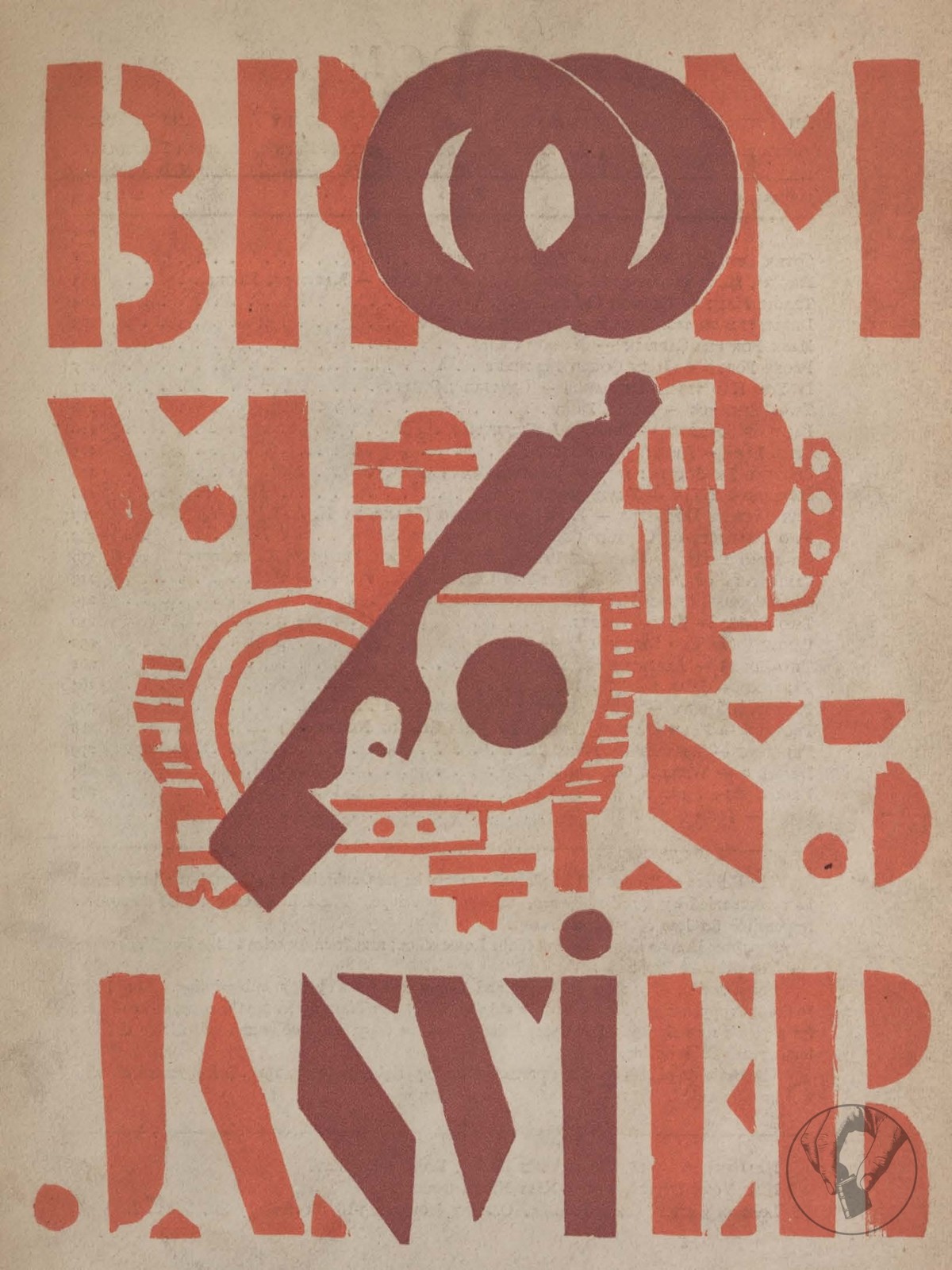
Broom is an international magazine of the arts published by Americans in Italy. This issue, Volume I, Number 3, dated January 1922, features contributions from various artists and writers, including Fernand Léger, Marianne Moore, Gordon Craig, Gertrude Stein, Raoul Dufy, and Juan Gris. The magazine showcases a range of artistic expressions, from woodcuts and paintings to prose poems and critical essays on theatre.