Page 1
BROOK NOVEMBER 1921
First pages of the volume, freely accessible.
BROOK NOVEMBER 1921
BROOM AN INTERNATIONAL MAGAZINE OF THE ARTS PUBLISHED BY AMERICANS IN ITALY EDITORS, HAROLD A. LOEB, ALFRED KREYMBORG — ASSOCIATE EDITOR, GIUSEPPE PREZZOLINI NOVEMBER 1921. VOL. I, No. 1 --- COVER DESIGN (WOODCUT) — E. PRAMPOLINI. --- Page --- LAKE — BAYARD BOYESEN --- BROOKLYN BRIDGE — JOSEPH STELLA --- HUNGER — JAMES STEPHENS --- MARNIA — WALLACE GOULD --- A UNION OF BEGGARS — MANUEL KOMROFF --- DRAWING OF IGOR STRAWINSKY — PABLO PICASSO --- PORTRAIT — ANDRÉ DERAIN --- STILL LIFE — JUAN GRIS --- PAINTING — ALBERT GLEIZES --- CHINESE POEMS OF J. WING — E. POWYS MATHERS --- THE FUNCTION OF CRITICISM? — CONRAD AIKEN --- DRAWING — BEPI FABIANO --- DRAWING — FREDIANO FREDIANI --- LILACS — AMY LOWELL --- SCULPTURE — JACQUES LIPCHITZ --- HE LAUGHED AT THE GODS — JAMES OPPENHEIM --- SEGUDILLA — MAN RAY --- IN THE DOCK — W. DE LA MARE --- THE SOUL OF AN ARTIST — J. D. BERESFORD --- TWO DRAWINGS — WILLIAM GROPPER --- HOSPITAL NIGHTS — LOLA RIDGE --- FAIRY TALE — DONALD CORLEY --- MAPLE-SUGAR SONG — LEW SARETT --- BAMBINO’S BEGINNING — HANIEL LONG --- EINSTEIN AND THE POETS — LOUIS UNTERMEYER --- AMERICA INVADERS EUROPE — EMMY VERONICA SANDERS --- BROOMIDES: COMMUNICATIONS FROM EDGAR VARÈSE, WALLACE GOULD, DAVID O’NEIL --- The Editors of Broom will be pleased to consider mss. submitted to them, but all mss. must be accompanied by a self-addressed stamped envelope. Mss. from Europe should be sent to the Rome office; mss. from America to the New York office, The Price of Broom is: For America, fifty cents the copy, and five dollars for a year’s subscription. For Italy, 10 lire the copy, 100 lire for a year’s subscription. For France, 6 francs the copy, 60 francs for a year’s subscription. For Great Britain, 2/6 for the copy, One pound and five shillings for a year’s subscription. The contents of this issue are protected by copyright, November 1921. Infringement of same will be prosecuted. --- HEADQUARTERS, 18, TRINITÀ DEI MONTI, ROME (6), ITALY. NEW YORK OFFICE, THREE EAST NINTH STREET. GENERAL DISTRIBUTOR FOR FRANCE, BELGIUM, AND HOLLAND, LIBRAIRIE DE FRANCE, 99 BOULEVARD RASPAIL, PARIS. EL
LAKE. There's too much selfhood in this lake: Though, varying, four streams partake In amber rushes till they break When softening confusions shake Identities into the lake. I know the four streams, all their ways; I've paddled in their amber sprays And flung them into bubbled praise Of sunlight; but I see too well The lake complacently will tell Only selfhood, nor admit How four streams engendered it. BAYARD BOYESSEN.
JOSEPH STELLA. Brooklyn Bridge.
HUNGER. A DUBLIN STORY. On some people misery comes unrelentingly, with such a continuous rage that one might say destruction had been sworn against them, and that they were doomed beyond appeal, or hope. That seemed to her to be the case as she sat, when her visitor had departed, looking on life as it had moved about her, and she saw that life had closed on her and crushed her, and that there was nothing to be said about it, and no one to be blamed. She was four years married, and she had three children. One of them had fallen when he was quite young, and had hurt his back so badly that the dispensary doctor instructed her not to let him walk for a few years. She loved all her children, but this child she loved greatly, for, of the three she had to do the most for him. Indeed she had to do everything for him, and she loved to do it. He was the eldest and he was always with her: so were the others, of course, for a woman in needy circumstances can never get away from her children; but the other youngsters were with her as screamings and demands, to be attended to and forgotten, while he was with her as a companion eye, a consciousness to whom she could talk and who would reply to her, and who would not by any means get into mischief. He could not get into anything else either. Her husband was a housepainter, and when work was brisk he got good wages: he could earn thirty-five shillings a week when he was working. But his work was constant only in the summer months: through the bad weather there was no call for him, for no one wanted housepainting done in the winter, and so the money which he earned in the five months had to be stretched and made to cover the remaining seven months of the year. Nor were these five months to be entirely depended upon: here and there in a week days would be missed, and with that his Society dues had to be paid, for he would pay those though he starved for it
Wages which have to be stretched so lengthily give but the slenderest sum towards a weekly budget: it was she who had to stretch them, and the doing of that occupied all the time she could spare for thinking. She made ends meet where nothing was but ends, and they met just over the death line of starvation. She had not known for three years what it was like not to be hungry for one day, but life is largely custom, and neither she nor her husband nor the children made much complaint about a condition which was normal for them all, and into which the children had been born. They could scarcely die of hunger for they were native to it: they were hunger, and there was no other hunger but them: and they only made a noise about food when they saw food. If she could have got work how gladly she would have taken it, how gladly she would have done it: sweated work, any work, so that it brought in if it was no more than two or three coppers in the day. But the children were there, three of them, and all were young and one was a cripple. Her own people, and those of her husband, lived, existed, far away in the country: they could not take the children off her hands: she could not give a neighbour anything to look after them while she went out working: she was held to them as fast as if she were chained to them, and, for to think in such cases is only to be worried, there was no use in thinking about it. She had already all the worry she could deal with, and she wanted no more. She remembered the tale she had laughed at, when she was young, about a woman who had been circumstanced as she was now: this woman used to put her two children into a box, for she had to go out every day to work in order that she might feed them, and she kept them in the box so that they might not injure themselves during her absence. It was a good idea, but the children came out of the box hunchbacks, and so stunted in their growth that it might be said they never grew thereafter. It would have been better for the children, and easier for them, if they had died; anyhow, their mother died, and the poor little oddities went to the workhouse, and must all their lives have got all the jeers which their appearance sanctioned. There was nothing to be done; even her husband had long ago given up thinking of how this could be arranged, and although she still and continually thought about it, she knew that nothing could be done. Her husband was a jolly man; he used to make up lists of the gigantic feeds they would have when the ship came home (what ship he did not say, nor did he ever say that he expected one), and he or she or the children would remind each other of foods which had been left out of his catalogue, for no food of which they knew the name could justly be omitted from their future. He was a robust man, and could have eaten a lot if he got it; indeed he had often tempted his wife to commit an act of madness and have one wild blow-
out, for which, as she pointed out to him, they would have to pay by whole days of whole starvation, instead of the whole days of semi-hunger to which they were accustomed. This was the only subject on which they came near to quarrelling, and he brought it forward with fortnightly regularity. Sometimes she went cold at the thought that he might on some pay-day go in for a wild orgy of eating, and perhaps spend half-a-crown; less than that sum could not nearly fill him, and the double of it would hardly fill him the way be wanted to be filled; for he wanted to be filled as tightly as a drum, and with such a weight and abundance of victual that he could hardly be lifted by a crane. But he was an honourable man, and she knew he would not do this unless she and the children were with him and could share and go mad with him. He was very fond of them, and if she could have fed him on her own flesh she would have sacrificed a slice or two, for she was very fond of him. The mild weather had come, and he got a cut in his hand, which festered and seemed stubbornly incurable: the reason was that the poor, gaunt man was not fed well enough to send clean blood down to doctor his cut hand; but in the end he did get over it. But for three weeks he had been unable to work, for who will give employment to a man whose hand looks like a poultice or a small football? The loss of these three weeks almost finished her. The distinguishing mark of her family had been thinness, it was now bonyness. To what a food-getting fervour she was compelled! She put the world of rubbish that was about her through a sieve, and found nourishment for her family where a rat would have found disappointment. She could not beg, but she did send her two children into the street, and sometimes one of these got a copper from a passing stranger; then that youngster gave out a loyal squeal for his companion, like the call of a famished crow who warns his brothers that he has discovered booty; and they trotted home with their penny. The sun shone on the day they got a penny: on the days when they got nothing the sun might split the bricks, but it did not shine. Her man returned to his work, and if she could hold on they would be able to regain the poverty of a few months previously, but which now beamed to her as distant, unattainable affluence. She could hold on, and she did; so that they tided feebly across those evil days, and came at last to the longed-for scarcity which yet was not absolute starvation, and whereby they could live in the condition of health to which they were accustomed, and which they recognised and spoke of as good-health. They could not absolutely come to this for at least a year; provision had
impediments which he found in the path of life so that it might flow on before it had time to become stagnant and rotten. He took from the dry-eyed, tongue-tied woman’s shoulders all the immediate worry of death and arranged about the death certificate and registration and burial. He paid the rent, and left something to go on with as well, and he promised to get her work either in his house or at his office, but he would get her work to do somehow. He came daily, and each day, in reply to her timid question as to news about her husband, he had nothing to say except that enquiries were being made. On the fifth day he had news, and he would have preferred any duty, however painful, to the duty of telling her his news. But he told it sitting on the one chair, with his hand over his eyes and nothing of his face visible except the mouth which shaped the sentences and spoke them. The munition people in Scotland had reported that a man of the name he was enquiring for had applied for work, and had been taken on a fortnight after his application. The morning after he began work he was found dead in a laneway. He had no lodgings in the city, and at the postmortem examination it was found that he had died of hunger and exposure. She listened to that tale, looking from the gentleman who told it to her little son who listened to it. She moistened her lips with her tongue, but she could not speak, she could only stammer and smile. The gentleman also was looking at the boy. “We must set this young man up,” said he, heavily. “I will send a doctor to look him over to-day.” And he went away all hot and cold, beating his hands together as he walked, and feeling upon his shoulders all the weariness and misery of the world. JAMES STEPHENS.
still to be made for the lean months to come, the winter months, and more than three weeks’ wages which should have been skimmed in this precaution had been unprofitable, had not existed. The difference had to be made up by a double skimming of the present wage, which must also pay the present necessities and recoup the baker and grocer for the few weeks’ credit these shop people had given her. In all, their lot for a long time was not to be envied, except by a beast in captivity, and by him only because he lusts for freedom and the chance of it as we lust for security and the destruction of chance. The winter came—the winter will come tho’ the lark protest and the worm cries out its woe; and she entered on that period with misgiving, with resolution, and a facing of everything that might come. What bravery she had! What a noble, unwearing courage, when in such a little time and as such small labour she might have died! But such an idea never came to her head. She looked on the world, and she found that the world was composed of a man and three children; while they lasted she could last, and when they were done it would be time enough to think of personal matters and her relation to things. Before the summer had quite ended, before autumn had tinted a leaf, the war broke out, and with its coming there came insecurity: not to her, not to them: they had no standard to measure security by; it came to the people who desire things done, who pay to have doors varnished and window-frames painted. These people drew silently but resolutely from expense; while he and she and the children sunk deeper into their spending as one wallows into a bog. The prices of things began to increase with a cumulative rapidity, and the quality of things began to deteriorate with equal speed. Bread and the eater of it came to a grey complexion. Meat got the cut direct instead of the direct cut. The vegetables emigrated with the birds. The potato got a rise in the world and recognised no more its oldest friends. There seemed to be nothing left but the rain, and the rain came loyally. They, those others, could retrench and draw in a little their horns, but from what could she go back? What could she avoid? What could she eliminate, who had come to the bare bone and shank of life? The necessity for the loaf comes daily, recurs pitilessly from digestion to digestion, and with the inexorable promptitude of the moon the rent collector wanes and waxes. They managed: she and he managed: work still was, although it was spaced and intervalled like a neglected storm-blown hedge. Here was a week and there another one, and from it they gleaned their spare constricted existence. They did not complain: those who are down do not complain. Nor did they know they were down; or, knowing it, they did not admit their downness;
for to face a fact is to face with naked hands a lion, and to admit is to give in, to be washed away and to be lost and drowned; anonymous, unhelpable, alive no more, but debris, or a straw which the wind takes and sails or tears or drifts or rots to powder and forgetfulness. A bone in a world of bones! And they gnawed these bones until it seemed that nothing moved in the world or was alive except their teeth. The winter came, and his work stopped as it always did in that season; he got jobs cleaning windows, he got jobs at the docks hoisting things which not Hercules nor the devil himself could lift, but which he could lift, or which his teeth and the teeth of his children detached from the ground as from foundations and rivettings; he got a job as a coalman, and as a night-watchman sitting in the angle of a black street before a bucket of stinking coal which had been a fire until the rain put it out; to-day he had a job, but tomorrow and for a week he had none. With what had been saved, skimmed, strained from the summer wages, and with what came from the jobs, and with the pennies the children unearthed from strangers as though they dug in those loath souls for coin, they lived through the winter, and did not feel they had passed through any experience worth recording, or that their endurance might have been rewarded with medals and a pension. They were living, as we all manage amazing to live, and, if others had an easier time that was their chance; but this was their life, and there were those who were even worse off than they were; for they paid the rent, and when that was done what a deed had been accomplished, how notable an enemy circumvented! The Spring came, but it brought no leaves to their tree; the Summer came but it did not come to them, nor warn them of harvest and a sickle in the yield There was no building done that summer; the price of material had gone up and the price of wages. The contractors did not care for that prospect, and the client thought of his income-tax and decided to wait. And her husband had no work! He had almost given up even looking for work. He would go out of the house and come into the house, and he and she would look at each other in a dumb questioning. Sometimes she would say — not that she had anything to say, but to ease his heart with a comradely word — “Any chance to-day, do you think?” and he would reply: “Chance!” and sit down and brood upon that lapsing word. They were not angry, they had not the blood to be angry with; for wrath you must be well fed or you must be drunk. The youngest child died of a disease which, whatever it was at the top, was hunger at the bottom, and she grew terrified. She heard that there was work to be had in plenty in the Munition Factories in Scotland, and by some means she gathered together the fare and sent her husband across the sea.
“Write, if you can,” said she, “the minute you get a place.” “Yes,” he replied. “And send us what you can spare,” she said. “Send something this week if you can.” “Yes,” he said; and he went away. Then she went into the streets to beg. She left the boy behind in his chair, and brought the other little one with her. She was frightened, for one can be arrested for begging, and she was afraid not to beg, for one can die of hunger. She got a penny here and a penny there, and bought bread; sometimes even she got a twist of tea: she could manage until the end of the week, until her man sent the money: she had thoughts of singing at the corners of streets, as she had so often seen done by toneless, ashenfaced women, who creak rusty music at the passer, and fix him with their eyes; but she was ashamed, and no song that she could remember seemed suitable, and she only could remember bits of songs; and she knew her voice would not work for her, but would creak and mourn like a rusty hinge. Her earnings were small, for she could not get in touch with people; they recognised her at a distance as a beggar, and she could only whisper to the back of a head or a cold shoulder. Sometimes when she went towards a person that person instantly crossed the road and walked for a while hastily. Sometimes people fixed upon her a cold, prohibitive eye, and she drew back from them humbled, her heart panting and her eyes hot at the idea that they took her for a beggar. At times someone, without glancing at her, stuck a hand in a pocket and gave her a penny without halting in their stride. One day she got twopence, one day she got sixpence, one day she got nothing. But she could hold out to the end of the week. The end of the week came, but it brought no letter. “It will come tomorrow,” she said; “he is in a strange country; he must have missed the post, God help him!” But on the following day there was no letter, and on the day after, and the day that succeeded to it there was no letter. “He…!” she said. But she could not speculate on him. She knew him too well, and this was not him; he could no more leave them in the lurch than he could jump across Ireland in one jump. “He has not got work”, she said; and she saw him strayed and stranded, without a hand, without a voice, bewildered and lost among strangers; going up streets and down streets, and twisting himself into a maze, a dizziness of loneliness and poverty and despair, or, she said, “The submarines had blown up the ship that was coming with the money.” The week went by, another came, and still she did not hear from him. She was not able to pay the rent. She looked at the children, and then she looked
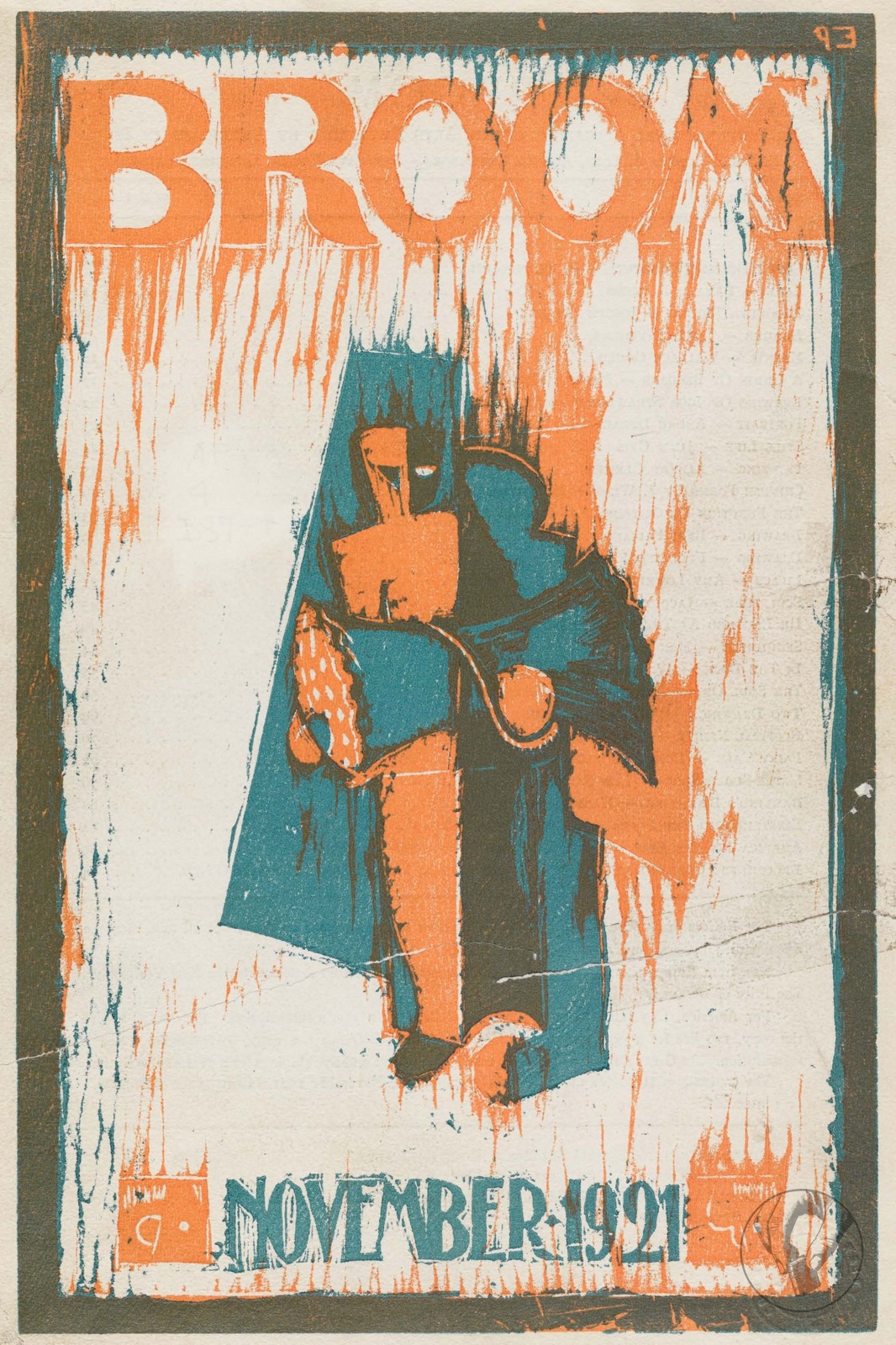
Broom is an international magazine of the arts published by Americans in Italy. This issue features contributions from various artists and writers, including Harold A. Loeb, Alfred Kreymborg, Giuseppe Prezzolini, E. Prampolini, Bayard Boyesen, Joseph Stella, James Stephens, Wallace Gould, Manuel Komroff, Pablo Picasso, André Derain, Juan Gris, Albert Gleizes, E. Powys Mathers, Conrad Aiken, Bepi Fabiano, Frediano Frediani, Amy Lowell, Jacques Lipchitz, James Oppenheim, Man Ray, W. de la Mare, J. D. Beresford, William Gropper, Lola Ridge, Donald Corley, Lew Sarett, Haniel Long, Louis Untermeyer, Emmy Veronica Sanders, and Edgar Varèse. The magazine aims to showcase exceptional contemporary literature and art, giving equal opportunity to both established and unknown artists.