Page 1
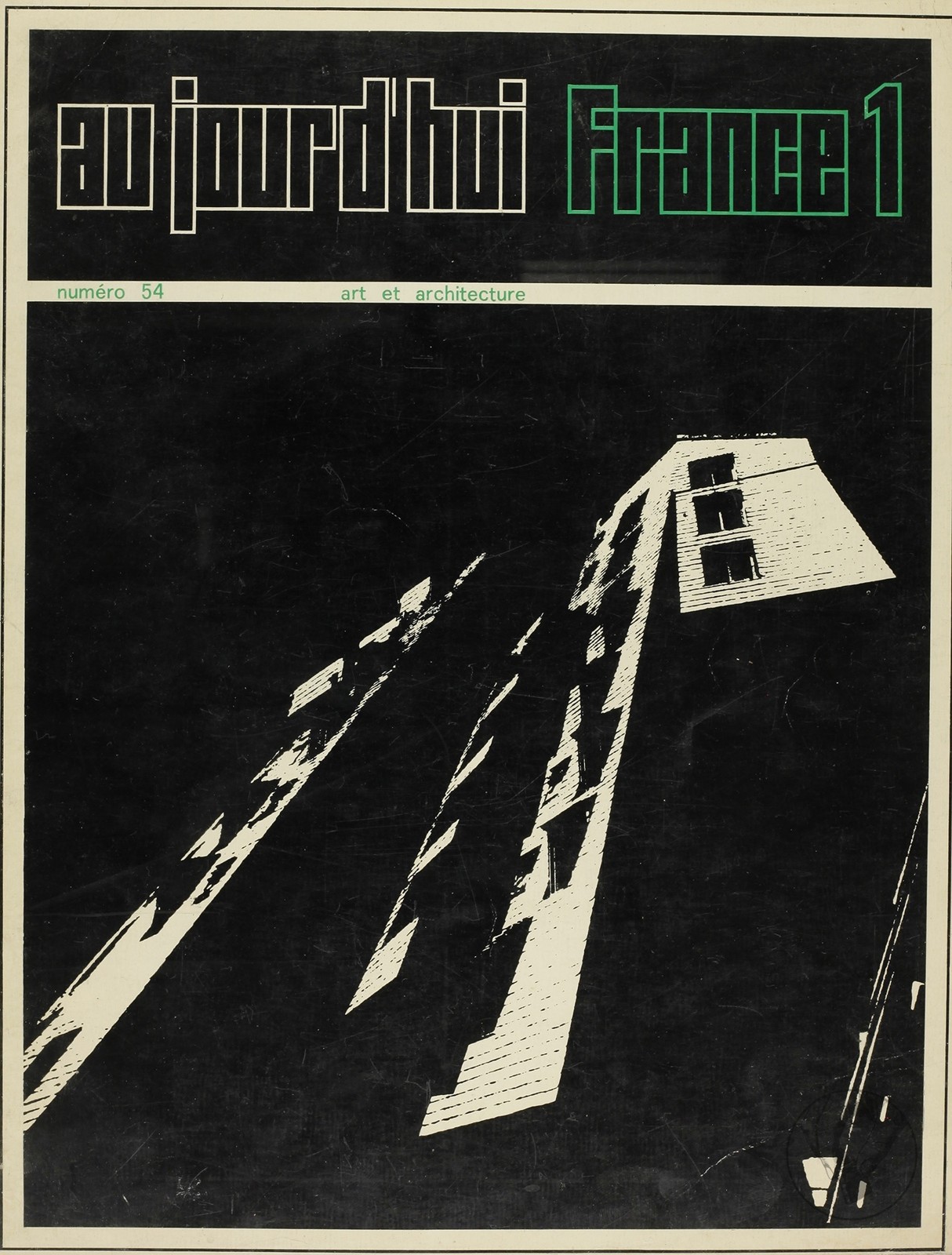
au jourd'hui France 1 numéro 54 art et architecture
First pages of the volume, freely accessible.
au jourd'hui France 1 numéro 54 art et architecture
La Demeure Tapisseries contemporaines d'Aubusson du 19 octobre au 13 novembre DOM ROBERT tapisseries récentes du 16 novembre au 11 décembre GILIOLI tapisseries récentes en permanence : - GILIOLI - JULLIEN - LAGRANGE - LE CORBUSIER - LURÇAT - MATEGOT - PICART LE DOUX - PRASSINOS - DOM ROBERT - SAINT SAËNS - SINGIER - TOURLIÈRE - WOGENSKY 30, rue Cambacérès Paris 8° 265-37-61 Directrices : Madeleine DAVID, Denise MAJOREL --- pierre matisse gallery baltbus dubuffet giacometti butler le corbusier millares calliyannis miró marini macIver tanguy riopelle roszak saura rivera new york 41 east 57
Nous sommes fervents du Style Du XXe siècle, ça va de soi. Par goût bien sûr, mais par esprit pratique aussi. Le rythme de la vie des affaires a évolué depuis Colbert. Le mobilier, lui, n’a pas toujours suivi. Plan System a justement été créé pour promouvoir des aménagements de bureaux et d’entreprises qui, parfaitement adaptés aux pratiques de la vie professionnelle d’aujourd’hui, n’en sacrifient pas moins à une esthétique raffinée et à un confort fonctionnel. Voici un exemple de l’esprit Plan System : le bureau d’un jeune patron. (Conception : Olivier Mourgue). --- plan system Production Airborne. Galerie d’exposition : 3, rue de Grenelle, Paris 6°. Tél. 222.29.37 et 38. Documentation sur demande.
--- GALERIEDESANCIENS ET DES MODERNES --- MARTIN-FERRIÈRES --- Un maître du paysage moderne --- 12 rue Génégaud PARIS VI 633-25-73 --- Galerie STADLER --- 51 rue de Seine Paris 6326-91-10 --- octobre --- NOUVELLES HYPERGRAPHIES --- vernissagele 13 octobre --- novembre --- BALANCI --- CERCLE ARTISTIQUE EUROPÉEN --- J. Geüens et Marg. Aers --- 15 rue du Jeu de l’Arc --- GENEVE Tél. 35-33-11 --- GALERIE KRIEGEL --- 36 Avenue Matignon Paris 8e359-17-89 --- BOLIN --- Novembre 1966 --- GALERIE JEANNE BUCHER --- DUBUFFET BISSIÈRE VIEIRA DA SILVA TOBEY STAHL Y DODEIGNE CARRADE AGUAYO MOSER NALLARD SEGUI --- 53 Rue de Seine PARIS VI Tél. 326.22.32 --- GALERIE LAMBERT --- 14 rue St Louis en L’Ile Paris 4326-51-09 --- ERNST NEIZVESTNI --- 9 novembre-3 décembre ---
Groupe Architecture Principe. Photo G. Ehrmann. E.T.E.B. ENTREPRISE TECHNIQUE D'ÉQUIPEMENT BATIMENT ET TRAVAUX PUBLICS Société anonyme capital 300 000 F 17-19, RUE PAUL-BERT MONTROUGE HAUTS-DE-SEINE TÉL. 253 41-96 ET 41-97 Eglise Sainte-Bernadette-du-Banlay à Nevers, église Saint-Joseph à Nevers, Maison de l'Iran à la Cité Universitaire de Paris, villa Bordeaux Le Pecq à Bois-le-Roi, immeuble à Maisons-Laffitte. --- FORGE FER S. A. Société anonyme capital 600 160 F SIÈGE SOCIAL ET USINE : LORIENT B. P. 206 ZONE INDUSTRIELLE DE KEROLAY. TEL.: (97) 64-35-01. AGENCE : ARGENTEUIL 196, AVENUE DE STALINGRAD. TEL.: 961.47.22. --- MIROITERIE PINIER Société anonyme capital 150 000 F 84, RUE PHILIPPE DE GIRARD PARIS 18° TÉL. 208 96-84 +
M. KNOEDLER et Cie 85 bis, rue du Faubourg Saint-Honoré PARIS VIII° 225-59-78 Choix de DESSINS de PICASSO Novembre NEW YORK : 14 East 57 th Street LONDRES 34 Saint James’s Street --- GALERIE SIMONE HELLER 33 rue de Seine Paris 326-89-62 TAGAYA ŒUVRES RÉCENTES 23 septembre - 10 octobre 1966 --- FLORENCE HOUSTON BROWN 4 rue du Pré-aux-Clercs Paris 7° 548-36-05 VAN HOLTHE SCULPTURES 28 septembre - 22 octobre 1966
AUGUST - DECEMBER 54 FRANCE - ENGLISH SUMMARY 2 INTRODUCTION, by André Bloc. Having devoted issues to architects and artists in Japan, Italy, Great Britain and Spain, we must now turn to survey the trend of creation in France in the world of painting, sculpture and architecture. Architecture can be organised as an organisation organised art-lovers can still confront their own opinions with those of trained critics, whereas in architecture there are few critics so we have sought out the best among young designers, publishing their projects full of originality. The title France show that our choice is not arbitrary or limited and later issues will feature other French architects, creative character being the main criterion used. We will gladly publish the opinions and reactions of around 10 experienced architects, since our aim is to stimulate discussion but here are a few of the author, Patrice Goulet’s comments: “Architecture which should have been organised a new nature has only one silhouette—that of prisons. Architects are responsible for this capitulation and one day, just as the prison walls must sweep aside false problems and solutions to reveal the essential core from which true architecture may develop. For this we must question all hitherto accepted notions.” Our readers must tell us if this severity is completely justified. ARCHITECTURE THE QUEST - ENDEAVOURS BY FIVE TEAMS, by Patrice Goulet. The five schemes described are among the best in French architecture, each featuring a tendency. 1) Architecture: A craft—Mailard and Ducamp are attached to concrete problems. Their key words are simplicity, truth, efficiency, each element in its place, nothing forgotten forgotten it-treated, and exhibited in the structure. However “solid” architecture is not enough—it must be adapted to present day necessities it must be “reasonable”. The sports centres at Meaux and Biontigny provide, evolution, using identical units whose grouping become an essential part of the general design. Industrialisation will accelerate this tendency altering study process since the unit will be designed first. It is striking to see the lack of proportion between the gravity of the problems and the reduced means of architectural offices. Designers are forced to study a plan which can be used again after a few modifications, for other schemes. There is therefore a risk of monotony, and instead of preserving its place faced with industry, perhaps architecture is thereby preparing its own adaptation. 2) Architecture: The development of a structure.—Renaudie, Riboulet, Thurnauer and Véret have few equivalents in France. The St. Denis and Gigaro schemes are interesting for the method used to vary space and scale. Le Corbusier’s free plan idea is present but postponed, structure becomes an element governed by the programme. This method tends to solve the problem raised by lack of time, avoiding hazard. In the Gigaro scheme the geometrical module is specific to the volumetric solution of the design, the site is respected space, and treated with great care. Therefore it would be convincing the final expression of architecture was not lacking. As for Saint-Denis, the site was devoid of relief, architecture developed in space by being superposed. Should the importance of these structures be so great as decisive to become composite architecture, this is not research because artificial limits where liberty is reached only through a yoke. 3) Architecture: Exploring a principle.—Parent’s architecture is always experimental, because his character is too subterrant to accept limits and he shut down narrow, low quality research. Therefore he conducts tentatives where quality and good taste have no importance by themselves, only research putting ideas into concrete form count. This is powerful architecture with a risk. However it fails in its self-destructive resistance of the environment which drives the architect to over-constructual combat against the authorities, clients, etc., the rapid deterioration of schemes whose architecture is diluted by clashing details, the lack of influence of certain credors which remain vital. Parent and Virilio try to consider this with wide, many objective arousing mankind to architecture by making it somatic, animating the urban dweller by dynamic architecture, each principle being illustrated in the schemes at Nerves and Charleville. 4) Architecture: Expression of inspiration.—Orzoni and Roques were fortunate to have important commitments early in their career. This inspired and romantic architecture owes its quality more to the personality of those who design it, more than the ideas behind it. The Mont Olympus project, already revealed the importance given to specifying space, the will to create living space organised with great flexibility, while the Avoriz scheme has another dimension, due perhaps to the surrounding site which inspired the design, did not stay before starting the project, but as soon as some time before starting the project, was made, the project was rapidly executed. Two essential features should be noted: the essential part inspirational plays, drawn from the feeling of surroundings, the use of all elements of expression, exterior volume based on resonance with the site, sculptured and modelled to fit in with the needs of the programme. Interior space remains classical, untouched by exterior influence. The relief, the view, and sunlight also influenced design and if the final expression is dramatic, this is because the scenery is dramatic; it has to be seen to be felt. 5) Architecture? Blossoming of a poetical world.—The source of the architecture of Bayel, Ginat and Marcoz is its vision of nature, its means are exultation, its aim is the knowledge of life. It affirms that all things can develop from the course alone give fruitfulness, only the open form is alive since it alone can be penetrated by space. Bayel’s apartment, by materialising its largest dimension, the diagonal, may be oriented which guides the whole design, regenerating in the decoration. The house at Ezanville expresses the power of geometry and from the central core shutting in the stairs and flues, spreads its wings to break the parallelism. However such works be defined? Only purity seems capable of recognising them. Perhaps better to let them speak for themselves. 1. H.P. MAILLARD, P. DUCAMP. In the beginning each project was designed as an isolated work. Now, because of the desire for standardisation and industrialisation, architects have been forced to consider each scheme as a grouping of basic units, which for their success, must lend themselves to as many combinations as possible. Our present trend is to define a building as a total of varying volumes appropriate to each of the functions of the programme, structure is calculated on the scale of the basic units and not on the scale of the whole design. This is how we have designed standard plans of swimming pools, sports halls, youth clubs. Appropriate volume is sought (restricted near shallow water, extensive round the diving platform), wind bracing is solved on the scale of the smallest units so that they may be assembled as required. Each bay is structurally independent, therefore heights may vary, plan can be irregular, roofing is possible in shells, plates, etc. The richness of the composition may therefore be created by grouping and opposing elements of varying height and breadth. 2. J. RENAUDIE, P. RIBOULET, G. THURNAUER, J. L. VERET. COURIPEZ. The architects intended from the beginning to abandon the isolated villa design, there was to be no separation of functions, the scheme being considered as one dwelling with multiple and complex life. Ecological vision was a fundamental rigorous organisation—a series of parallels spaced at 7 meters. A multitude of volume combinations are possible but they must be sought in the perspective of the solidness of the project. There is no return to the old world village atmosphere, but research for forms which harmonise with the development of a human group in the richness of its relationships. GIGARO. It could be thought that in the schemes for Gigaro and Saint-Denis the aim was to reach perfect objectivity and that for this diagram could realistic invention and that the design simply consists of fitting large structural mechanisms in place. Such a method would be dangerous, eliminating imagination. Composing Gigaro brought a surprise every moment, chance, if controlled raises opposition to a strict system and becomes a constructive force, revealing its possibilities. These symptoms make up the whole story of the scheme and the means, capable of absorbing discoveries due to chance into a unified design. SAINT-DENIS. This residential development scheme consists of a substructure for distribution, and housing raised from the ground and linked together by pedestrian circulation with community equipment, installed shops, recreation rooms, schools, etc., and activities providing employment for many people. The organisation of these elements is set up in the evolving system with no dissociation of function, but the desire to create opportunity for contact and animation. Hence, housing in pyramid shaped blocks encourages inhabitants to adapt themselves rapidly to urban life. Riccardo Porto. There had a hard struggle “modern” architecture has finally been accepted by the whole world. But the principles of the great masters are enforced automatically and are unfortunately now only a reflexion of bureaucratic thinking. This produces nothing but inhuman and ugly space where mankind becomes a difficult object to accommodate. They packed away in tiny kind and box. Many architects revolt against this and those I will mention stand out for their violent reaction to this conformist way of thinking. MAILLARD AND DUCAMP. In their design structure is not used as an end, in itself but as a means to create rich spaces. The most traditional research the more they succeed in dividing form with interesting results. RENAUDIE, RIBOULET, THURNAUER, VERET. They start with a free plan, and continue their research through geometry. PARENT AND VIRIO. Their architecture seeks an image, as strong as possible, of something which strikes them in the world around us. They are going to make their buildings into aggressive objects, in machine. The curves of their design result are streamlined outside, their vision is close to that of artists like Paolozzi, Tinguely or César. They are seeking harmony with nature because of the relationship of form, they endeavour to continue the landscape, but there is no identity. If the concentration between inside and outside is reduced to a minimum, the exterior suggests a rich interior being but the relationship is not pursued. Interior and exterior are opposites, but diagonals dominate everywhere. As regards design methods they first consider the exterior volume to give a powerful vision, from there they organise function to make exterior form and interior function coincide in perfect harmony. On Nevera church they have succeeded, with closed volume, fluid architectural space linked by diagonals organising simple volume. Charleville exploits a single parallel oblique in relief. LABRO, ORZINI, ROQUES. This team seem to have been influenced by German romanticism. At Avoriz they have converted all the buildings into immense roofs, hallucinating in a dramatic landscape. The exterior is powerful and falling snow down these monsters must underline an extraordinary imperialism. They deform natural elements, endeavouring to express the concealed agony of man living in a world under crisis. BAILEY, GINAT, MARCOZ. One of the most lyrical architects of our time, Bayel affirms that the true French tradition is that of the great gothic gondolas. His love of nature guides him towards fluid architectural space linked to natural space. Wrights influence is evident in the house at Ezanville but his own evolution is also apparent. Bayel is approaching French vitalism and usually finds economical solutions through his research. J. C. PARENT. Faced with the problems of present day reality, the architect must adopt an attitude of action dictated by his personal reaction, a pledge decided by his character, his conception of life, his position in relation to mankind. Plunged in an atmosphere unfavourable to the artist, he is confronted with a moral code and a policy for action. If he is free, he will take a limit more which he must not fall. Tracing a policy is more interesting since it involves architecture itself. An architect may design a project, then find a space interested in financing it, or he may receive a “brief” with interest in which to be considered as a private residence (however to be considered as a vague survival to be discouraged) and can be treated as research on architectural structure, on a plastic theme, but must be used as a starting point for larger projects. The space structure or theme is amplified, but not multiplied since a large housing block must never be considered as a group of separate dwellings. It has quite a different nature. These considerations are revealed in the two following examples: development of an organic diagram in three houses near Paris where the two branches of an obtuse angle group two distinct volumes. This theme is recalled in a block in Paris and will be used again since it has the advantage of creating living space in which continuity is set up more easily than with the right angle. The oblique function nearly always calls for an obtuse angle for ramps but in this case the transposition of the organic diagram will be assured by passing from the plane to the section along the axis of the deepest circle. The second research is the exploration of special transparency with simple parallel volume. Two examples are André Bloc’s house at Cap d’Antibes and the train hostel at the Paris Cité Universitaire. The link is moving the plastic expression of architecture creates a link through his work, unfortunately insufficient because it varies according to different kinds of buildings (schools, factories, etc.), financial possibilities, site, sunlight, etc. The result is the lack of coherence visible in built-up urban districts. The architect can only deplore this, but he also contributes to it in spite of himself, since each building may be a success in itself, but taken together they do not make up in itself. Therefore the architect shows a knack to dominate the plastic whole, carrying out research on structure (in the philosophical sense of the word). For this there are two tactics—the everyday struggle for details and then a detachment from them to prepare the list of having a minimum of positive results. This should take the form of theoretical research on concepts, principles, and finally control of consequences. It is encouraging to see that, as soon as research is undertaken,
its influence is felt on practical work in progress (Architecture Principles Theory on the Nevers church, the Charleville cultural centre) with obliques, cantilevered elements; the certainty of giving mankind the possibility of being involved in architecture by exercising an individual physiological potentiality. These principles are strongly linked with mankind while essential for the advance between them. Architecture has its own being like an independent unit and it is the interaction, the succession of position that man adopts with it which make up its reality, its non-abstraction and true life, autonomous of the impact of our epoch as well as consciousness of the form of human man. Therefore there is interdependence between man and architecture but never restraint. Charleville church is based on the oblique function with cantilevered waves, repelling nearby things to prevent contraction. By this plan it polarizes surrounding space. The plan is organic, shaped like a heart. At Charleville cultural centre the activation of oblique architecture is rendered plastic, with a theatre on the roof where scenic views are presented opposite. To the same site had to be taken into consideration and the oblique function avoided danger by using the art of emersion into the scenery. For the house at Bois-et-Roi, the design consisted of featuring three columns, with heights on the ledge and a horizon. This extrapolation to a higher dimension of this model, the adaptation of shell structures towards usefulness for living, lead to a link with the proposals for urban unity by the Architecture Principle group, would we must solve the problem of the need to decide on experimenting which will open the doors to the future. ARCHITECTURE PRINCIPLE C. PARENT, P. VIRILIO. The failure of classical and moral powers faced with the problems of mankind and his economy, reveal architecture in its true definition—that of the natural moral of society. We are forced to accept the death of the vertical line as an axis for elevation, the death of the horizontal as a permanent plane, in few ways through which man’s slant to create new urban order which will also reinvent a new vocabulary in architecture. This change must be understood for what it is—the third possibility of architecture in space. Structure. A structure is a load-bearing frame to support ideas, and architecture is the linking structure between people in the universe—earth, air, sea and Man. The transfer is made possible by materialising the notion of space. If Man were deprived of structure, he would be incapable of communicating with the universe, then ever necessary if we are to conquer outer space. But Man must become sensitive and receptive, therefore he must become an opportunity since it forces man to participate by giving him a potential value calculated for each individual, exalting each autonomy. Motion housing. Architecture seems paralysed by human fluidity and the discrepancy between immobility and movement as depending the modern city. Two main tendencies are in opposition—mobile architecture and motion housing. The first borrows its cause, means and effects from industry, the second returns to the very roots of architecture to find the solution to problems considered too long as a protective element, hence its stagnation. Once liberated it has escaped into the design of stairs, dams, bridges to find its true active significance, when it is faced with another spiritual or moralistic. Then the popular today is such that it forms an overwhelming force of inertia. Assume conditions are ready for architecture to assume its real role—the invention of society. We must create an art of town building where the oblique function overtakes the permanent horizontal planes which man puts onto the very outline of housing. Motion and immobility have been separated too long. Tomorrow architecture will be circulatory, standing space will lose its importance to transfer space, housing like the whole city will be set in motion by the oblique function. City scheme at Sainte-Bernadette at Nevers. In the first theoretical research, Architecture for worship cannot have a better aim than creating an environment favourable to man, and this experience has helped us to further our definition of new forms of space for living. We wanted to create useful space where experimenting outside, contemplation, where architecture proves itself by motion and the quality of motion. By giving a maximum value to the meaning of their movements, we favour the psychological spatial character of individuals, breaking for time the way of enervating a longing year to replace it by the sensation of the reality. Structural elements have a socio-psychological character and architecture may soon draw attention to an element up to now hidden-the floor, which will tend to dispose other factors away. New importance by using the oblique function. It is the way for architecture to give a spatial character to its contents, and for us, Nevers has been a means of crystallising these notions. 64 S. H. BALEY, D. GINAT, A. MARCOZ. Architecture is the means of situating the individual in a living context. It is the gesture of creating a place, of creating a welcome. Form welcomes space and space welcome. Buildings like plant showup. Architectural creation is constantly changing with the construction of life, it can neither be defined or theorised. It is an atmosphere and not an image, which is always beautiful or ugly. An atmosphere is always suggestive. Architecture is incantation, its research is knowledge of life, its expression is poetry, its message is beyond time. PAINTING. SCULPTURE. 83 YOUNG FRENCH ARTISTS. CRITICS OPINIONS. André FERMIGIER. The future of painting depends on painters alone. In spite of the importance of historical documentation, discoveries and successes are due to individuals. Movements and schools are such epicycles and only exist on the moral level. In any case why tall of youth in painting, since the very virtues of youth find no use there, especially in France and Italy? Julien Bendé says youth is a value in sport, in love, but not in art”. This is more true today since artistic production is in the hands of business’. Styles becomes fashions and new artists are presented like an admired object (critics who help in the search for their own). They are not prepared for this kind of competition. The present day situation seems disheartening and recent exhibitions have left a sad memory with me, especially as regards the general outlook. It seems remiss and dirty, but we have seen the past paintings and find in our history. We must just wait for a saviour. Denise BRETEAU. Artistic life is grave yet exciting. We are for the moment at the end of a cycle, suffering from the lack of exactingness on the past of galleries, critics; or even five artists who, from weakness of character do not known themselves. The most important of young painters worthy of interest, that is why we have only organised reflection exhibitions which I intend to continue next season. Gérard GASCIOT-TALABOT. The last six years have been extremely rich. The 1960 generation has reacted deeply against abstract academinism in a movement which basic revolts stifling the bands they proved of followers. These real artists have been able to flourish in rarefied but purified air. The coming of “objectors” is undoubtedly one of the significant moments showing the artists decision. To interior research and secret research in the effects of surroundings. To begin the liberty of gesture, they oppose slow but sure technique entirely controlled by the artist. Is the painter only a companion in humdrum everyday life instead of a discoverer of structures, a creator of objects? Yes, he does not have pictures really in his simple operation of ascertainment. No! where he goes beyond the dimensions of this reality by a new plurality, to transform the signification of the object, the style which inspires him to split them into a personal vision of the world and to spirit in a bond or liberty that the artist wishes to his basic material. In this adventure young French artists have played a leading part Rayse has sought to impose a French conception, replying in his own way to old questions—death, the woman, freedom, freedom of conscience, in his new figurative, Cheval-Berland in his intellectual clarity, others like Arnal, Aillaud, Tisserand, Bettencourt, etc., are also worthy of mention. They are all French one way or another. Michel RAGON. I have chosen two artists. Hamisky has the merit, the course to follow the fashion, he endeavours to be himself, a discreet artist, making no attempts at oratory with his brushes. But he reveals poetical nostalgia, crumpled like his paintings scarred by hard tenerness, drowned in white. Phinonell is up to date, although he prizes, on areas of fame, his new figuration so novel in 1962. At the present day contradiction he has a tendency to become abstract. Let’s say he is “poppy”, a mixture of pop art and op art, with a tinge of “happiness”. He is a force of nature, explosive. Simone FRIGERIO. It is easy today as it was twenty years ago to be an accepted young artist.” I believe so, considering the young Biennial unique of its kind. The first in 1959 coincided with the blossoming of a new generation of artists, proclaiming the recess of their heritage. The diversity of tastes sex, which has already incited critics to classify them, because it must be noted that the critics have also evolved realist, less and less bombastic. Important exhibitions have hung a growing number of artists who have been a training in a career we must face a lone water struggle. Apart from groups called “Research in visual art”, present day trends are either “new realism”, “narrative figuration”, “erotic expression”. Sculpture has opened for the new figuration, drawing benefit also from the respect of nature, everything by a generation of abstract painters is sacrificed by the brilliant artists from 1945 to 1955 and now the young set. But a revival is coming from America, and the dramatic meeting between abstract and figurative does not give us incomparable richness in creation. Unfortunately we are still at the stage of miscarried intentions. Gilbert GATELLIER. It is with the feeling of being incompletely informed that I make the following remarks, inspired by the most recent developments in French painting. Humanity has often thought that the crucial turning of art has not been interrupted even so. Even if our planet is changing, art will not capacitate faced with electronics and mechanical aids. It is premature to exclude the painted picture which is the result of the new urban environment of mechanical image and the new urban environment of which it is a part. I am pleased to see that artists like Dupo endeavour to place themselves on the borders between several categories which critics are anxious to set apart. However it is not essential to dominate the limit between sculpture and painting. We must also monitor research on environment carried out by some artists and cite and that of the new generation of abstracts in visual Buraglio, not forgetting the Research group in visual art or the trend followed by Genevieve Claisse. But any style of expression remains possible provided it corresponds to the artist’s temperament. Julien ALARD. It is by mutation of a taste for violence that a certain number of painters have been brought to reconsider their work, thus branching off in two distinct directions. One stumbled on irritation faced with an over-understanding world, exploding in rage and nihilism. The other became a world and bought for the possession of deep transparent space pictured especially by Duivilier. The panic which is slowing overcoming mankind fleeing the town, is echoed in painting, a new conception of nature where air becomes the essential element to dominate the space. Painters like Benrath, Lerin, Loubchansky, Lèqueve, Perret and others translate the desire and anguish of space. Some seek mastery rather than romantic submission. Anguish, air, heights depths, this is not a common denominator in the chains of evolution which follow their course. Pierre RESTANY. The decline of abstract art has raised many false problems, the first of which is the new figuration. We have a growing tendency to read clearly what we felt yesterday by issue because non-identifiable land uses are not much painting which has changed and its vision of things. The only new figuration to-day is mechanical art with industrial aids (photography, printing, shadow theory, etc.) called “mechanical”, even cooled in less-messing. Though the concept of research on the vast images long enough to be noted as a living trend in art. The fathers of U.S. pop Rauschenberg and Warhol prefer to keep to serigraphy but they are not up to date in their techniques where are now a long way from the canvas on the easel. Jean-Jacques LEVEQUE. More than ever, art whatever its nationality, springs from differing sources and is modified by influences which are often contradiction. The French artist undertakes his pilgrimage to New York and is led toward a lower heaven therefore he has abandoned the Seine waterfront and all other traditional symbols. In the eclecticism of expression which glean their sources beyond the strict limits of frontiers, we must notice the leaven of an art which finds its basic harmony in a society which is fed joyfully with science comes from the four corners of the world. This young art in France as elsewhere is the reflection of society seeking unity beyond its frontiers. That which politics and commerce fail to do for any duration, art succeeds in establishing, out of sheer necessity. J.-A. FRICAIS. The youngsters—where are they? They have to be sought out in their miserable garets, big art-dealers ignore them, small ones flee them. However the four Biennales between 1959-1965 brought some together including 39 French. Let us look at the practice of sculpture. The poets have created some environments back in 1959 and Yves Klein has been the indicator of new trends, he who dared to have and to live his ideas. It would be difficult to say that ideas, good ones, were common fare in French painting after Dupuy, Delahaye, and others and other companies like Kipps, Delahaye, and others and other companies like Kipps, Delahaye, and others and other companies like Kipps, Delahaye, and others and other companies like Kipps, Delahaye, and others and other companies like Kipps, Delahaye, and others and other companies like Kipps, Delahaye, and others and other companies like Kipps, Delahaye, and others and other companies like Kipps, Delahaye, and others and other companies like Kipps, Delahaye, and others and other companies like Kipps, Delahaye, and others and other companies like Kipps, Delahaye, and others and other companies like Kipps, Delahaye, and others and other companies like Kipps, Delahaye, and others and other companies like Kipps, Delahaye, and others and other companies like Kipps, Delahaye, and others and other companies like Kipps, Delahaye, and others and other companies like Kipps, Delahaye, and others and other companies like Kipps, Delahaye, and others and other companies like Kipps, Delahaye, and others and other companies like Kipps, Delahaye, and others and other companies like Kipps, Delahaye, and others and other companies like Kipps, Delahaye, and others and other companies like Kipps, Delahaye, and others and other companies like Kipps, Delahaye, and others and other companies like Kipps, Delahaye, and others and other companies like Kipps, Delahaye, and others and other companies like Kipps, Delahaye, and others and other companies like Kipps, Delahaye, and others and other companies like Kipps, Delahaye, and others and other companies like Kipps, Delahaye, and others and other companies like Kipps, Delahaye, and others and other companies like Kipps, Delahaye, and others and other companies like Kipps, Delahaye, and others and other companies like Kipps, Delahaye, and others and other companies like Kipps, Delahaye, and others and other companies like Kipps, Delahaye, and others and other companies like Kipps, Delahaye, and others and other companies like Kipps, Delahaye, and others and other companies like Kipps, Delahaye, and others and other companies like Kipps, Delahaye, and others and other companies like Kipps, Delahaye, and others and other companies like Kipps, Delahaye, and others and other companies like Kipps, Delahaye, and others and other companies like Kipps, Delahaye, and others and other companies like Kipps, Delahaye, and others and other companies like Kipps, Delahaye, and others and other companies like Kipps, Delahaye, and others and other companies like Kipps, Delahaye, and others and other companies like Kipps, Delahaye, and others and other companies like Kipps, Delahaye, and others and other companies like Kipps, Delahaye, and others and other companies like Kipps, Delahaye, and others and other companies like Kipps, Delahaye, and others and other companies like Kipps, Delahaye, and others and other companies like Kipps, Delahaye, and others and other companies like Kipps, Delahaye, and others and other companies like Kipps, Delahaye, and others and other companies like Kipps, Delahaye, and others and other companies like Kipps, Delahaye, and others and other companies like Kipps, Delahaye, and others and other companies like Kipps, Delahaye, and others and other companies like Kipps, Delahaye, and others and other companies like Kipps, Delahaye, and others and other companies like Kipps, Delahaye, and others and other companies like Kipps, Delahaye, and others and other companies like Kipps, Delahaye, and others and other companies like Kipps, Delahaye, and others and other companies like Kipps, Delahaye, and others and other companies like Kipps, Delahaye, and others and other companies like Kipps, Delahaye, and others and other companies like Kipps, Delahaye, and others and other companies like Kipps, Delahaye, and others and other companies like Kipps, Delahaye, and others and other companies like Kipps, Delahaye, and others and other companies like Kipps, Delahaye, and others and other companies like Kipps, Delahaye, and others and other companies like Kipps, Delahaye, and others and other companies like Kipps, Delahaye, and others and other companies like Kipps, Delahaye, and others and other companies like Kipps, Delahaye, and others and other companies like Kipps, Delahaye, and others
au jourd'hui
Présentation par André Bloc Après avoir consacré des numéros spéciaux aux architectes et artistes du Japon, de l'Italie, de la Grande-Bretagne et de l'Espagne, il était indispensable de situer l'état de la création en France dans les domaines de la peinture, de la sculpture et de l'architecture. Il était intéressant d'ouvrir largement la revue aux nouvelles générations, de confronter les tendances diverses, d'obtenir aussi des appréciations. Pour la peinture, la critique est puissante, organisée, souvent même engagée et plus souvent encore partielle et injuste, mais au travers d'opinions plus ou moins contradictoires les œuvres apparaissent et le lecteur peut confronter ses propres opinions avec celles de la critique. Pour l'architecture, il fallait rechercher les meilleurs parmi les jeunes architectes, mais la critique architecturale se pratique peu et mal. Nous avons donc ouvert largement nos colonnes à de jeunes équipes, présenté plus de projets que de réalisations, mais des projets pleins de mérite et parfois d'originalité. Les aînés pourront apprécier s'ils le désirent. Ce numéro a pris pour titre FRANCE I pour bien préciser que le choix n'était ni arbitraire, ni limitatif. La valeur réelle compte essentiellement et le nombre des pages consacrées à certains ne préjuge pas la valeur absolue des travaux des équipes sélectionnées pour cette publication. Des numéros ultérieurs présenteront les travaux d'autres architectes français de diverses générations, le caractère créatif étant toujours le principal critère du choix effectué. Un jeune a fait le dosage, à propos duquel il serait loisible de discuter. Nous entendrons et publierons volontiers les opinions et les réactions soit des jeunes architectes non publiés, soit de leurs aînés. Notre but est de stimuler la discussion, mais déjà voici ce que pense le jeune Patrice Goulet, auteur de la sélection des œuvres publiées : Or, l'architecture, organisatrice d'une nouvelle nature, qu'est-elle devenue ? Il suffit de regarder autour de soi : aucun commentaire ne peut remplacer la vision de ce visage qui n'a qu'une silhouette, celle des prisons. Et qui d'autres en sont les premiers responsables sinon les architectes ? Un jour il leur en sera demandé justice. Mettre en lumière cette démission n'est qu'un premier pas ; bien plus important encore est de déblayer les faux problèmes et leurs fausses solutions, afin d'arriver à l'essentiel, c'est-à-dire à un noyau d'où pourra se développer enfin une véritable architecture. Aussi faut-il remettre en question toutes les notions admises, toutes les idées reçues et pour cela avant tout les reconnaître. La sévérité de ce jeune Robespierre de l'architecture est-elle entièrement justifiée ? A nos lecteurs de répondre. André BLOC. --- DIRECTION ANDRE BLOC. REALISATION PIERRE LACOMBE ET PATRICE GOULET - Septembre 1966 - 10ème année - Bimestriel - tirage 7 000 ex. - Administration et rédaction : 5 rue Bartholdi 92 Boulogne Tél. 605-61-80 C.C.P. Paris 1519.97 - Ce numéro : France 13 F. Etranger 15 F - Abonnement : 1 an 5 numéros : France 57 F. Etranger 14,10 dollars
France 1 Présentation par André Bloc ARCHITECTURE CINQ RECHERCHES par Patrice Goulet 1. H.P. MAILLARD, P. DUCAMP - Agence. Habitations à Motteux et Laval. Piscines de Bagnoles-de-l'Orne, Boulogne-Billancourt, Melun. Ensembles sportifs de Persan-Beaumont, Condé-sur-Escaut, Meaux (1ère étude) - Ensembles sportifs de Meaux (2e étude) et Briançon (1ère étude) - Ensemble sportif et culturel d'Alençon - Piscines de Valence, Fontenay-sous-Bois, Berck-Plage. Etudes de piscines industrialisées - Etude pour un bassin de 50 m 2. J. RENAUDIE, P. RIBOULET, G. THURNAUER, J.L. VERET - Bibliothèque d'enfants à Clamart, crèche à Montrouge - Cinq études pour l'ensemble administratif et technique de l'E.D.F., Issy-les-Moulineaux - Ensembles résidentiels de vacances, Château Volterra, Cap Camarat; Coumipez, Bonne-Terrasse; Gigaro, La Croix-Valmer - Etude d'un ensemble de 5 000 logements à Saint-Denis 3. C. PARENT - Appartement à Neuilly. Maison des Jeunes, Troyes. Station-service, La Celle-Saint-Cloud. Habitations Domont, Meudon, Versailles. Immeubles à Paris, avenue du Maine, rue de Ponthieu, rue Michelis. Habitation, Antibes. Maison de l'Iran, Cité Universitaire, Paris. Immeubles à Blanc-Mesnil et à Cannes - Habitation-atelier à Bois-le-Roi avec P. VIRILIO - Structure - Complexe paroissial de Sainte-Bernadette à Nevers - Etude pour un équipement culturel, Charleville 4. J. LABRO, J.J. ORZONI, J.M. ROQUES - Concours international, Mont Olympus, Hollywood. Résidences pour un chirurgien, un amateur d'art, un amateur de musique - Avoriaz, Les Dromonts, le Sequoia, Le Mélèze, Hôtel des Hauts-Forts, Galerie marchande 5. H. BALEY, D. GINAT, A. MARCOZ - Appartements à Paris - Habitation à l'est de Paris - Habitation à Ezanville - Habitation à Fontenay-aux-Roses - Pavillon de vacances. Station-service à Ermont. Habitation à Paris. Habitation à Fontenay-aux-Roses (1ère étude) - Stand d'exposition à Coignières. Habitation à Croissy. Habitation à Dourdan. Immeuble à Bondy. Habitation près de Reims. Habitation à Saint-Maur. Immeuble de bureaux à Reims - Immeubles à Dinan et à Clamart PEINTURE SCULPTURE JEUNES ARTISTES FRANÇAIS Opinions des critiques: André Fermigier, Denise Breteau, Gérald Gassiot-Talabot, Michel Ragon, Simone Frigerio, Gilbert Gatellier, Julien Alvard, Pierre Restany, Jean-Jacques Lévêque, J.A. França, Henry Galy-Carles ACTUALITÉS - J.F. Zevaco. Groupe scolaire et bureau de poste à Agadir - R.G. Tallon - Paco Rabanne - Les expositions à Paris et en province, par S. Frigerio, G. Gassiot-Talabot, J. Lepage - La 33e Biennale de Venise, par S. Frigerio, J. Alvard, G. Gassiot-Talabot, J.A. França - Les expositions à l'étranger, par C. Roberts, G. Gassiot-Talabot, S. Frigerio - Informations, bibliographie Couverture: Avoriaz (J. Labro, J.J. Orzoni, J.M. Roques), d'après une photo de P. Joly et V. Cardot. Page de garde: Complexe paroissial Sainte-Bernadette à Nevers (C. Parent, P. Virilio), photo P. Goulet. 4e couverture: Habitation à Ezanville (H. Baley, D. Ginat, A. Marcoz), photos P. Goulet.
Ce numéro de la collection « Aujourd'hui - art et architecture » présente des tapisseries contemporaines d'Aubusson, avec des expositions dédiées à Dom Robert et Gilioli, ainsi qu'une liste d'artistes permanents. Il explore également le mobilier de bureau moderne avec Plan System et présente des galeries d'art parisiennes et internationales. Des articles détaillent les tendances de l'architecture française contemporaine, notamment les travaux des groupes Architecture Principe et E.T.E.B., et abordent des mouvements artistiques comme Dada et le Surréalisme à travers des ouvrages de Hans Richter et Patrick Waldberg.