Extrait
Premières pages de l'ouvrage, en accès libre.
Page 1
ALBERT DÜRER
par GASTON VARENNE
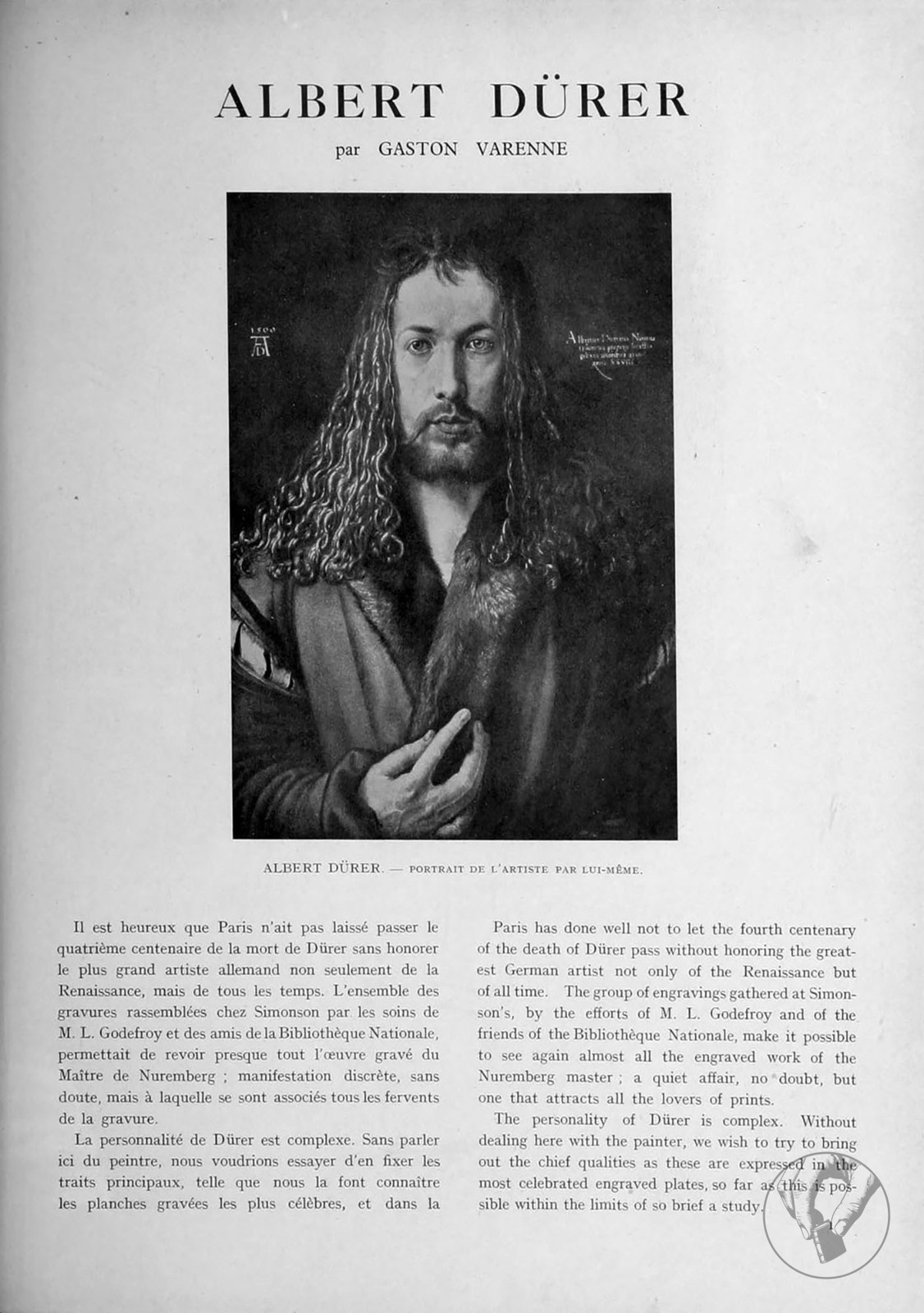
ALBERT DÜRER. — PORTRAIT DE L’ARTISTE PAR LUI-MÊME.
Il est heureux que Paris n’ait pas laissé passer le quatrième centenaire de la mort de Dürer sans honorer le plus grand artiste allemand non seulement de la Renaissance, mais de tous les temps. L’ensemble des gravures rassemblées chez Simonson par les soins de M. L. Godefroy et des amis de la Bibliothèque Nationale, permettait de revoir presque tout l’œuvre gravé du Maître de Nuremberg ; manifestation discrète, sans doute, mais à laquelle se sont associés tous les fervents de la gravure.
La personnalité de Dürer est complexe. Sans parler ici du peintre, nous voudrions essayer d’en fixer les traits principaux, telle que nous la font connaître les planches gravées les plus célèbres, et dans la
Paris has done well not to let the fourth centenary of the death of Dürer pass without honoring the greatest German artist not only of the Renaissance but of all time. The group of engravings gathered at Simonson’s, by the efforts of M. L. Godefroy and of the friends of the Bibliothèque Nationale, make it possible to see again almost all the engraved work of the Nuremberg master; a quiet affair, no doubt, but one that attracts all the lovers of prints.
The personality of Dürer is complex. Without dealing here with the painter, we wish to try to bring out the chief qualities as these are expressed in the most celebrated engraved plates, so far as this is possible within the limits of so brief a study.
Page 2
LA RENAISSANCE
ALBERT DÜRER. — ADAM ET ÈVE.
GRAVURE SUR CUIVRE.
faible mesure où le permet une aussi brève étude.
Héritier de l'esprit et des traditions dont Schon-
gauer avait enrichi l'art allemand, c'est-à-dire pénétré
de la meilleure tradition du gothique, continuateur non
pas d'un art local et purement nurembergeois, mais de
cet art haut-rhénan qui constitue, à la fin du xve siècle,
la plus parfaite expression du génie plastique de l'Alle-
magne, Dürer subit fortement l'influence de l'Italie,
aux environs de 1495. Quel sera le résultat de ce heurt
entre deux civilisations ? Problème éternel que posera
désormais l'art allemand à presque tous les tournants de
son évolution et que, pour la première fois, Dürer nous
force à envisager.
Dans son très beau livre consacré à l'art de Dürer,
Henri Wölfflin a parfaitement compris le tragique de
cette rencontre et de la fascination qu'devait exercer.
Heir of the spirit and of the traditions with which
Schongauer had enriched German art, that is to say,
penetrated with the best Gothic tradition, preserver
not of a local art of Nuremberg alone, but of that art
of the upper Rhine which constituted, at the end of
the XVth Century, the most perfect expression of the
plastic genius of Germany, Dürer was greatly influenced
by Italy, about 1495. What will be the result of this
coming together of two civilizations? That is the eter-
nal problem which German art will set hereafter at
almost every turn of its evolution, and which Dürer
forces us to face for the first time.
In his very fine book devoted to Dürer's art, Henri
Wolfflin has perfectly brought together the tragic ele-
ment of this collision and the fascination which the
powerful genius of a Mantegna was bound to exercise
Page 3
LA RENAISSANCE
ALBERT DÜRER. — LA GRANDE FORTUNE.
GRAVURE SUR CUIVRE.
sur un artiste germanique le talent puissant d'un Mantegna. L'art allemand pouvait y sombrer. Le génie de Dürer sortit victorieux de l'épreuve. On s'en rend compte en comparant le style tout linéaire des gravures de Schongauer et des premiers dessins de Dürer avec celui des planches qu'il compose après avoir étudié ou copié les œuvres de Mantegna, de Lorenzo di Credi et de Pollajuolo. Le dessin conservé à l'Albertina de Vienne, inspiré du Combat de Tritons de Mantegna, montre clairement le sens dans lequel il veut évoluer. Les bois ne permettent pas de juger parfaitement l'élargissement de l'art de Dürer à cette époque. Le métier le condamnait, malgré lui, à rester l'esclave de la ligne. Du moins sait-il lui donner une valeur décorative qu'on ne rencontre pas avant lui et, dès l'achèvement en 1492, de l'Apocalypse où il se rattache encore à la tradition upon a German artist. German art might have been overcast by it. The genius of Dürer came through the test victorious. One sees this in comparing the altogether linear style of Schongauer engravings and of the first designs of Dürer with that of the plates he composed after having studied or copied the works of Mantegna, of Lorenzo de Credi and of Pollajuolo. The design preserved at the Albertina museum of Vienna, inspired by the Combat of Tritons by Mantegna, shows clearly the direction in which he desired to develop. Wood engravings do not allow us to judge perfectly of the enlarging of Dürer's art in this period. The method forced him, in spite of himself, to remain a slave to the line. At least he is able to give it a decorative value that one does not find before him and from the time of the creation, in 1492, of the Apocalypse where he
Page 4
LA RENAISSANCE
ALBERT DÜRER. — LES CAVALIERS DE L’APOCALYPSE.
populaire de la Bible de Cologne de 1480, il témoigne d’un souci nouveau de style. Jamais le bois gravé n’avait atteint en Allemagne à cette puissance expressive et à cette grandeur. Le génie germanique cherchait, pour la première fois, à se libérer de toutes ses hésitations, de ses petitesesses, de ses mesquineries et il y parvenait par un effort encore visible qui, de plus en plus, semblera aisé et naturel. La Grande Passion, depuis longtemps sur le chantier et terminée après 1510, conserve les mêmes qualités. Dans la Vie de la Vierge exécutée entre 1505 et 1511, nous retrouvons plus d’intimité, plus de soucis purement descriptifs. Le sujet le voulait et cette œuvre charmante prouve que le génie de Dürer sut préserver, même après l’étude des graveurs italiens, le meilleur des dons qu’il devait à sa sensibilité germanique. Ces dons n’empêchent pas des qualités nouvelles de se révéler. Une répartition plus nuancée, plus habile still holds to the popular tradition of the Cologne Bible of 1480, he testifies to a new attention to style. Never had wood engraving attained that expressive power and that greatness in Germany. For the first time, German genius sought to free itself from all hesitation, from all pettiness, from its beggarly limitations, and it succeeded by an effort still visible, which will become more and more effortless and instinctive. The Grand Passion, which was long in the workshop and was finished after 1510, keeps the same qualities. In the Life of the Virgin, done between 1505 and 1511, we find more intimacy, more care for purely descriptive elements. The subject makes it possible, and this charming work proves that the genius of Dürer knows how to keep, even after study of Italian engravers, the best of the gifts that he owes to his Germanic feeling. These gifts do not prevent new qualities from revealing
Page 5
LA RENAISSANCE
ALBERT DÜRER. — LE CHEVALIER, LA MORT ET LE DIABLE. — GRAVURE SUR CUIVRE.
que jamais, de la lumière et de l'ombre, voilà le gain certain dû à l'étude des œuvres de la Renaissance italienne. L'aboutissement en sera la Petite Passion, sur bois, achevée vers 1521 et la plus populaire des Passions de Dürer.
C'est dans ses cuivres toutefois que Dürer nous donne la plus parfaite expression de son génie. Ils méritent une étude des plus attentives si l'on veut y noter l'heureux équilibre réalisé entre les dons naturels d'un artiste et les qualités acquises. Les premiers essais trahissent les années d'apprentissage passées dans l'atelier d'un orfèvre. La Madone à la sauterelle, la Madone au Singe et l'Enfant prodigue marquent ce point de départ. Après la révélation de l'habileté des Italiens à représenter le corps humain dans sa nudité harmonieuse et non plus écrasé sous les lourds vêtements à plis anguleux dont les artistes allemands du xve siècle n'avaient pas réussi à themselves. A more delicate, more skilful, dividing of light and shadow, that is the certain profit of the study of works of the Italian Renaissance. The final result will be the Little Passion on wood, finished about 1521 and the most popular of Dürer's Passions.
It is always in his copper plates that Dürer gives us the most perfect expression of his genius. They are worth most careful study, if one would see the happy balance of the original gifts of an artist and acquired qualities. The first efforts show the apprentice years passed in a goldsmith's workshop. The Madonna at the Locust, the Madonna at the Monkey and the Prodigal Son mark this point of departure. After the revelation of the skill of Italians in representing the human body in its harmonious nudity and no more weighed down under the heavy garments with angular folds from which German artists of the Fifteenth Cen-
Page 6
LA RENAISSANCE
alléger le poids, Dürer hésite. Il sent l'infériorité où il se trouve encore à leur égard. Il cherche à se hausser à leur niveau. Si l'on voulait suivre l'admirable série de ses essais jusqu'au moment où il parvient à son tour à une maîtrise qui sauvegarde sa vraie personnalité, il faudrait étudier successivement son Sébastien à la colonne, les Quatre Sorcières de 1496, son Adam et Eve de 1504, dont il reprend le thème dans son tableau de 1507, exécuté au retour du voyage à Venise et, sans parler de planches moins importantes ou moins connues, aboutir à la Grande Fortune, pièce merveilleuse où Dürer nous apparaît affranchi, dans la fermeté de son écriture, de toute imitation étrangère, où il a retrouvé la saveur de l'accent germanique. Et il faudrait joindre à l'examen de ces œuvres le Bain des hommes, un des rares bois, dû peut-être à l'influence de Michel-Ange, où Dürer tenta une étude de nus aussi poussée.
Les seize cuivres de la Petite Passion, puis le Saint Jérôme qui ne figurait pas, malheureusement, à l'Exposition de la rue Caumartin et la Mélancolie de 1514 témoignent enfin de la façon la plus nette des résultats pour l'art allemand de ses contacts avec l'Italie. La forme est d'une sûreté qui est voisine de la perfection et ces qualités formelles, Dürer ne les a pas acquises par le sacrifice de sa sensibilité, par une déformation de son tempérament et de sa vision. Rien de plus allemand que ces deux sujets : Saint Jérôme méditant dans sa cellule et poursuivant le rêve intérieur qui l'emplit tout entier et cette femme aux ailes inutiles et repliées, entourée de tous les symboles du savoir humain dont elle éprouve la vanité. Et le Chevalier, la Mort et le Diable ne garde pas moins une saveur profondément germanique, lors même que le cheval est traité visiblement d'après le projet de Léonard de Vinci pour le monument équestre de François Sforza.
Le voyage en Hollande n'eut pas pour, Dürer graveur, une importance aussi grande que ses voyages en Italie. Il intéresse surtout le peintre. Il lui fait retrouver, après la cinquantaine, après tant d'années de luttes et d'efforts, une seconde jeunesse. Il lui apprend à regarder de nouveau la nature, dans ses moindres détails, avec des yeux naïfs, certain qu'il est de ne plus s'égarer, habitué désormais à subordonner chaque détail à l'ensemble qui seul doit lui donner sa pleine signification. Il a trouvé l'équilibre qui fait les grands artistes. Jamais il ne sera plus simple, plus vrai et plus émouvant et, à défaut de gravures capables d'en témoigner suffisamment, ce sont les figures des quatre apôtres de Munich qui montrent le terme définitif de son évolution. L'art allemand, avec des œuvres de cette qualité, atteignait sa majorité.
La conciliation, voulue par Dürer, entre la forme latine et la pensée germanique, est celle que Goethe poursuivra tury had not succeeded in lifting the load, Dürer hesitates. He feels his inferiority in comparison with them. He seeks to raise himself to their level. If one would follow the admirable series of his attempts up to the moment when he in his turn arrives at a mastery which guards his true personality, it is necessary to study in their order his Sebastian at the Column, his Four Sorcerers of 1496, his Adam and Eve of 1504, of which he takes up the theme once more in his painting of 1507, done on the return from a trip to Venice, and without referring to plates less important or less known, end with the Great Fortune, the marvelous piece in which Dürer appears to us liberated, in the firmness of his handiwork, from all foreign imitation, in which he has recaptured the tang of Germanic accent. And to the examination of these works should be joined the Bath of Men, one of the rare wood engravings which owes something perhaps to the influence of Michelangelo, in which Dürer tries an extreme study of nudes.
The sixteen plates of the Little Passion, then the Saint Jerome which does not figure, unfortunately, in the rue Caumartin exhibition, and the Melancholy of 1514 testify, finally, in the clearest fashion to the results of contacts with Italy on German art. The form is of a certainty that neighbours on perfection, and these formal qualities Dürer did not acquire by the sacrifice of his feeling, by any deforming of his temperament and his vision. There is nothing more German than his two subjects : Saint Jerome meditating in his cell and following the inner dream which wholly absorbs him, and that woman with wings useless and folded, surrounded with all the symbols of human knowledge of which she has proven the vanity. And the Knight, the Death and the Devil hold no less of a quality profoundly Germanic, although the horse obviously suggests Leonardo da Vinci's plan for the equestrian statue of Francesco Sforza.
The trip to Holland had no such importance for Dürer the engraver as his trips to Italy. It interests the painter chiefly. It helped him to find again, in his fifties, after so many years of struggles and of attempts, a second youth. It taught him to see nature freshly, in her smallest details, with eyes naive, sure that he will not go astray, having acquired the habit of subordinating every detail to the whole effect, which alone must give it the full significance. He has found the equilibrium which makes great artists. Never has he been more simple, more true and more moving and for want of engravings capable of bearing strong enough witness to this, there are the figures of the four apostles, of Munich, which indicate the definitive period of his evolution. With works of this quality, German art attains its majority.
Page 7
LA RENAISSANCE
jusqu'au moment où, lui aussi, par des voies différentes, avec d'autres moyens, une ampleur infiniment supérieure à celle à laquelle peut prétendre Dürer, il parvient à un équilibre qui demeure l'expression d'un même trouble de la pensée et de l'instinct germaniques devant le monde de beauté révélé par l'art des peuples latins. Mais c'est à Dürer que revient le mérite d'avoir établi, pour la première fois en Allemagne, les vrais rapports entre la nature et l'art. Au terme de sa longue expérience, Goethe ne fait que confirmer, trois siècles plus tard, la nature de ces rapports devinés par Dürer, en disant que l'art n'est pas entièrement soumis aux lois naturelles, qu'il obéit aussi à des lois qui lui sont particulières. « Les liens entre l'artiste et la nature, ajoutait-il, ont un double caractère : l'artiste est à la fois le maître et l'esclave de la nature. Il est son esclave en ce sens qu'il lui faut se servir des moyens naturels pour être compris, mais il est son maître en tant qu'il met ces moyens naturels au service d'une idée supérieure. »
Malgré quelques erreurs regrettables dans les jugements portés par Goethe sur Dürer, lorsque le classicisme l'eut écarté définitivement de ce qu'il appelait « l'art caractéristique » reconnu d'abord pour le seul vrai, n'est-il pas curieux de constater que, sur un point au moins, leurs pensées s'étaient rencontrées. « Un bon peintre, écrivait Dürer, a l'imagination pleine de figures et s'il pouvait vivre éternellement, ses idées, suivant l'expression de Platon, produiraient toujours quelque chose de nouveau. L'art se féconde de lui-même, grandit et porte des fruits de son espèce. Le mystérieux trésor amassé au fond de son cœur se révèle alors au moyen des œuvres et de la créature nouvelle que l'on tire de son sein en lui donnant une forme sensible. »
La rencontre entre les deux génies s'est faite au point précis où nous constatons, chez l'un comme chez l'autre, un même fonds de sensibilité germanique qu'ils ne sacrifient pas à l'ennoblissement de leur langage et de leur style. C'est par là qu'ils demeurent les représentants les plus autorisés de la pensée et de l'art de leur pays, quelles que soient les différences profondes qui les séparent par ailleurs.
The union desired by Dürer between Latin form and Germanic thought is that which Goethe pursued up to the point where he also, by different ways, by other means, a scope infinitely wider than that to which Dürer could aspire, arrived at a state of equilibrium which remains the expression of a like questioning of Germanic thought and instinct before the world of beauty revealed by the art of the Latin peoples. But to Dürer goes the credit of having established for the first time the true relations between nature and German art. Goethe only confirmed, three centuries later, the nature of these relations divined by Dürer, in saying that art is not wholly submissive to natural laws, that she also obeys laws that are for her alone. " The bonds between the artist and nature", he adds, "have a double character: the artist is at once master and slave of nature. He is her slave in the sense that he is obliged to use natural means to be understood, but he is her master so far as be puts these natural means at the service of a superior thought". On spite of some regrettable errors in the judgments passed by Goethe upon Dürer, when classicism drew him definitely away from what be called " specialized art ", at first considered the only kind that was true, is n't it odd to find that on one point at least their views are harmonious. " A good painter, wrote Dürer, has an imagination full of figures and if he could live forever, his ideas, following the expression of Plato, would produce always something new. Art fertilizes itself, increases and bears fruits of its own kind. The mysterious treasure amassed in the depths of his heart reveals itself then by means of his works and of the new creature that one draws from his breast, giving it tangible form."
The meeting between these two men of genius comes at the precise point where we perceive in one as in the other the same basic German feeling which they do not sacrifice to the elevation of their language and their style. That is why they remain the most authoritative representatives of the thought and the art of their country, whatever profound differences may otherwise hold them apart.
ALBERT DÜRER.
LA VIERGE ALLAITANT L'ENFANT JÉSUS.
Page 8
WILLIAM GRIMM
par, PAUL-SENTENAC
WILLIAM GRIMM. — PAYSAGE DE SAINT-PAUL (PROVENCE). — COLLECTION VALLOMBROSA.
Au Quai de Bourbon, dans un vieil hôtel d’autrefois, une large salle dont les trois fenêtres s’ouvrent sur des verdures ensoleillées et sur les eaux argentées de la Seine. Sous le vent léger d’une fin de journée d’été, se reflète sur le tapis, qui étale au milieu de la pièce la bigarrure de ses couleurs, le frissonnement des branchages du dehors dont toutes les feuilles renvoient du soleil comme des milliers de petits miroirs. Sur la cheminée, une statue de Jésus, taillée naïvement dans le bois, propose une méditation mystique. Des livres d’art, des recueils artistiques rapprochent les tons clairs, des couvertures et des dos, sur les rayons ou sur la table basse. Ambiance appropriée au recueillement d’un poète. Pourtant, dans un coin de la pièce si lumineuse, sur un chevalet, une toile est commencée ; des callas jaunes se dressent, tels des jets d’eau, et s’évasent comme
On the Quai de Bourbon, in an old house of other days, a large room whose three windows open on verdure brightened by sunshine and upon the silver waters of the Seine. Under the light wind of the close of a summer day, upon the many colors of the carpet in the middle of the room, comes the reflection of the trembling branches outside, where all the leaves send back the sun like thousands of little mirrors. Upon the mantelpiece, a statue of Jesus naively carved in wood suggests a mystical meditation. Books on art, artistic treatises, bring together the bright tones of their sides and backs, upon shelves or on the low table. Appropriate surroundings for the meditation of a poet. Nevertheless, on an easel in a corner of so bright a room, a canvas is begun; yellow calla lilies, rise like streams of water and spread out as in a fountain, beside some
Page 9
LA RENAISSANCE
des vasques auprès de quelques pêches veloutées. A côté du chevalet, une palette offre de larges coulées de jaune et de carmin.
C'est donc là le cadre entourant non le travail d'un poète mais celui d'un peintre, William Grimm. La Comtesse de Vallombrosa, avec sa finesse habituelle, a pensé que ces lieux se trouvaient destinés à abriter le labeur et la vie familiale du peintre qu'elle protège, parce qu'elle sent particulièrement son art. Cette vieille demeure d'autrefois, édifiée par Le Vau, l'architecte du célèbre hôtel Lambert tout voisin, se montrait favorable pour reprendre la tradition des siècles passés où les gentilshommes et les dames de l'aristocratie s'honoraient en patronnant les peintres et les sculpteurs. Le financier Crozat hébergeait en son domaine de Montmorency la mélancolie d'un Watteau. M. de la Live de Jully donnait l'hospitalité dans son hôtel au tableau de Greuze, Le Père de famille lisant la Bible à ses enfants, et conviait ses amis à l'y venir voir. La protection du Duc de Choiseul permettait au paysagiste Hubert Robert de partir pour Rome. Et que d'exemples de ce genre encore.
Pourtant, ma première impression ne m'avait pas tout à fait trompé, lorsqu'elle m'avait représenté que ce calme logis du Quai Bourbon prêterait le décor le plus opportun à un écrivain. Le peintre Grimm m'a fait une confidence. Le premier mode d'expression d'âme qu'il avait envisagé avait été tout d'abord non la palette et le pinceau mais la plume et l'encrier. William Grimm se complaisait et se cherchait dans la lecture des autobiographies d'un Jean-Jacques Rousseau, d'un Stendhal ou d'un Benjamin Constant. Tourmenté par le désir de se raconter, cet artiste était inquiété pourtant par
WILLIAM GRIMM. — PORTRAIT DE LA COMTESSE DE VALLOMBROSA. COLLECTION VALLOMBROSA.
velvet peaches. Near the easel, a pallet offers large supplies of yellow and of carmine.
So this is the frame surrounding the work not of a poet, but of a painter, William Grimm. The Comtesse de Vallombrosa, with her usual fine feeling, had the idea that such a place was the right one to shelter the everyday life of the painter of whom she is the patroness, because she responds particularly to his art. This old dwelling once built by Le Vau, architect of the famous neighboring Lambert house, proves to be the right place to continue the tradition of past centuries when gentlemen and ladies of the aristocracy counted it an honor to be the patrons of painters and of sculptors. The financier Crozat harbored the melancholy of a Watteau in his domain at Montmorency. M. de La Live de Jully gave the hospitality of his house to the Greuze painting, “The Father of a Family Reading the Bible to His Children”, and he invited his friends to come and see it there. The patronage of the Duc de Choiseul made it possible for the landscape artist Hubert Robert to go to Rome. And how many other examples there are of that kind.
Nevertheless my first impression did not lead me altogether astray, when it made me feel that this calm dwelling on the Quai de Bourbon carried the most admirable setting for an author. The painter Grimm took me into his confidence. The first means of soul expression that he dreamed of was not the pallet and brush but the pen and inkwell. William Grimm found himself at home and made explorations in the autobiographies of a Jean Jacques Rousseau, of a Stendhal or of a Benjamin Constant. Tormented by the desire for
Page 10
LA RENAISSANCE
le désaccord entre son tempérament, lequel le poussait à le faire avec une grande franchise, directement, et son esprit qui lui imposait une certaine attitude de retenue, de discrétion; et aussi ses aspirations vers l'idéalisme. Aussi abandonna-t-il le livre, où il est difficile de résister à son penchant de tout dire, pour la peinture où les confessions de l'auteur, s'habillant du vêtement plastique, deviennent moins personnelles.
L'artiste, dès lors, fut amené à se révéler en traduisant la physionomie des personnes qu'il portraiturait. On retrouve dans ses portraits ce goût pour la vérité qu'il nourrit profondément en lui. Les relations mondaines qu'à nouées à Paris William Grimm dans la haute société, tant française qu'étrangère, ont amené devant son chevalet de délicats visages féminins aux traits raffinés, des attitudes distinguées dans des robes de grands couturiers. Le peintre a su traduire l'élégance racée de ses modèles en des portraits marquants comme celui de la Comtesse de Vallombrosa, de Mme Hays, de Mlle Hays, de Mme Manloe, de Mlle Murphy, de Mme Litetsky, de l'artiste Hélène Dufau. On ne découvre dans ses figures aucun maniériste, aucune afféterie, aucune exagération dans la grâce factice allant jusqu'à la mièvrerie. Les femmes du monde, peintes par Grimm, montrent toute l'aristocratie de leur personne avec simplicité, sans ces contorsions des bras ou des chevilles dont certains portraitistes en renom se croient obligés de les gratifier. Grimm les représente dans des poses naturelles. Celle-ci tient un petit chien, celle-là croise ses mains fines sur son genou. Le peintre les observe et les voit en psychologue. Car toutes ces figures fémis-
WILLIAM GRIMM. — PORTRAIT DU COMTE DE VALLOMBROSA. COLLECTION VALLOMBROSA.
self-expression, this artist was troubled, on the other hand, by the lack of harmony between his temperament which urged him to the frankest utterance and his spirit which imposed upon him a certain attitude of restraint, of discretion, and also his aspirations toward idealism. So he gave up the book, where it is difficult to resist his tendency to say everything, for painting, in which the confessions of the author, being clothed in plastic garments, become less personal.
Beyond that, the artist was drawn to self revelation in translating the features of the persons of whom he did portraits. In his portraits may be found this love of truth that he has cherished deeply within himself. The worldly relations which have tied William Grimm to Paris in high society, as much French as foreign, have drawn to his easel delicate feminine faces with fine lines, distinguished attitudes, in gowns by the great couturiers. The painter has been able to translate the racial elegance of his subjects in notable portraits like that of the Comtesse de Vallombrosa, of Mrs. Hays, of Miss Hays, of Mme. Manloe, of Miss Murphy, of Mme. Litetsky, of the artist Hélène Dufau. In his portraits one finds no mannerism, no affectation, no exaggeration of artificial grace running into an arch pretence of gayety. The women of the world painted by Grimm show all the aristocratic elements of their form with simplicity, without those contorsions of the arms or ankles by which certain famous portraitists think they are obliged to please their subjects. Grimm represents them in natural poses. This one holds a little dog, that one crosses her fine hands over her knee.
Page 11
LA RENAISSANCE
WILLIAM GRIMM.
PORTRAIT DE FLORENCE LUCIUS.
nines pensent devant nous. A ce point de vue, le portrait de la jeune romancière américaine Anita Loos, l'auteur de ce curieux livre dont le succès a été si vif en Amérique, puis à Paris, Les gentlemen préfèrent les blondes, est des plus significatifs. L'aspect de cette jeune femme brune, à la silhouette de jeune garçon avec ses cheveux coupés, s'affirme des plus impressionnants. Pourtant nul moyen particulièrement démonstratif n'a été employé par le portraitiste dans la réalisation de cette figure, laquelle se présente de trois quarts, presque de profil, sans aucun accessoire autour d'elle, à mi-jambes, de sorte qu'on peut se demander si elle est vêtue d'un fourreau féminin ou d'un pyjama. Mais l'intensité du regard absorbé dans la pensée est vraiment saisissante. Le fluide de l'âme semble lui sortir par les yeux. Ainsi William Grimm s'attache à rendre le caractère distinctif de chacun de ses modèles féminins, sans mensonge. Ce diable d'homme ne sait pas farder la nature, il ne peint pas avec des crayons de fard. Il a exécuté de son épouse un portrait caractéristique, vivant, au sujet duquel un ami a fait à peu près cette réflexion « C'est le portrait de la femme vue par le mari ! » Réflexion juste et qui voulait traduire simplement que le peintre connaissait bien le modèle qu'il portraiturait et ne fixait pas ses traits à la légère. La conception que Grimm a du portrait s'apparenterait plutôt, par la sobriété dépouillée, par l'accent de la
WILLIAM GRIMM.
PORTRAIT DE LA JEUNE ROMANCIÈRE AMÉRICAINE ANITA LOOS.
The painter observes them and sees them with the eye of a psychologist. For all these feminine figures think before us. From this point of view, the portrait of the young American novelist, Anita Loos, author of that curious book the success of which was so great in America and then in Paris, “Gentlemen Prefer Blonds”, is the most significant. The aspect of this dark young woman with a young boy’s silhouette and bobbed hair is most impressive. Nevertheless, no specially marked way of getting the result has been employed by the portraitist in execution of this figure, which is of three-quarters length, almost in profile, without any accessory detail, so that one might ask if she were dressed in a girl’s frock or pyjamas. But the intensity of a look absorbed in thought is truly striking. The fluid of the soul seems to flow from her eyes. So William Grimm sets himself to the rendering of the distinctive character of each of his feminine subjects, without telling any falsehood. This devil of a man does not know how to whitewash nature, he does not work with a lying brush. He has done a characteristic, living, portrait of his wife, in regard to which a friend made this remark : “ It is the portrait of the wife seen by the husband! ” A just judgment, which means simply that the painter well knew the subject portrayed and did not express her qualities superficially. The conception which Grimm has of the portrait is evident first of all in the