Page 1
au jour d'hui numéro spécial art et architecture
Premières pages de l'ouvrage, en accès libre.
au jour d'hui numéro spécial art et architecture
VIe FESTIVAL DES ARTS PLASTIQUES DE LA CÔTE D’AZUR 24 MAI - 30 JUIN ANTIBES • CANNES • MONACO NICE • SAINT-PAUL-DE-VENCE --- - Dans le programme général des manifestations du FESTIVAL DU MARAIS XVIIIe Salon de la JEUNE SCULPTURE 7 juin • 15 juillet Place des Vosges Paris IV --- pierre matisse gallery baltbus dubuffet giacometti butler le corbusier millares calliyannis miró marini macIver tanguy riopelle roszak saura rivera new york 41 east 57
AU JOURD'HUI art et architecture NOUVELLE VERSION --- grande bretagne aujourd'hui art et architecture --- aujourd'hui numéro spécialement le Corbusier la vie est sans pitié numéro spécialement le Corbusier --- aujourd'hui italie art et architecture numéro 46 --- NUMÉROS DISPONIBLES - JAPON - ITALIE - GRANDE BRETAGNE - ESPAGNE France 11 F Etranger 13 F - LE CORBUSIER France 15 F Etranger 17 F --- NUMÉROS A PARAITRE FRANCE LA JEUNE AMÉRIQUE EUROPE FRANK LLOYD WRIGHT L'ÉCOLE DE F. L. WRIGHT --- BULLETIN DE COMMANDE A RENVOYER A AUJOURD'HUI 5 RUE BARTHOLDI 92 BOULOGNE FRANCE --- Veuillez noter : mon abonnement à la revue AUJOURD'HUI à partir du n° ___________________________ Abonnement 1 an : 5 numéros : France 57 F Etranger 14,10 dollars Règlement par chèque mandat virement au CCP Paris 1519:97 La commande suivante Frais de port en sus : par exemplaire, France : 1,50 F ; Etranger : 2 F Nom ______________________________________________________ Date _________________________ Adresse ___________________________________________________ Signature _____________________
Publishers of Original Graphics and Multiple Originals $\mathcal{ea}$ Editions Alecto 27 Kelso Place London W8 Western 6611 Bernard Cohen Alan Davie Robyn Denny Jim Dine Richard Hamilton David Hockney Howard Hodgkin Allen Jones Kenneth Noland Eduardo Paolozzi Peter Sedgley Richard Smith --- GALERIE IRIS CLERT 28 rue du Faubourg St Honoré Paris 8 265-32-05 •• Le Palais des Miroirs •• ERIK BORJA ET MONCHÂTRE à partir du 28 juin --- GALERIE DENISE RENÉ 124 rue La Boétie Paris 8° 359.93.17 VASARELY œuvres récentes JUIN 1966 --- $\mathcal{qu}$ ARTE CONTEMPORANEA - Une nouvelle revue d'art née d'une exigence de jour en jour plus forte : éclaircir le moment artistique par le moyen le plus efficace. - N° 1, mai 1966. London as an art center, by Charles S. Spencer. Attualità di Boccioni, di Elio Mercuri. Boccioni e l'avanguardia futurista, di Marisa Volpi. Pol Bury, par André Balthazar. Biennale di Sao Paolo, di Giovanni Carandente. Le nouveau Musée d'Israël, par William J. Sandberg. Die Bewegung des Lichtes : Heinz Mack von Jürgen Claus. Cronache, recensioni, aste e mercato d'arte. - N° 2, septembre 1966. La Biennale di Venezia. - Le numéro Lit. 1 300 • Etranger $ 3. Abonnement 1 an • 4 numéros • Italie Lit. 5 000 • Etranger $ 10 • - Administration • Abonnement • Publicité - EDITALIA, via di Pallacorda 7, Rome. C.C.P. 1/10228.
AUJOURD'HUI N° 53 SCULPTURE SPACE - ARCHITECTURE SPACE --- NATURE. NATURE'S ARCHITECTURE. Julien Alvard. What is the meaning we must give to nature’s architecture, can it be imitated, is this imitation desirable? Luigi Figini chooses the church of St. John the Baptist designed by Michelucci to seek the limits between art and nature which he sees separated by a “great wall of China”. However man forms part of nature, therefore his works are those of nature. But he must defend himself against nature. Thus it is that to serve nature, we must copy it although this idea has weakened during the twentieth century. Figini discovers in nature forms similar to those modeled by man, and considers that they were a source of inspiration. In any case it must be admitted that we are now ready to cast a fresh glance at nature which reveals two kinds of natural architecture, the first of which may be used as a model, the second being only a element to impress the imagination. Rocks, grottos, islands were chosen for protection and defense, but they should only be used as a stimulus for the imagination. They offer the impression of overwhelming scale now copied in bridges, dams any skyscrapers, thanks to modern techniques. It is certainly in this direction that humanity’s will for power can best be expressed. The second sphere in which the use of nature is evident is in the development of sculpture-architecture such as in the work of Etienne Martin-Michelucci, André Blec. They are above all dwelling-sculptures and we must note that Mondrain-style architecture progresses parallel with the return of interest for wild and primitive things, and archeology. Is this regret for the past or desire to stay in contact as long as possible before we are pushed further on? Nature seems to suffer from this acceleration of progress, turning us to study its martyrdom to find forms to reproduce. However in Europe few sites have been left unadulterated, but we have retained the love of high-perched fortresses. The author concludes his article by choosing examples of natural architecture from Africa-rocks and mountains particularly in Mali; sand, a fluid material which transforms into other forms of nature, being in turn itself transformed by wind, the forms evolved are streamlined or undulating, recalling the best creations in plastics; snow generates the most perfect curves possible; volcanoes work to modify and level angular surfaces of the earth, when in eruption their accelerated creative movement is still beyond our reach; water, a major creating agent, be it sea or river, provokes numerous examples of its architectural powers, down to the iceberg, which is an excellent floating city, doubles with a high psychic potentiality since they have given to mankind the idea that God lives there in paradise; biological architecture, the most complicated of natural architectures, where the human body has been taken into consideration at least spiritually for building (the body Christ and the plan of a church). Nature encourages us to shelter from her changes of mood, but we must learn to take possession of sites without spoiling them by dwellings as did F.L. Wright, and even go further. This calls for another way of thinking than that of the builder who aspires first of all to a “large bay overlooking a sea view”. --- VINCENNES ZOO. Patrice Goulet. The Vincennes Zoo is one of the most magic places in Paris, where cliffs, rocks and grotto form man-made savage scenery already transformed by time and vegetation to look like nature’s work. It gives the impression of waiting for a weakness on the part of man to revolt and become a jungle or a nightmare ruin where the animal will be king. --- NOTES ON MOTORWAY CHURCH. Luigi Figini. Do limits exist between the works built by man and those built by nature? Who can separate them? Is man really on one side and Nature on the other, or are there breaches in this “great wall of China” which allow infiltrations? To build spectacular monuments, nature has worked with the T-Square and the plumb line, or without them, by “feeling”, or with a mixture of these three “tools”. Man has not always superimposed lines and volumes to Nature, he has some collaboration which leads nevertheless to contamination like the Harmakis temple, the tombs at Petra, the grottos of Ajanta. Often nature with its models has proposed its own types from the organic splendour of the human or animal body to the geometrical splendour of quartz crystals, the egg, the snail’s shell, the informal splendour of rock formation, icebergs etc: Northern forests live again in Gothi architecture, Gaudi discovered in imported tree fruits inspiration for the collars. In the design of this church we are faced with a kind of controlled anarchy not unlimited, but on the contrary within the limits of a form of autoimposition working on the lines of a programme with predetermined arbitration margins (which, how many, how). This complex architecture illustrates the non-representability of its form by normal graphic methods. Only three-dimensional modelling could help but Michelucci works without modelling to reunite unpredictable sequences of space which means we must have a sixth sense unknown to others. Since Creation, nobody has created from nothing, the artist is never a traveller without luggage, since he has his private world of “sympathy”, conscious or unconscious affinities all of which he can never leave since they will always belong to him, in spite of himself. The church has been called informal architecture, but this seems unjust. Michelucci’s art is premeditated from the beginning, nothing is left to improvisation, even if new variations or regrets are added. He does not wait for the god of chance or the demon of unconsciousness to tell him to stop, he knows how, why and where he wants to come. It has also been called existentialist and its deep religiousness are sufficient to refute this. It is far removed from the existential spirit which all costs Figini prefers to choose the definition of natural architecture brought to a more natural significance. --- NATURAL FORM AND ARCHITECTURE. Enzio Gianotti. The first models of shelter, protection, order, were copied by man from nature, at first directly and later as a means. It is the modification of certain ethical values, conditioning all the structure and expressions of life which alter the organic balance of architecture and which develop the dynamic power, the verticality along lines of centrifugal force. The abandon of a static conception of life in favour of another dynamic separates architecture form nature, interrupting cosmos. The architecture of ancient times was so accustomed to a monumental and self-contained conception of form that it developed in measures and rhythms which draw from sculpture the decorative intention and symbolic significances to the highest degree, expressed most perfectly in Greece. Architecture became not only sculpture’s servant, but it became sculpture. Mathematics triumphed in the Acropolis, Ictinos would have sculptured a temple from a solid block of marble had it been possible, since he was not preoccupied by structure. --- ARCHITECTURE WITHOUT ARCHITECTS. Bernard Rudofsky. Architectural history as taught in the Western world, has never been concerned with more than a few select cultures — Europe, Egypt, Anatolia. Moreover the evolution of architecture is dealt with only in its late phases, to be explained by the scarcity of monuments, but the discriminative approach of the historian is due to his parochialism. It is also biased on the social plane, an anthology of buildings of, by and for the privileged with no mention of the dwellings of lesser people. The exhibition “Architecture without Architect” attempts to introduce the non pedigreed architecture unfortunately a view distorted by a shortage of documents, visual and otherwise. Alluding to possible sources of information Rudofsky finds the Bible disconcerting in its episodes on the city built by Cain and the Ark, but considers that on the other hand, the impious who prefer to turn to science in their quest for the origins of architecture will have to accept indigestible facts, such as the precise cious dam science of leaves and the intelligent habits of orang and apes. Yet once believed no and beast walked the earth, some kind of architecture existed, coarsely modeled by the primeval forces of creation, polished by water and wind into elegant structure. Although exotic arts have long been appreciated in the Western world, exotic architecture has evoked no response. No --- English Summary
literature exists on the subject, and our attitude remains condescending. The exhibition is non-technical, comparing the serenity of architecture in underdeveloped countries with architectural blight in industrial countries. It seems as on communal enterprise and we have much to learn from it. It demonstrates an admirable talent for fitting buildings into natural surroundings, welcoming the vagaries of climate and the challenge of topography. The tendency to build on sites of difficult access can be traced no doubt to a desire for security but perhaps even more to the need of defining a community’s borders. Walls help to thwart undesirable urban expansion. Innocent as we are of urbanistics, we exhaust ourselves in architectural proliferation. We ascribe to all specialists exceptional insight into problems of living when in truth most of them are concerned with problems of business and prestige. Besides the art of living is now neither taught nor encouraged. This situation came about through the diligence of the historian, who emphasized the part played by architects and their patrons, but obscured the talents and achievements of anonymous builders. The beauty of this architecture has long been dismissed as accidental but now we should be able to recognize it as a result of rare good sense in the handling of practical problems. Transmitted like those of hundred generations the shapes of houses seem eternally mitted like those of their tools. INDIGENOUS ARCHITECTURE. Varenka Marc. Indigenous architecture attracts, moves, reassures. Its perfect integration into the landscape has never been surpassed by the great contemporary architects. It is a direct translation of the spirit of the people now only subsisting in regions which have remained pure of all foreign influence. These craftsmen builders never studied architecture; they create it by instinct. They improve size but not improvement in logical. It is the perfect example of functional architecture since the form is elaborated from the elected function. The native house blends perfectly with its surroundings, to become cooperation between nature and man. Rigorous, without concessions it has influenced Wright and Le Corbusier. But new machine age means now make a return to popular architecture impossible. The forms we believe similar have no real link. Now we must admire indigenous architecture and accept its pleasure, its respect for the site, the materials but not be carried away by the sole pleasure of the eye. Contemporary society is searching for functional architectural which must be authentic — it cannot accept imitation. FUNCTION-PROVOCATION. 26 Gunther Feuerstein. At first functional architecture is liberation from confusion and the birth of new conceptions of thought; later, it becomes excuse and constraint. Functionalistic architecture brings comfort, banishes fantasy, vision, intuition. When it conforms with function, architecture works; here we eat, here we sleep, but where can we laugh and cry? It must provide space for all human activities, therefore we must free it from material function (the functions of Rheins cathedral call only for a quarter of its built space, the Guggenheim picture gallery by F.L. Wright could be used or many other activities, Louis Kahn’s laboratories have many functional drawbacks but remain one of our strongest present-day designs). Architecture freed of function, becomes a function itself; and this function is provocation which includes scandal, encouragement, excitement. Man feels its contact, reads its message, since the function and true mission of architecture it to reflect in a provocative way spiritual and social factors and fictions. We must build monuments to reflect our force, use buildings for anything or nothing, construct witnesses for society since we meet our fellow men in architecture. Place must be left in buildings for illusion, change, wandering. Sculpture is the symbol of man, whereas architecture is the symbol of human coexistence of faith, of power. They are both space, which is the relationship of mysterious volume under tension to the tensions of human community. Space—the room, the house, the city, the universe are regulated by it; architecture is provocation, proof, space. HERMANN FINSTERLIN. 28 INTERIOR SPACE DESIGN. It is an amazing omission that the study of the acoustics of the soul (the echo produced by the solid forms which surround us) should be so neglected in present day design. The human being is constantly exposed to the assaults of his environment, against which he fights consciously, unconsciously or subconsciously. In the refuge of his home he could neutralise these attacks to find equilibrium and harmony. If unit to present the majority of humans live in the bowels of the cubic Trojan homes he would themselves, few inspired beings breathe into the lifeless stone a new spirit, that is the freed human spirit, to transform it into a new cristalline fluid state. We do not understand, we do not appreciate sufficiently the force of life, the essential character of art seen under its aspect of prolonging Nature, of a cosmic and mystic phenomenon. A machine, a building, a painting are wholes daily taken from the totum of life unless that author would like under the term of “Heraldic Architecture” to open the door to their rationalisation on earth, to the evolutions and variations of these elements. Between this new architecture and conventional architecture, there is the same kind of relationship as between an orchid and a daisy. In art as in nature a purely teleological is a kind of restraint. It is the divine smile blurred with tears. However, Finsterlin believes it to last heartily if he condemned perhaps to disappear but meanwhile under the brilliant appearance of a crystals, proclaiming the victory of its kind beyond the darkest nights towards the dazzling dawn of future centuries. If the overpersonal tone of these schemes were to shock the population’s feelings, we can reassure them with the information that a basic variation of this new architecture lends itself perfectly to its development in a community and popular type of character. In church building this new conception offers numerous possibilities. Its culminating point, the new city, designed as a homogeneous and well defined organisation would express with more dignity the spiritual programme of the population than any of the cyclopedan lairs we have been offered. From the new conception also influences the smallest elements of an architectural whole. In the new kind of dwelling the occurrer will feel himself in the centre of a fairy-like crystal druse, an inhabitant of a living organism. The trace of interlocking transitional structures are to be found in the caries going from the town, to house, to furniture, to container. One is born from the other, but they cannot be dispersed haphazardly. If our present day furniture were placed in space modèles on a new design, it would become incongruous, encumbrances and destructive. In the future bedroom, the furniture will be built-in, inseparable from the organs of the house, and made of the same or very similar material. Beds will be majolica blossoming from the floor lined with down, craters will be scooped out to invite hotel bodies to repose, feet will walk on transparent floors which no longer hinder the sensorial perception of relaxation, whose abolishing the horizontal plane, if this is too massive and opaque, it would cut closed space by a new kind of building like a pathological skin. The transparent floor helps the space impression to disperse freely in all directions and insure a sense of balance to the inhabitant. It will be decorated with carpets of new shaparts and tints on which the light, penetrating through the organic windows, will play. These patterns are the thinnest parts of the walls, areas devoid of furniture over relief patterns on the floor to revive the sense of touch so neglected at the present time. The home could then become a living experience, protecting us with tenderness and not bombs for rag dolls. For those who nurture the sense of reality, the author reality that we received from mad or the creator of an artist like gladiator would have set up the “carrus navalis” on this good, simple earth of a fairy-tale which face away as soon as it is separated from its Utopia. But is not the fairy-tale the expression of our constant nostalgia, an aubade which History offers to the future our greatest incentive to create the image of the coming epoch? It includes all the psychological superman. But since we constantly rub the magic lamp to establish contact which will assure us the services of the mighty spirits of the powers of the earth, why shut our homes to the spring breeze of the fairy-tale which is ready to materialize? FREDERICK KIESLER. 30 Kiesler, painter, sculptor, architect, was born in Vienne and studied at the Fine Arts school there between 1910 and 1914. All his research centres on a unique aim—the pursuit of continuity, implying action, movement, correlation—shipment the elements, life and space. To be valid, he preclaims aesthetics must not only evolve in relation to the structure, but the structure must have been designed from the continent which are the inner force coordinating the continuum of colours, forms, structures of space. Contents-continuity, these concepts sum up his basic principles, driven to their culmination in the last design of the Endless house, a ribbon wound around itself. Kiesler’s aim was to create a people’s architecture, no longer copied on the Renaissance and Greece, no more feudalism, no more pseudo-functionalism and no return to nature, but homes whose elasticity is equal to that of the vital functions they contain. P. Goulet. In an interview with Thomas H. Creighton in Progressive Architecture published July 1961, Kiesler explains that his ideas for the Endless House date from around 1922. It was a double-shell building to have a capacity of 10,000 people, where spectators and actors could mix anywhere. In space, and as a first extension at an arc and interval, the architects using the construction principle of continuous tension without a single column. Asked if there was such a thing as intuitive design in engineering, Kiesler agreed there was, but it called for an artist to execute it, otherwise there is no structural continuity and integration. Interest in outer space has connected our existence to everything around us, awakening in us a new sense for active continuity beyond the greasy and five senses but in full of which we become the most positive new sense we will develop and explains the present day interest in the Endless House which was already designed when Kiesler arrived in the U.S.A. in 1926. The only person who paid real attention to it was Harvey Wiley Corett, who took Kiesler into his firm. Among the De Stijl group it became known that Kiesler had deviated, but van Doesburg and Mondrian stood by him, while the others were doubtful. The Endless was never built, looked like an egg and not the usual box, therefore was outside the mode of the International Style. But now sudden awareness of the conquest of outer space has brought fear, created a new emotional climate. Humanity wants to save its small life and live in emotional peace in a balanced psychic state. When beliefs break down, we turn to our own security source, which is instinct. Animals forced to eat, confined with earth, the sun and the sky. This is our present reaction as far as art and architecture are concerned. Our brain can no longer give us the answer, but meditation is the state where questions are answered because the mind has reached a standstill. Emotion engulfs us like the turbulence of outer space and creates a counterpoint to the peace within, and this is the best description of the Endless House. Asked what could be done about the multiplicity of ideas and present day chaos in design forms, Kiesler contends that a clue to it is continuity and the multiplicity of an idea. The central idea lies in the artist who cannot know when it will break into the open, but he can learn to recognise it by corollary happenings. To conclude Kiesler exposed his opinion on rectangular spaces opposed to continuity. Rectangular space implies confinement, but this is no longer, since we need to approach the multitude of the outer world. Temporary confinement is more important because it is when we want to push out a wall or lift a ceiling that we understand the advantage of the Endless House where the interior can expand or contract in a lullaby way. This cannot be done with boxes. However the Endless is not just a sculptural form. It is a combination of strictly dimensional areas, all different in height, width, shape and textures. P. 32. The Endless House 1960—the form of the Endless is elaborated from a way of living directed more on fundamental truths than the mechanics of house equipment. Its proportions and size are regulated by the activity it must contain. P. 34. The Universal Theater 1962, a project for a large urban theater for 2,000 spectators. Built in continued tension it includes a large multi-purpose theater, a smaller hall, a shopping centre and 30-story office and studio building. P. 36. The Shrine of the Book to become the sanctuary of manuscripts of the Bible, is an experiment in ideological architecture, including 16 units all in complete contrast of volume. PAOLO SOLERI. 38 TAKEN AT RANDOM FROM SKETCHBOOKS. Born in Turin in 1920 where he later studied engineering. Soleri now lives in the Arizona desert. He devotes considerable time to handicrafts but his main occupations is research on a scholarship from the “Graham Foundation for Advanced Studies in Fine Arts”, for a futurist world “Mesa City”, Cosanti Foundation and Babel II. In the jottings in his sketchbook he contends that to find meaning in our actions we try to recede towards the “second cause” which could read “fate is the statistical structure of matter”. Any living thing is a battle-ground between fate, the statistical structure of materiality and the will towards consciousness.
The degree of liveliness is the degree by which consciousness defeats the purposelessness of fate. Life is purposefulness. Structure is what consciousness “avowes from.” It is fate reduction to essentials and the framework needed by consciousness to pursue its quest. Rationale is, in other cases, effect liaison. The conditions for their love and vision; vision so as to reach unheard-of regions, love so as to build in the abstractness the grace of man’s care. From science and technique the off-spring is sterile. Fertility remains at the outset where the visionary burns in his own fire to mould his convictions of the universe into one single matter only: cosmically; that is the creator gazes upon his labour from both the tremor of inner longing and the indifference of the whole universe, furiously dedicated and coldly indifferent. Man may work at the production of a particular inorganic universe. Our own is possibly the product of an undissipated intelligent species. We would then be looking at a universe and at ourselves computed and produced by past gods whose flesh ceased long ago to be necessary. Page 40 shows veils of Soleri’s home and workshop in Arizona where the vaults are concrete poured on the earth used as formwork and removed after hardening to reveal the final shape. Bottom left and right is a plan of the cuscat foundation at arts research centre. Architecture is the primary aim of the foundation, through mixed courses to graduates and apprentices teaching them the reciprocity existing between man and nature. P. 44. Soleri’s bridges. His vision is based on a humanist philosophy oriented towards the discovery of form but on the scale of tomorrow’s architecture and its landscape. For him, technique is secondary, he sees only a formal will made possible by the application of audacious techniques. His bridges almost always include a combination of varied functional elements they are “crosable architecture” on which many subsidiary utilities are grafted (hotels, etc.) with “sculpture stages” which are plastic “happenings” to give soul to long distance highways. --- ANDRE BLOC. 46 If we refer to present-day custom, at least in France, we could give certain definitions of architecture, as it is carried out: Architecture is the art of building homes, schools, government offices, factories, rapidly with minimum expenditure. Architecture is the art of building to ensure the welfare of populations, through material comfort and essential amenities within certain economic limits. As for contemporary town planning, it would be: Town planning is the way in which space and built-up areas are organised in cities of work and play, the way in which superstructures, amenities, sports installations, and a few cultural buildings and some open space are prepared. In other words, the authorities are directed almost exclusively by technical and materi al matters. For the plastic quality they rely on the architects’ qualification and ability. The resources made available to architectural research are practically nil, whereas scientific research is well catered for. This seems to mean that the authorities consider they can leave such matters to the professional body without discussion. But would it be possible to ask architects and town planners to undertake research with their private means? It seems impossible, therefore great respect is due to those who go beyond the simple application of administrative rulings and who attempt to put the best of themselves into difficult work. Among these conscientious professional men, there are a few dreamers, difficult to giving a share of their poetic world, but they have no means of doing so. Not only even the authorities and the general public do not asks as much, but they do not even feel concerned by these problems whose importance does not occur to them. After lengthy hesitation, to-day I accept presenting a few modest attempts which I consider to be simple advances along my work as a sculptor. Experience in using form has taught me that sculpture today is only of secondary interest to a means of expression. Certain people continue to prepare young artists who will meet dissolutions later. There are a few museums who collect works, even one at Duisbourg exclusively devoted to research and purchase of representative modern sculpture. This gesture is appreciable, but it would be untrue to state that sculptors hold a part in the world-to-day. It does not fit the way of form, but perhaps more curiously if it entered everyday life by way of architectural design, nevertheless carried out by means and with the intentions of sculpture. The first surprise dissipated, such working methods could be understood by most of the public. Bricklayers become interested collaborators as soon as they are given uncommon structures in a building which differ from their husbandry duties. On the other hand, hostility is to be feared from the section sector of the middle-class which considers itself cultured. As for the authorities they cannot accept easy architecture which escapes from standards and codes of practice. Those who undertake research must remain “back-room” workers. Experiments are tolerated but application is considered undesirable. There is no indulgence for those who take risks and make mistakes. As for my personal struggle, I hope to have the possibility one day of working for a better, stimulating environment. There is much to be done to bring a minimum of variety to architecture and town planning. Pretentious, no doubt, but convinced, I carry on this difficult struggle, attempting to establish direct relationship between architecture and sculpture which in older days added lures to great civilisations. Architecture is not a plastic art like the others. Machine civilisation is still searching for its true expression. May I salute those who carry out alone and sit their own way true difficult undertakings, who strive for the same ideas as my Great general talents of the architectural world have left a void behind them but their influence lives on. However evolution is a necessity, and if they come up against lack of understanding, nevertheless they have not struggled in vain. Now it is up to others to harness themselves to new tasks. Architecture represents one of the basic spiritual values of all times. --- HANS HOLLEIN, WALTER PICHLER. 54 A period of architecture is coming to a close. It is not an academic style which has been made to die in this great will of abstinence but rather imagination, feeling and poetry. “Architecture” drew itself aside, shut away far from “building”, which took advantage to invade our environment. Faced with this failure, it is natural that the younger artists should wish to take up the struggle, but it is abnormal that they should have started off from the same stage, springing from the same mythology. In their stock of pictures only the second wave of the machine age appears; they add dams and refractories to their silos, aircraft carriers to liners, electronics to mechanics. The main feature in Hollein’s and Pichler’s work is the importance they concede to form. Pure form, action form, monumental form, a new cathedral like a focal point towering above urban built-up areas. The architect’s creation becomes a decisive action, a confirmation of the power of man, his will to be god. It is more than a political act, it is a religious act. P. Goulet. Walter Pichler considers that architecture is the expression of the most powerful thoughts. For humans it will be restraint, to stiffle or to live in. It is not an envelope for the primitive instincts of the masses, but the incarnation of the power and aspirations of a few, without taking into consideration either stupidity or weakness. It never is used it crushes those who do not suffer it. Hans Hollein. Architecture is the order of the mind organised into construction, it is an idea in infinite space, showing the force and the spiritual power of man, the form and the expression of his destiny, of his life. All building action is culture, the very expression of man, at the same time flesh and mind. Architecture is elementary, material, primordial, sensual, powerful, dominating the incarnation of subtle emotions, the work of those who occupy the highest level of civilisation, the elite. It dominates space by rising above the earth, furrowing under it, spreading over the ground in all directions, dominating by mass and by dominating space with space. Here there is no question of the world, but, if we must renew it, will the sensual beat of elemental power. It is not the material condition which enforces the form of the construction. The work must not show its utilitarian character, it is not the expression of the structure, it is no an envelope nor a refuge. The construction must exist for itself, architecture is aimless, what we build will find its use after, since form does not result from function. Form in architecture is a form defined and constructed by the individual. For the first time in the history of humanity, at a time when the development experienced by science and technology gives us all the means of building what we wish and as we wish, architecture which uses techniques but which is not dependent on them is pure and absolute. To-day the human being is master of infinite space. TECHNIQUE. Is there such a thing as architecture to-day, has it a meaning in the second machine era? Which are the buildings which express our times? “Cathedrals of another aspect of the world” such is the expression used by the American journalist Edwin Diamond for the space ship launching ground at Cape Kennedy. Today’s architecture can only be a little reflection of our times provided it does not oppose the technique, provide it, not only its useful aspects but also the plastic dynamic, expressive, formal, and emotional qualities. The objectives of technical constructions is a false legend, because they are often influenced by sentiment. New scales dominate the landscape. H. H. CITIES, CENTRES WHERE LIFE CONVERGES. As soon as man learned to stand, he started to build, piling stones one on the other, thus architecture was born. Man put boundaries round centres where human activities developed, and the town was born. The town is the methodical organisation of space materialised by building, the most personal creation of man, the incarnation of his ill, of his desires, and spiritual force. It is also the proof to his evolution. The destiny and the purpose of man, his culture and his civilization are inconceivable, without the town and cannot be separated from it. There it is that the ideal is achieved, and the peoples and palaces rise out of the ground, revolutions come to a head, the elite gather. At the sommet of civilisation and culture, man wishes to live in space saturated with human life in the town. He aspires to a denser town and a purer countryside, he gives priority to his mind over his body. In cities the hierarchy of spaces and purposes reigns. We need concentration, but not decentralisation. We do not want millions of small built-up areas spoiling the country but rather modern agricultural cities, which will leave us an authentic countryside. H. H. THE FUTURE OF ARCHITECTURE. Architecture is the will of man to define his own environment. Towns represent the three dimensional expression of his behaviour. The towns of the past answered the needs of commercial directions or strategic, political or religious strong points with towers and walls. Today’s town is the expression of emotions and passions, the proof of conquest and domination of space, unity of all humanity. It is dynamic and not static. The symbols are different, the pyramids were simple in aim and made of one material, the contemporary city springs from complex elaboration faced with numerous solutions. These cities change the surface of the earth, they develop in turn with several skyscrapers. Traffic moves the ground, and motor transport such as automatic sidewalks and escalators are used. New symbols spring up which in themselves conceal the idea of monuments and which represent important functions of city life. Thus for example the water tower and the refectory become predominating elements of an agricultural community, as does a dam. Bridge piles become the immense new gates to the city on aerodromes and highways. The appearance of buildings will change. Technical advances will favour spherical forms and overhanging elements which will encourage oblique as opposed to vertical building. We shall also furore under the earth to hide our stocks. Architecture in such conditions as the antarctic will be put to the test since no sky, no sun, no trees will help to soften its mistakes with flattering shadow. We have the mobile house, one day the mobile city. Several men had this vision as we must renew it, we must renew it again. If they even became the planners and politicians remained blind. If they had had eyes to see, they would have realised the immense promises the Eiffel Tower held. The means exist to carry this out, but the will and the spirit of our century is lacking. H. H. --- THE ARCHITECTS OF FLORENCE. 68 THE CHURCH OF ST. JOHN BAPTIST AT CAMPI BISENZIO. Giovanni Michelucci. Nobody has felt in this church on the motorway other than the sense of movement, and not the thought or the presence of death which is constant as if death is the end to which each space leads. The architect did not intend to make this thought evident when he planned the church but he could not avoid this evidence: He believes that at the heart of every artistic work, this presence must always be met, clearly or relied. It may even become the theme. He therefore proposes this argument, but realises that the forms he is designing are the result of a dialogue set up with men, nature, objects, materials and everything concerned with life and consequently death. Hence
notions that seemed obscure became clear and seemed new. This procures for the architect the surprise of discovery and the desire to understand what he discovers. Michelcini affirms that stylish-perfected structural purity and invention have never interested him, on the contrary it is influenced by rupture which indicate the arrival in the mind of new possibilities and new paths to follow, even if these ruptures interrupt the progression of form. What counts is that architecture should take the visitor’s hand and lead him to discover something in himself. A hundred artists sought work came, in Europe, each with his ideas and personality, doubts and hopes so that the construction locates its formal unity to take on a chorus of utilities, simple but rich with interior suggestions for those who observe. The architect explains that he is often questioned on the form he would imagine for another church and he considers he would have to build a whole town or part to be monuments but this theories: He explains people expect public places to be monuments but this provides diversity of opinion on costs, functions, etc. Also he can no longer consider a church alone, it must be integrated into a city. It has been said that the motorway church is not modern because it does not use advanced techniques. But architecture is space to exalt human values and “fantasticity,” therefore it can be achieved with any material or technique. The choice is guided by function. Yet an interactive dialogue can be established between the architect and the site workers or the occupiers. Often construction remains anonymous, resulting from and in difference. But Michelcini’s church gave rise to many friendships through collaboration. It has also been said that this church is a work of fantasy, meaning a process which is beyond reality whereas others from real facts will become space adapted to situations to essential moments of hope and desperate solitude revealed by research. In conclusion Michelcini points out that modern architecture made of steel and glass, becomes impersonal and sad because it has never sought to have a human aspect but has only shown its technique. Those who are to live in new towns are now the traditional and their criticism will remain the elementary element of renting or refusing of life in these constructions all their life. Religious building has not been spared by modern tastes. It too has become arid with technical complacency and few contemporary examples have demonstrated the need and the possibility of reconquering liberty which will give new awakening of fantasy. Far from being a traitor to functional utility will give new meaning to man’s participation, by his spiritual life, to architectural space. GENESIS OF RESEARCH. Vittorio Giorgini. A few historical verifications of the Baroque style, of Gaudini and Van de Velde experiments and the rediscovery of Kiesler and Saarinen studies awakened Giorgini’s interest in research on free form. He directed his attention to membrane structure by trying to show that they had generally been designed using traditional geometry. There is however another freer geometrical method used and and consent with which he has persevered. Resulting forms may have no formal intention—they are forms by which natural structures are revealed. The building of the first sculptural dwelling brought a great deal of technical experience and even promised possibilities of prefabrication on more scientific lines. Coupled with new experiment on vibration, Giorgini is convinced that it will be to co-existists with the help of projects designed by architects; sculptors to purifierise space on magnetic grids similar to the electronic process. But in this work all false and artificial expression, uplaid by formalism and “cultrumisms” devoid of real and necessary meaning must be refused. ARCHITECTURAL RESEARCH. Christian Hunziker. ARCHITECTS AND SCULPTORS. What is the meaning of the interdependence of the arts? An American observer writes that the days when architecture owned so much to sculptors and artists experiences have passed. If no longer needs them for basic esthetical inspiration. This change of opinion does not seem to exist in Europe for the moment. From it we may make a supposition — if architects do not participate in contemporary arts they will be obliged to seek inspiration from the past. Like all arts, architecture must “get across” to create communication between the “building” and the occupier. But to-day since their activities are so different as to state war what they really are—and their criticism will be less than always? Above all they must co-ordinate. Kevin Lynch’s plan has proved that the participation of sculptors in setting up town plans could make them much more “readable” to the inhabitant. We had learnt that in practice, living depends on the aptitudes that objects have of becoming real, to clarify this reality the laws of human perception must be respected. This is equally true for materials such as concrete, metal, glass, plastics, etc. These have then become architecture? Some great masters have succeeded in transforming them, but for the majority they remain in the state of coloured or stratified imagery which is a painful transitional stage for the population, anxious to be at ease in its surroundings. Familiarity and frequent use is not sufficient to enable a material to cross in the threshold of permanence. These who are familiar with form foreknowledge of reinforced concrete will be able to appreciate his success, although he himself minimises the importance of material, simple because he has solved the problem. The creativeness of those who work in new fields with new schemes is sharpened by the challenge (steam-engines, aviation) but this is not true of all sectors. Only few architects are gifted with artistic maturity, therefore total trust in hell to pass it. In the research for constant responsibilities at the beginning of a project. The sculptor can provide the plastic model which will make the space conception understandable, also help to choose materials and their use. The modern world with its economic technique and resources is in action but only as regards means, there remains to find its expression. Walter Forderer. The main new possibility offered by reinforced concrete is its continuous shaping in formwork. Contemporary culture contains synthesis capable of satisfying our real vital necessities. Painters and sculptors have passed on orientation images to us. All we have to do now is put them into place. Faith in the human continuity of primary creative force is to be found in painting and sculpture. In their expression these works can correspond to the solutions Forderer feels as adequate for buildings. Piotr Kowalski. HOUSING PROJECT. The use of surfaces in tension, supple and sliding formwork, sprayed materials offer architecture and sculpture a tool to create complex space and form. They enables us to enhance architecture other than by prefabricated panels which finally produce expensive variations must be similar with formwork. Any effort should be made to restrict the standardising to building components to elements which lend themselves easily to this—sanitary installation, kitchens, etc. François Dallegret. THE DRUG, MONTRÉAL. Dallegret explains that in his design he sought a new means of pleasing, by creating an organic and mechanic image. It is an anti-design, at first surprise, uneasiness, uncomfortableness and details which will incite the observer to want to complete volumes and spaces which differ with the viewing angle. Since the paint is white, with time, it will be scribbled on by the public, the walls will become a “happening”. Charles Deaton. SCULPTURED ARCHITECTURE. Deaton believes that sculptured architecture preceded angular architectures since mankind lived in undulating hills and caves. Structural necessity was the reason for the rounded round hut but now progress in steel enables us to almost be loath in the ever curving architecture has always existed, therefore the main question is not to define if it is a novelty or not, but rather to find how it can be developed as architectural design. Constant. NEW BABYLON. With automation man will be able to abandon his existence of labour to become a creator. Instead of being able to just “keep alive”, man will be able to “live”, in freedom, a human life, complete for the first time. He will no longer be attached by his work to a certain locality, he will become a nomade, eager for adventure and exploration, in an environment which he will rapidly change and adapt to his fancy. New Babylon is the land of a whole industry—entirely adapted to permanent changes, flexible from the master plan to the least detail. The construction unit is the sector representing a link in a long chain, no frontiers, no barriers. It is built slowly, demolishing old quarters when necessary. Intervening open space is accessible to all. Each sector includes horizontal planes on stilts leaving the ground free. Interior space can be divided off with multiple partitions. Permanent equipment provided in each sector for communal activities. The creative initiative of each individual will affect his fellows and cause spontaneous reactions, which will have linked repercussions, finally forming a collective creation. The rhythm of the ebb and flow of moments of environment will fix the proportion time-space of New Babylon. SCULPTURE. SCULPTURE AND ARCHITECTURE. Gerald Gassiot-Talabol. The failure of the union between sculpture and architecture betrays a deep need, which seeks to pass over laxness, routine and abile. Each sculpture has an ideal image which would be sculpture and architecture, useless and dead. It is a perfect art and closed experience. It is this attraction of sculpture to go towards architecture which interests us, a fragile moment of transition which becomes eternity in certain works. Behind the opaque form and the full volume hides an imaginary home for mankind not yet invented. Giloli set out to carve a nude and finally designed a hall which could have been a church. Sculpture stretching out to architecture is petrified at a chosen moment in a trajectory with no downward curve, it bears witness to the deepest ambition of the sculptor but also to one of his most overbearing complexes. It is with a patient approach and simple confidence between patron and artist that the complete volume, the yearned-for synthesis will be achieved. SCULPTURE IN ARCHITECTURAL ENVIRONMENT AND DETACHED SCULPTURE. Simone Frigerio. Sculpture and architecture have always advanced side by side like a couple in the quest of perfect harmony. But gradually, in spite of a common vocabulary, the basic difference between them has come to be the fact that architecture is considered functional whereas sculpture has become non-indispensable, a luxury for the happy few. But sculpture should play the part of significant non-necessary moment in sculpture (like Greek columns, Gothic gaioteries, etc.). To try to separate in exact terms the personal contribution of the sculptor and the architect in historic building is impossible. One of the best examples of their cooperation is given by the art of sepulchres through the ages, including those of Michel-Ange and up to the beginning of the century sculpture was essential in interior decorating. In garden landscaping through the centuries statues, fountains, ballastreades have been a complement to the surrounding architecture up to the contemporary Japanese garden. However the pure architecture stripped of ornament which came to us from pioneers in Holland, Germany, Switzerland, Finland, is cut off from sculpture, which has been put into the background. Progress in building technique has encouraged this, while architecture was able to follow progressive sculpture remains a craft, but sculptures were still interested in following developments. The Cubist House presented in 1912 by Duchamp-Villon and Mare was a landmark on the path of reconciliation between the arts. In recent years sculpture is once again faced with the choice of remaining independent or impinging the essential plastic value in the midst of architectural environment. It is in sculpture that architecture will progress again, as proved by the latest Biennal of Youth where a great many polychrome sculptures proved to be architectural models in the making. GARDEN IN PARIS. Tom Hatashita. Hatashita moved tons of earth and rocks to transform them in this garden in which there is always something sacred, alive and meaningful. Rocks, the unchanging element in the Japanese garden began to acquire new meaning they speak. The author’s stay in Japan completely changed him to consider that art and culture were elements which awaken our inner consciousness. But the beauty and the inner response to all he saw was overshadowed by the material and spiritual poverty of man. When invited to design the gardens in Paris, Hatashita translated pre-feelings into sculpture rock forms, graphically a huge boulder breaking open the earth’s crust, the expression of a strong inner life force. It also represents Man emerging from his shell, breaking the bondage of acquired prejudices. Psychological problems as well as technical difficulties arising from Limited space and surrounding walls were many and often exacting but they have been adapted to advantage. Translation by Marie GEUDELIN.
Galerie La Demeure 30 rue Cambacérès Paris 8° 265-37-61 --- MATEGOT Tapisseries petits formats du 8 au 30 juin 1966 --- Galerie STADLER 51 rue de Seine Paris 6 Danton 91-10 TAPIES • 8 juin • 9 juillet • --- HOMMAGE A MARTIN-FERRIERES Du pointillisme de 1930 aux Foules en Fleur de 1950 MARS et AVRIL à LA GALERIE des ANCIENS et des MODERNES 12, rue Génégaud PARIS 6 --- GALERIE JEANNE BUCHER DUBUFFET BISSIERE VIEIRA DA SILVA TOBEY SZENES DODEIGNE AGUAYO CARRADE MOSER NALLARD SEGUI FIORINI 53 Rue de Seine PARIS VI Tél. 326.22.32

FJF Numéro 53 art et architecture - Mai-juin 1966 - 9e année - Bimestriel - tirage 7 000 ex. - Administration et rédaction : 5 rue Bartholdi 92 Boulogne Tél. 605-61-80 C.C.P. Paris 1519.97 - Ce numéro spécial : France 13 F. Etranger 15 F - Abonnement : 1 an 5 numéros : France 57 F. Etranger 14,10 dollars Nos lecteurs manifesteront peut-être quelque intérêt et aussi de la surprise en prenant connaissance de ce numéro qui rompt délibérément avec nos propres habitudes. Face à la crise qui caractérise la situation des arts plastiques dans le monde, nous avons été amenés à donner une nouvelle orientation à notre revue. Nous entendons chercher des remèdes à cette situation en faisant appel à tous ceux qui déplorent le malaise actuel. La peinture et la sculpture ne jouent plus depuis longtemps qu'un rôle mineur. Commercialisés et soumis à une action publicitaire forcenée, ces deux arts ne concernent plus qu'une minorité asservie inconsciemment à des galeries, ou à de faux prophètes. Les vrais chercheurs sont découragés ou s'essoufflent dans un monde où l'hurluberlu le dispute à une certaine forme de révolte, où les plaisanteries d'Ecole deviennent rapidement des vérités officialisées. L'architecture contemporaine qui semblait avoir pris un bon départ au début du siècle, a cessé le plus souvent d'être un art pour devenir un métier profitable, qu'il s'agisse d'architecture fonctionnelle, standardisée, industrialisée ou non. Trop d'architectes reconnus dignes de ce titre par les gouvernements se contentent d'appliquer des formules à la mode et se démarquent mutuellement. Il serait injuste d'englober dans cette critique sévère quelques équipes courageuses dont certaines se livrent à une recherche pure et difficile dans des conditions de précarité. D'autres ont accepté une certaine conciliation pour subsister, mais limitent les concessions et réalisent des constructions qui sans être essentielles ne sont pas déshonorantes. Le bilan international reste maigre aussi bien en architecture qu'en art. Les responsables sont partout, dans la politique, la finance, les administrations et les bureaux d'études. Nous souhaitons mener un combat énergique et clairvoyant avec l'aide de tous ceux qui souffrent comme nous des déficiences et qui souhaitent de travailler sans compromission pour exprimer en toute conscience un art authentique. Au moment où la population du globe s'accroît à une cadence inquiétante, la construction poursuit une activité aveugle avec les seules considérations de l'économie, de la vitesse et du nombre. La société technocratique contemporaine tolère un passage étroit à ceux qui ambitionnent autre chose que des créations scientifiques ou techniques. Les ressources issues de nouvelles découvertes des ingénieurs et constructeurs ne sont considérées que comme de nouveaux moyens d'exécution pour une production accélérée. L'urbanisme et l'architecture dont il est toujours question dans les propos, ne réussissent pas à se matérialiser et la qualité de l'environnement se dégrade de la façon la plus rapide. L'expression architecturale contemporaine qui avait cru trouver ses bases dans la Civilisation Machiniste ne parvient plus qu'à un piétinement. Les groupes célèbres comme ceux du Stilj hollandais, du Bauhaus allemand et des CIAM internationaux avaient suscité beaucoup d'espoir, mais ils ont finalement abouti à une certaine sclérose dont de nouvelles individualités s'efforcent de nous éloigner. Conscients des difficultés actuelles, quelques sculpteurs se sont proposés de participer directement à l'élaboration d'une architecture vivante. Certains architectes se comportent eux-mêmes comme de véritables sculpteurs et leurs travaux constituent parfois des œuvres originales, dignes de notre temps, même quand les prouesses techniques n'ont pas été jugées essentielles. L'harmonie reste selon nous le critère fondamental de toute œuvre construite. Dans le marasme général des arts plastiques, la place occupée par les peintres et sculpteurs qualifiés reste des plus modestes. Leurs travaux sont suivis de près mais seulement par quelques milliers de spécialistes qui trouvent leur plaisir à collectionner quand ils le peuvent, ou simplement à visiter les Musées, les collections privées et les galeries d'art. Le rôle des artistes pourrait être plus important si un nouveau courant d'opinion, soutenu par une critique éclairée et par un public intéressé les aidait à participer plus directement à la création ou à la mise en ordre de notre milieu. A l'instigation de Le Corbusier et de quelques autres, on a parlé bien souvent de l'intégration ou de la Synthèse des Arts. Jusqu'à présent nous sommes surtout contentés d'intentions. La synthèse n'est pas une addition. Il ne suffit pas d'ajouter quelques œuvres peintes ou sculptées à l'architecture pour assurer la qualité des édifices. La revue « Aujourd'hui » donnera toujours le meilleur accueil aux vrais créateurs sans distinction de tendances, mais en recherchant surtout ceux dont les convictions et le travail sans compromission permettent les meilleurs espoirs. Dans la nouvelle version de notre revue nous n'entendons pas adopter une attitude négative ou de refus, même lorsqu'il se produit des divergences d'opinions. Nous ne souhaitons pas imposer une nouvelle doctrine, mais nous désirons au contraire apporter une contribution efficace à l'élaboration du monde contemporain. Les valeurs réelles de la culture ne peuvent pas être laissées seulement entre les mains des fonctionnaires, ou des personnes en place. Peu importe le volume des travaux c'est la qualité que nous demandons. Nous souhaitons que nos lecteurs apprécient nos initiatives et qu'il nous aide à mener un combat difficile. « AUJOURD'HUI ».
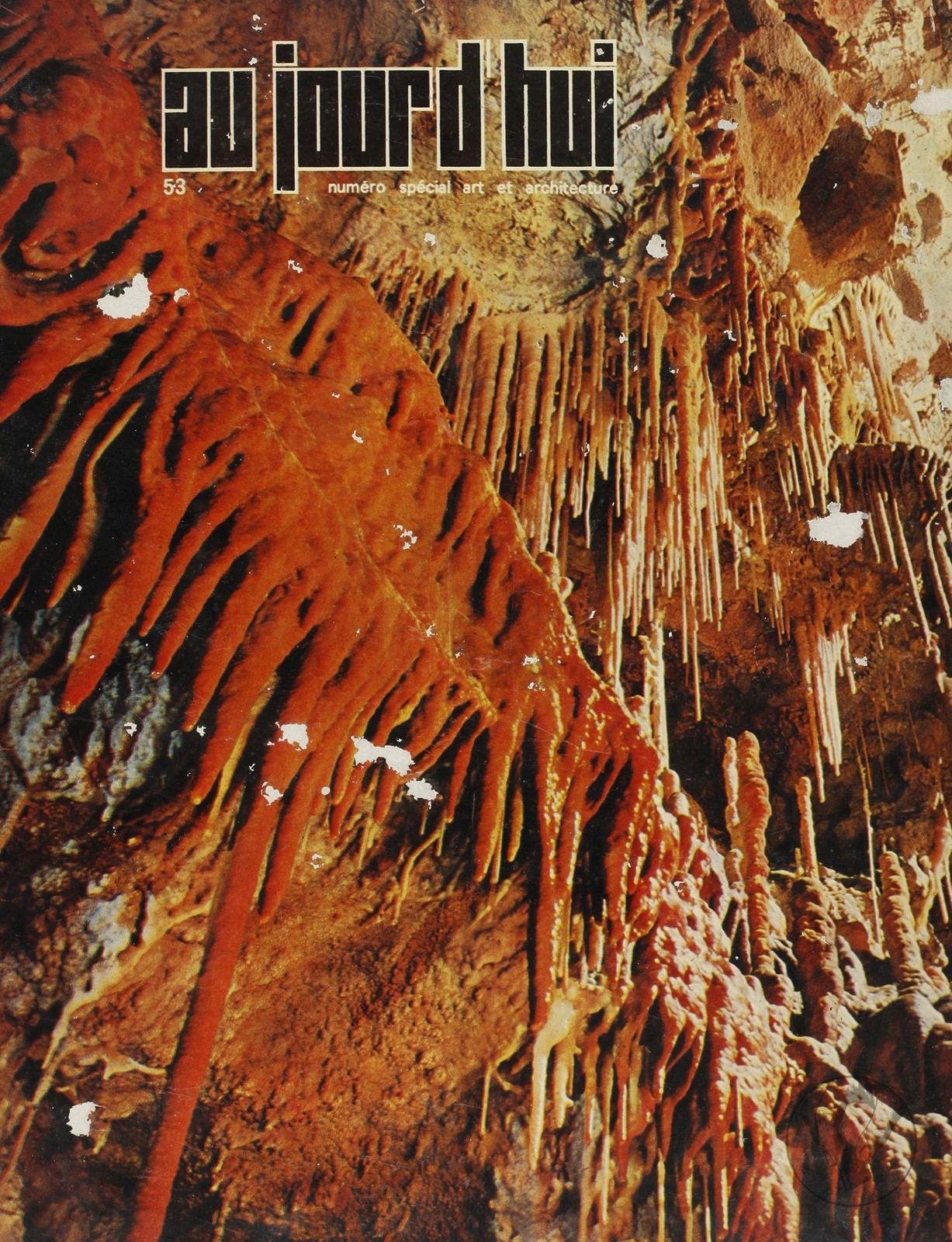
Ce numéro spécial de la revue "Aujourd'hui - art et architecture" est consacré à la sculpture, à l'espace et à l'architecture. Il explore la relation entre la nature et l'architecture, l'architecture indigène, et les concepts de fonctionnalité et de provocation dans la conception architecturale. Des articles traitent également des visions de Soleri, des ponts comme architecture, et des définitions contemporaines de l'architecture et de l'urbanisme.