Page 1
ART art et architecture numéro 52 --- ÉTAUVE
Premières pages de l'ouvrage, en accès libre.
ART art et architecture numéro 52 --- ÉTAUVE
Aujourd'hui art et architecture numéros spéciaux 48 - Italie ARCHITECTURE C. Parent, P. Goulet Œuvres des architectes: Vigano, Sacripanti, Ricci, Galvani, Savioli, De Carlo, Valle, Pagliara, Pellegrin, d'Olivo, Pastor, Dardi, Magistretti, Portoghesi, Dezzi-Bardeschi, Castiglioni. L'architecture et l'intellectualisme en Italie, S. Ketoff. ART CONTEMPORAIN La dialectique des tendances en Italie, B. Morucchio. Les artistes de Rome, G. de Marchis. Peintres et sculpteurs de Milan, C. Dorfles. Récents développements de l'art à Turin, A. Oggero. Peintres et sculpteurs de la Vénétie, G. Zara. La peinture à Florence en 1964, E. Migliorini. Perspectives et personnalités de la jeune sculpture en Italie, E. Crispolti. La jeune peinture italienne explore les dimensions de notre monde, E. Crispolti. Les nouveaux Romains, E. Crispolti. Les sculpteurs italiens de Paris, D. Chevalier. Les peintres italiens de Paris, J. Alvard, R. Boullier, R. Bordier, D. Chevalier, J.-A. França, S. Frigerio, G. Gassiot-Talabot. J.-J. Lévêque, R. Massat. ACTUALITES Les expositions à Paris et dans le monde. 50 - Grande Bretagne ARCHITECTURE C. Parent, P. Goulet Œuvres des architectes: Sheppard, Martin et Wilson, Lasdun, Stirling, Gowan, Howell, Killick, Partridge et Amis, Ahrends, Burton et Koralek, Hodkingston, Evans et Gailey, Colquhoun et Miller, Whitfield, Dowson, Luder, Gordon, Drawbridge, Casson, Neville and partners, Price, groupe Archigram. ART CONTEMPORAIN La guerilla de l'avant-garde, G.S. Whittet. Arts plastiques en Grande-Bretagne, J.P. Hodin. Jeunesse de l'art britannique, S. Frigerio. Les Anglais vont à l'école, J.-A. França. Le Moyen Age, J. Alvard. Francis Bacon, J. Russell. La jeune génération en Grande-Bretagne, J. Reichardt. La jeune sculpture en Grande-Bretagne, D. Chevalier. Artistes anglais de Paris, D. Chevalier, G. Gassiot-Talabot. ACTUALITES Les expositions à Paris et dans le monde. 51 - Le Corbusier Introduction : André Bloc. ARCHITECTURE, URBANISME: C. Parent, P. Goulet. La Révélation, 1908-1920 : Lettre à Charles l'Eplattenier. Les premières réalisations. Extraits des mémoires d'A. Ozenfant. La Prophétie, 1920-1930 : les écrits pamphlétaire, la ville de trois millions d'habitants, le plan voisin de Paris, les immeubles-villas, l'évolution de la maison Citrohan (Pessac, Stuttgart, Carthage). Les programmes spécifiques : habitations particulières, les maisons blanches, Cité du Refuge, immeuble Clarté, Centrosyus. Deux concours : Palais de la Société des Nations, Musée d'Art Moderne. Les œuvres clés, 1930-1938 : Les Heures Claires, le Pavillon suisse, le Palais des Soviets, la maison de week-end, le gratte-ciel d'Alger. Urbanisme, 1930-1950 : La Ville Radieuse, les unités d'habitations (Nemours, Marseille, Nantes, Berlin, Briey la Forêt, Bogota), Alger. Architecture, 1950-1965 : Réalisations et derniers projets. Deux prises de positions : I. Xenakis, H. Baley et D. Zimbacca. SCULPTURE, J. Savina. PEINTURE, F. Bergot. TEMOIGNAGES réunis par la rédaction de « l'Architecture d'Aujourd'hui ». Abonnement 1 an 6 numéros : France 57 F, étranger 14,10 dollars AUJOURD'HUI 5 rue Bartholdi 92 Boulogne France 11 F étranger 13 F France 11 F étranger 13 F France 15 F étranger 17 F
GUY SOLEILLE - POLYESTERS DE COULEURS CHARTRES - 10 RUE DES VIEUX-CAPUCINS ANDRE BLOC: SCULPTURE HABITACLE.
Galerie STADLER 51 rue de Seine Paris 6Danton 91-10 PIAUBERTPeintures métaphysiques 24 février - 26 mars --- GALERIE IRIS CLERT28 rue du Faubourg Saint-HonoréParis 8 17 marsHABBAHle sculpteur de Bagdad 27 avrilPIERRE DE MARIA --- Galerie des Anciens et des Modernes12, rue Guénégaud, Paris (6)Médicis 25-73 Hommage à Martin-FerrièresPeintures et gouaches et à Chana OrloffSculptures et dessins Janvier - février - mars --- Galerie Beno d’Incelli et Cie43 rue de Miromesnil Paris 8BAL. 10-16 16 février - 16 mars Bengt OLSON 26 mars - 26 avril Galerie BleueSturegatan 28 - Tél. 63-81-51Stockholm ö ---
la biennale di venezio ART CINÉMA MUSIQUE THÉÂTRE Revue de l'Institut Autonome « La Biennale de Venise » Umbro Apollonio, directeur. Wladimiro Dorigo, rédacteur en chef SOMMAIRE DU N° 59 Emilio Garroni Arte e comunicazione Miroslav Lamac Il cubismo ceco 1907-1917 Ferruccio Marotti Marionette utopia del teatro Piero Raffa La rivoluzione costruttiva e la poetica theatrale di Majakovskij-Mejerchol’d Germano Celant Lara Vinca Masini Luigi Pestalozza Roberto Rebora Marisa Volpi Piero Zanotto Osservatorio Un numéro : 1 300 L. Etranger : 3 $ Abonnement annuel : Italie, 5 000 L. Etranger, 10 $ DIRECTION REDACTION Ca’ Giustinian. Venise PUBLICITE ET ABONNEMENT Editalia. Edizioni Italia. Via di Pallacorda 7 Rome --- pierre matisse gallery baltbus dubuffet giacometti butler le corbusier millares calliyannis miró marini macIver tanguy riopelle roszak saura new york 41 east 57
COMPARAISONS MUSEE D'ART MODERNE DE LA VILLE DE PARIS 11, AVENUE DU PRESIDENT-WILSON 7 au 28 mars INVITES D'HONNEUR : PEINTRES ET SCULPTEURS DU JAPON --- FLORENCE HOUSTON-BROWN 4 rue du Pré-aux-Clercs Paris 7 et CERES FRANCO présentent : EX-VOTOS DU BRÉSIL 13 mai - 11 juin 1966 --- SYNTHÈSE 66 boulevard Raspail Paris 6 Littré 47-32 LICATA du 9 mars au 2 avril --- Tandis qu'à Berlin se poursuit la grande exposition LETTRISME ET HYPERGRAPHIE organisée à la galerie Europa par Maurice Lemaître La Librairie-Galerie Anglaise présente MAUVAISES TOILES DE LEMAÎTRE ET AUTRES CHEFS-D'ŒUVRE du 26 février au 10 mars 1966 42 rue de Seine Paris 6 --- GALERIE RIQUELME 25 rue de l'Echaudé Paris 6 Danton 81-97 INGER SITTER 17 février - 9 mars ARMAND PETITJEAN 11 mars - 2 avril --- GALERIE DE L'UNIVERSITÉ 32 rue de l'Université Paris Littré 83-80 ROBERT TATIN 21 avril - 10 mai. Catherine Viviano Gallery 42 East 57 Street New York 22 N.Y. EUROPÉENS ET AMÉRICAINS CONTEMPORAINS --- art et architecture Veuillez noter : mon abonnement à la revue AUJOURD'HUI à partir du n° ____________ Abonnement 1 an : 5 numéros : France 57 F Etranger 14,10 dollars Règlement par chèque mandat virement au CCP Paris 1519-97 La commande suivante Frais de port en sus : par exemplaire, France : 1,50 F ; Etranger : 2 F Nom ______________________ date _______________ Adresse ______________________ signature _______________
AUJOURD'HUI N° 52 SPAIN English Summary --- ing in Barcelona. Santos Torroella (p. 57). celona, capital of Catalan, occupies quite a special position in all of Spanish activities. This region is so different from the economical point of view as well as from the cultural and artistic angle, ally since the middle of the nineteenth century when the Catalan revival consciousness and the desire to protect this independence, while outside ea it is often greeted with fear, leading to political measures to stem ss. ing the twentieth century, art, even more than literature, has undergone extraordinary development, outstripping other schools in the peninsula. names as Gaudi, Sert, Coderch for architecture, Picasso, Miro Dali, for painting, Gargallo, Gonzalez, Manolo, for sculpture, illustrate the ity of Catalan artistic life. All important movements have immediately an echo in Catalan and only in Barcelona has contemporary art been o form a continuous permanent tradition. Cubism was mainly elaborated catalan village during Picasso's stay there. It was in Barcelona at the as Dalmau that he exhibited in 1912 at the same time as Marcel Duchamp his "Nu descendant l'escalier". Picabia's visit to Barcelona in 1917 he publication of his review "391" was to be the only contact that had with dadaism. The surrealist movement, especially through Miro iali and visits to Barcelona by André Breton, Paul Eluard and others iced artistic circles more than past styles. is interesting to refer to this supremacy since it is the start of more trends whose origins go back to the "Dau al Set" group in 1948. The ar brought art and literature to a sudden stop, since many artists either lost in the combat or took the road to exile. The loss was great and the birth of a new generation in 1948, there was nothing but an ous void which a few survivors of the figurative school tried in vain to he "Dau al Set" generation included Antonio Tapies Juan Pasic, Guinovart, T. Tharrat, Guinovait, Vilacasas, Curos and others. With them are Aleu, Llort, Brotat and others following a trend to renovate the expressiveness urative pictures. These last two years, the arrival of Pop Art has marked inginning of the liquidation of a style of painting which was already ering in stiffness and academism. The special position of Spanish civil ads to the fact that the will for sensor and for protest is more accentuated. dew figuration, in cases such as Cardona Torrendell, Mensa and others nded more on the social desire for unconformism than on purely aesthetic s. All these new trends have the advantage of behaving like revulsives cul-de-sac where informality has led young Catalan painting. Rare are who came through the test with success-Tapiés, Pijuan, Guinovart, Cixjant, one of the most gifted, is still full of hesitation, and has et revealed himself with the talent we can expect him. Tharattles imprisoned by his virtuosity and good taste. As for the others, do not occupy a position which promises wide possibilities in the field tent revival which is life and death to all contemporary painting. --- tion of the Madrid school of painting. Henry Galy-Carles (p. 60). nost ten years have passed since the group "El Paso" founded by Canogar, Felto, Viola, Rivera, Millares, revealed, at the Venice Biennial 6, the presence of a contemporary Spain, perfectly informed of the main i in up-to-date painting. This exhibition shown later in Paris, proved that n Spanish artists intended to oppose conservative trends which dominated eir country. "El Paso" was a liberating movement, showing in its ion of revolt, the will not only to affirm the personality of its members, o renew relations with the tense universe to which Copants associated, Sombre blacks, pure whites, melancholy geys, disenchanted, and browns, lightened by scarce reds and blues, tragic grandeur, with moving ty". iat is the position of Spanish painting to-day particularly in Madrid? The 'aso" group was joined by the artists of the new generation, as well as certain number of painters of the same age who were gradually drawn ds it. All these artists now belong to the international intelitenza which rs in Madrid. Many had come to the capital to confront their ideas and inspiration in the shape of a common artistic aesthetic to reach a point nthesis which overcomes local and national differences to attain the st cosmic and universal conception of man. rthermore, each individual artist is a prisoner of physiological preponces of his character, defined by a particular conglomerate of energies shape them. The conglomerate classifies the artist, whatever his reality or his style, into an introvert or an extravert, introversion meaning physiological, intellectual supremacy encourages the artist to consider go, his own sensitiveness; abstract egocentrism for abstract painters in ich as certain of them translate on to their canvas their affective ve and intellectual volitions; "subconsciousness" when they recreate shapes and signs hidden in their subconscious mind. This superiority not imply an absence of extraversion, there is on the contrary, very difference between them, since Man cannot live without the outside . Therefore inversely, extravert supremacy gives life to certain pictorial
COMPARAISONS MUSEE D'ART MODERNE DE LA VILLE DE PARIS 11, AVENUE DU PRESIDENT-WILSON 7 au 28 mars INVITES D'HONNEUR : PEINTRES ET SCULPTEURS DU JAPON --- FLORENCE HOUSTON-BROWN 4 rue du Pré-aux-Clercs Paris 7 et CERES FRANCO présentent : EX-VOTOS DU BRÉSIL 13 mai - 11 juin 1966 --- SYNTHÈSE 66 boulevard Raspail Paris 6 Littré 47-32 LICATA du 9 mars au 2 avril --- art et architecture Veuillez noter : mon abonnement à la revue AUJOURD'H Abonnement 1 an : 5 numéros : France 57 F Règlement par chèque mandat viremen La commande suivante Frais de port en sus : par exemplaire, France. Nom Adresse --- Castles in Spain. Spain was overrun by Berber raiders in 711 A.D. and it was not until 719 A.D. that Christian armies were able to turn the tide of invasion. During eight centuries the history of the peninsula is a succession of battles and short periods of peace, until in 1492 the Catholic rulers finally reconquered their kingdoms. With this constant state of war it is not surprising to find numerous examples of defensive architecture in Spain. However such castles were built in the 14th and 15th centuries by local lords for their own protection; sometimes even against the king. Left in ruins for centuries unlike those in England, France and Germany, they are now being restored by the government. The most historic date from the 11th century and are situated in Andalusia. They are varied in style, size and structure. The original unit is the tower, surrounded first by a fence, which becomes a wall with a moat, the tower is then divided into various chambers with winding stairs in its thick walls. After the courtyard comes the creation of the main tower with high windows surrounded by lower buildings while secret passageways lead underground to the open country, invaluable in the event of siege. The period of fortified palaces begins at the end of the 15th century. Calahorra is a perfect example with its severe exterior leading to an elegant interior in pure Italian Renaissance style. The design of these castles is closely linked with their structures when hewn stone is used the walls are straight with acute angles whereas with ashlar, cures are used to erect cylindrical towers. Brick favours varied design and was often used in horizontal bands between stone. Geographical position also influences style: However it is rare to find delicate and refined details in these medieval fortresses although the examples of the Grenada Alhambra and the Seville Alcazar are well-known. On the whole Spanish castles remain witnesses of the violence of the Middle Ages. Carlos Flores (p. 4). --- ARCHITECTURE IN SPAIN Claude Parent and Patrice Goulet (p. 10). Until the discovery of the works of Codorch and Valls around 1950, the only Spanish names known abroad connected with architecture were Gaudí, Candela and Torcoja. However discrete research continued, since two young artists, Corrales and Molezun were able to attract international attention in 1958 at the Brussels Exhibition. What is the position at the present time? It is believed that the discovery of personalities worthy of assuming the responsibility of the future will be facilitated by studying entries to recent competitions. Five Spaniards submitted outstanding plans for the Madrid Opera House: Alba, severe, with wide movement of opaque blocks which follow the distinction of function, the breaking down of principal volume, the rupture of the general mass is linked to the staggered roof-line; Corrales and Molezun dislocated masses, used continuous horizontal strips of window structure rendering; Higueras concentrated on the research for simplicity through natural materials, he endeavours in a lighter style to obtain strong animation of surrounding space, using terraces, staggered roof-line, permanent interior-exterior relationship, based on a simple form where radio-concentration is often the principal feature; Fullaondo, expressive, original, he pursues his demonstration of romanticism, monumentalism and vigour, despising international architecture, he is free of economic and political phraseology. The competition for the Exhibition and Congress Hall of Madrid confirms these impressions. Higueras and Fullaondo stand out once again, especially the latter in his project to use the roof, the “fifth wall” as a meeting place, and his desire to find a natural qualification, a new reality, his interest in drawing at the creative stage. Drawing becomes the driving element research, she is by linking forms and schemes that the artist finally reveals the continuity of space. Since these architects are voluntarily so involved, their attitude to town planning is worthy of note. They respect their principals, there is no abdication. The new realism movement is very important in Spain and the desire to include the notion of moral comfort, to avoid any emotional shock for the occupier leads compulsorily to a return to the success of it, which is still so alive in Spain that new realism attempts lead to quaintness. A greater danger is revealed in their written theory, which indicates that architecture is now considered only as the result of a certain number of economic, social and political conditions. It must content itself with modestly expressing these conditions. But remaining modest is not a remedy; revolt risk enthusiasm are more effective. It is to be hoped that artists will realise their possibilities of action over the world, the vast problems to be solved should compel them to change the scale of their research. Daniel Fullaondo (p. 14). --- Competition for the Madrid Opera House. Daniel Fullaondo (p. 14). We have sought to create natural dramatic space, furrowed into the earth like a grotto, where function, expression and construction harmonise, respecting more subtle criteria than those which might develop from clearer schemes using glass and light materials. This work raised many questions to which we tried to reply with a contemporary solution in language which bears witness to our technological and social realities. In the broken exchange of symmetry and rising rhythms, we have retained the constructive severity of concrete violently apparent on the exterior, the throbbing complex of vertical rhythms is crowned by the continuous liquid movement of the copper roof, chosen for its lasting quality and aspect. We are convinced that the beauty of a building should not depend on a generous application of concrete tones us back to used as cosmetics, but on space and volume. This project is linked to romantic and traditional technology. Without this inspiration we would fall back on the incomplete visions come from numerous fields with which architectural reality is in contact without them being its centre. We simply claim to have organised and limited a dramatic space by taking our inspiration from the root of contemporary and perpetual architecture. --- Competition for the Euro-Kursaal, San Sebastian. Daniel Fullaondo (p. 24). We wish our solution to spring from the very roots of urban, cultural and social development. The site places us in the presence of violent, realistic elements-sea, coast, river. We must take the responsibility of this contrast in our search for a unified articulation of criteria including those of function, geology, town planning and form. Our design prolongs, shapes and analyses the flow of urban structure, indicated by the river and turns resolutely to face the sea. It begins to take shape as a semi-independent timber to a shore-side castle or watch tower. Our residential theme rebels against the vast proliferation of the new academy and its character who no longer considers human truths. The roof has been designed as a gentle path, outlining the upper courts, surrounding the high points with vigorous geometry. It is the fifth wall, the spatial reply that our unit offers to the observer, it studies and crowns the heavy masses of concrete and stones. Concrete lends us back to authentic rock qualities, to resist time and tempest. With this material we have endeavoured to link up with strong technology capable of standing up to a violent natural context as does rock.
Offices for the Hartz Building Society in Barcelona. Daniel Fullaondo (p. 28). Present-day use and planning of interior space lacks organisation. Its most striking feature is a deliberate lack of personality which is covered by a careful choice of materials and finishes to define our contemporary style. An example of this is the spatial aventure with light carried out by the great masters of baroque architecture compared with the stifling growth of curtain walls and indirect lighting today. However, technical means for developing space have never been better. In their work we wished to develop rules of composition which tend to overtake the poetical limits of the 30s, we seek to reconsider the revision of usual concepts. Our solution reveals an individual style which gives a spatial value to each element with the help of pale finishes on the walls, floors and ceilings, against which each element (furniture or decoration) clearly affirms its individual existence. The “living machine” had its hour of duty, but now its truth is nolonger complete. In just anybody’s hands this machine has become a spinning wheel which is equipped with a treadle, of course. A. Fernandez Alba (p. 44). Those who have already grasped the reasons underlying the Modern Movement are conscious that it is impossible to remain faithful to its assumptions. It has lost cons of its ability to modify itself because our society has transformed them into dogma. Architectural movements and their high priests always boast of their individuality. To-day artists work like specialists and their production is only meant for rare groups which can claim to esthetic experience. This is time when human relations of architecture through tests of divine mission through social engagement. As a means of bringing beauty to everyday life architecture seems to have become a monstrous game of virtuality. New Realism. Oriol Bohigas (p. 48). The fact that the industrial revolution, which brought to light new methods of production and a new class of consumers, was one of the fundamental causes of the growth of modern architecture has already been discussed many times. At the same time many der Rohe. They quickly understood which way the machine age should develop, so they invented forms which were, at that time, experimental. But the industry did not progress where no more experiments it took before these experiments were ever continued, and the technical ideals conceived with modern architecture are far from becoming reality. Is it wise then, to continue with these ideals, since all the lessons possible have already been drawn from them? To persist will only lead to the sacrifice of a new generation in its attempt to produce prototypes. Unfortunately there are always men who remain obstinate enough to immortalize form which no longer any meaning. Because they were created to be built by industrial means, whereas they were finally erected by small craftsmen. This is why new realism has appeared, a reaction against formalism, facing at the same time abstract idealism. It goes beyond the purely constructive theme to include all the extremes of a profound cultural position, consideration of the attitudes and psychology of those who must live in the house to be built, a taste for design, the desire to give interest to a wall and a simple partition instead of simply justifying their assembly the respect for traditional form which can still be integrated, the struggle against any symptom of formalism. But let it not be thought that with this reaction we have lost the pre-war conquests that rationalism made. New realism becomes its only possibility of continuing so that the victories of Gropius and others do not fall back into sterile mannerism. The personalities linked with the new realism are Louis Kahn, Paul Rudolph, Gardano, Albion and others, perhaps Kenzo Tange, but some all Alva Aalto. New realism is the authentic return to reason, the only way to evolve from the prototypes of the pioneers to the exact sociological, technical, economical and political first-fruits of to-day. SPANISH CONTEMPORARY ART Spain, 1956-66. Jose Auguste França (p. 56). In 1958 the Venice Biennial presented quite an unexpected aspect of Spanish painting. An art which had been drowsy since Goya, suddenly awoke to become passionate and violent. Critics were unanimous in their praise of the remarkable unity of inspiration shown by the sixteen participants of whom eleven were under forty years of age. A new generation took possession of Spanish art as the nation slowly began to react against the poke it bore from the civil war. Artists were active, dynamic witnesses of a national conscience, they guaranteed its necessity. Hope was born in their message of liberty proposing a new historical situation, although images often remained symbolic. But the fact that they exist helps to define a new reality. Realism constitutes a kind of “constant” of painting elaborated over Europe during the seventeenth century. Velasquez, Ribeiro and others went through to western periods in their sense of constantness with the world around. This leads to passionate art which intervenes in the structure of national life, as a portrait and a protest at the same time. These feelings linger on in Goya but they are the last expression of an aesthetic situation which deteriorates and finally dwindles away in the emptiness of the nineteenth century blindered by academic conformism. This “constant” does not imply the existence of an immovable Spanish “condition”—the very direction of protestation, be it sentimental or revolutionary, cannot but alter it. We refer rather to a combination of circumstances which realism informs beyond all ideological engagement, either at the level of themes, or the representation of nature. Spanish realism appears therefore, not as a subject but as artistic creation, but as mental organisation within an artistic universe. Artists who came upon the scene towards the end of the 1950 have taken up a realistic position which plunges its roots in the specific reality of contemporary Spain. However it is the action of these artists which constitutes the beginning of the end of this sombre period. Doubtlessly, we owe them the most powerful invitation to the European dialogue to which some of them bring original poetical propositions. They were the first ones to express about a change in the historical position, revealing the new needs of mortified Spain. This becomes a problem of the sociology of art which cannot be pushed aside without comment. The relationship between art and society is brought to light. That which was vague and uncertain is crystallised in a few paintings which are presented with new forces, of a major countering force. Faced with this force, the official authorities had to waver. Contemporary Spanish painting at the time offered us a sorry picture. What is still called the “Madrid School” represents very prudent modernism—degenerated art was elsewhere—in Paris with Picasso, Gris and others. The third Spanish-American Biennial in 1955 accepted entries from avant-garde artists, they were seen for the first time officially. In 1956 the “School of the New twentieth century Spanish painters” shown in London included half a dozen young artists. Two years later it was officially followed in 1959 by the Spanish exhibition in the Arts Decoratís Museum in Paris. From this time on the movement has continued, to everybody’s amazement. Behind the numerous young artists there is, of course, a bureaucratic machine too happy to show the world that Spain is reviving and that Spaniards are protected by a system which favors avant-garde culture. This is obviously evident and many artists refuse to be caught in the propaganda. So however this use of art, even if we can doubt its sincerity, nevertheless indicates submission and a victory scored by talent. Or perhaps by history, since the real sense of contemporary Spanish life lies in this search for reality—these shapeless, massacred bodies painted by Millares, this blind and powerful wall by Tapies compose the world which are echoed throughout the world. There are three camps from Madrid for Barcelona, the core of the centennial traditions, aspects of a general message which has continued to grow. Between 1956 and 1966 we have seen it pass from being a cry to becoming a massive statement of quality before quantity. We have seen it build its structure like a modern, that is to say universal, reality. Painting in Barcelona. Santos Torrella (p. 57). Barcelona, capital of Catalan, occupies quite a special position in all kinds of Spanish activities. This region is so different from the economical and social point of view as well as from the cultural and artistic angle, especially since the middle of the nineteenth century when the Catalan Revolution began. One of the singular characteristics of Spanish art is this: while Kindles proud consciousness and the desire to protect this independence, while outside the area it is often greeted with fear, even more to political measures to stem progress. During the twentieth century, art, even more than literature, has undergone an extraordinary development, outstripping other shoots in the peninsula. Such names as Gaudi, Sert, Coderch for architecture, Picasso, Miro Dali, Tapies for painting, Gargallo, González, Manolo, for sculpture, illustrate the intensity of Catalan artistic life. All important movements have immediately found an echo in Catalan and only in Barcelona has contemporary art been able to form a continuous permanent tradition. Cubism was mainly elaborated in a Catalan village during Picasso’s stay there. It was in 1912, as Marcel Duchamp hung in “No descendant” (escalier). Picabia’s visit to Barcelona in 1917 and the publication of his review “391” was to be the only contact that Spain had with daismad. The surrealist movement, especially through Miro and Dali and visits to Barcelona by André Breton, Paul Eluard and others influenced artistic circles more than past styles. Art referring to re-rer to the modernist since it is the start of more recent trends whose origins go back to the “Dau al Sal” group in 1948. The civil war brought art and literature to a sudden stop, since many artists either were lost in the combat or took the road to exile. The loss was great and until the birth of a new generation in 1948, there was nothing but an enormous void which a few survivors of the figurative school tried to fill. The “Dau al Sal” generation involved the artist Juan Luis Sart, Modesto Cuixart. These were the artists who continued across the void, the modest of pre-civil war painting, above all the Ada movement set up around Picasso and Miro with the architect Juan Luis Sart at its head. Daismad and surrealist memories influence the guiding line followed by “Dau al Sal”. The Barcelona school of painting then crossed a brilliant period which was favoured by the French Institute of Fine Art and traditional schools. Furthermore, strengthen relationships between artists painting and artists. During this period the debate exhibition, the experimental courses of new art and the Cobalt Club 49 were set up. The third Spanish-American Biennial held in 1955 consecrated Tapies and with him information which was to open the way to all young callings. This is confirmed by the exhibition the “Other Art” held in 1957 at the Salon Casparino. During the last ten years informalism, the research of the artists has predominated in the new painting of this movement are Tapies, Cuixart, Tharratt, Guinovati, Vilacasas, Curos and others. With them are Aleu, Garcia Llorit, Brotat and others following a trend to renovate the expressiveness of figurative pictures. These last two years, the arrival of Pop Art has marked the beginning of the liquidation of a style of painting which was already floundering in stiffness and academism. The special location of Spanish civil life leads to the fact that the will for censor and for protest is more accentuated. The particular figuration, in cases such as Cardona, Torrendad, Mensa and others is founded more on the social desire for unconformism than on purely aesthetic objects. All these new trends have the advantage of behaving like revulsives in the cul-de-sac where informalism has led with success-Tapies, Guinovati, Roford, Cuixart, once the artist gifted is still full of hesitations, and has not yet revealed himself with the talent we can expect of him. Tharrats remains imprisoned by his virtuosity and good taste. As for the others, they do not occupy a position which promises wide possibilities in the field of urgent revival which is life and death to all contemporary painting. Position of the Madrid school of painting. Henry Galy-Carles (p. 60). Almost ten years have passed since the group “El Paso” founded by Saura Canagar, Feito, Viola, Rivera, Millares, revealed, at the Venice Biennial in 1956, the presence of a contemporary Spain, perfectly informed of the main trends in up-to-date painting. This exhibition shown later in Paris, proved that certain up-to-date artists intended to oppose conservative trends which dominated in their country. “El Paso” was a liberating movement, reminding us of its explosion of revolt, the will not only to affirm the legitimacy of its members, but to renew relations with the public, to which Goya had accustomed so much as certain of them translate on to their canvases their affective, sensitive and intellectual volitions; “subconscious mind” when they recreate the shapes and signs hidden in their subconscious mind. This superiority does not imply an absence of extraversion, there is on the contrary very little difference between them, since Man cannot live without the outside world. Therefore inversely, extravert supremacy gives life to certain pictorial
trends like the “inobject” which specifies the composition on a canvas of a group of colours on lines which push the ego to the background. The canvas becomes simply an object, resulting in a questionable intellectual position. However, this trend is already the proof of a kind of personal sensitiveness. However, this trend has sometimes favoured the change of geometrical aesthetics to that of “abstract imagining naturalism” also called “abstract landscapes” which is one of the two main kinds of contemporary abstract or post-abstract painting, the other being “subconsciousness”. Some of those working in Madrid include Pilar Morales using various materials to create paintings: feelings-card-board, wood, trellis, paper. In tracing a rapid outline of the various trends in Spanish painting, we must mention, under the heading “abstract egocentrism” or “tachisme” or “action painting” Millares in his brutal, refined, inverted intellectual universe with black and white space, revealing a tormented personality symbolic of transformer. Spain, Soria in the same torment who makes fluid space loom up through a span of fine strips of steel, creating third dimension, in which large sheets of time-battered metal remain immobile to add refined distinction; Lucio Munoz creating a sombre, dramatic world in his wood carving, Antonio Suarez whose pictorial impasto spreads an atmosphere of revolt and poetry; Ferreres expressing a dramatic work by a dynamic expression of balance and white spaced with grey); San Bernardino impressions of fields with geometrical flats, lit by a warm, sensual sun) and Marco (warm, diffused light, haloing landscapes); the second “suggesting nature by symbols”-Zobel (creating space with dynamic movement, subtle, underlined by a hatched style, Viola (more romantic, succeeding in expressing the sensuality of fluid elements in natural Yakuba) creating a similar nature by including rough wooden structures (hard barren landscapes with tragic grandeur) Valdes and Salvador Victoria in the same style. There are also the followers of a geometrical style like Rueda who uses wood panels, painted in bright colours to cast delicate shadows; Sempero, whose work reveals great dynamic refinement through the metricalical complexity of its structures Rivera with, by means of “mirrorous” and lattice, they become the signature of space geometry. As for Rivera and Canagar, they are responsible for the false “new representation” and the true “neo-expressionism”. Sculpture in Madrid is dominated by the strong person- ality of Pablo Serrano who exhibited a remarkable abstract subject revealing powerful force at the Venice Biennial in 1962, he has since progressed towards the style of the much more modernist elements of Martin and by Maguire, while retaining more dramatic preoccupation, since he produces forms and which closed tragic, stifled space is held, revealing his desire to prolong the life of form in space. Feliciani is a more traditional abstract sculptor who expresses split form showing density and gravity. Chirino creates dynamic form, smooth and geometrical which plays elegantly with space. Amador Rodriguez’s work is more traditional, extremely delicate, with his elegant treatment of masses and rhythms. Such is, briefly, ten years after his first international presentation, the position of painting and sculpture in Madrid, dominated by the expression of an anxious, tormented, sombre and dramatic universe, characteristic of Castilian Spain. Condy Condoy, who died in 1953 travelled widely in Italy, France and Belgium but never exhibited in Paris, where his work remains unknown and misunderstood. It was intricate and strong with alternating realistic tendencies and inspiration towards stylisation and abstract purifying of form. Even in his first sculptures he proves to be a vigorous portrait artist. The basic elements of Spanish life and erotism are revealed with good natured vigour. His coloured busts with slightly deformed features, go further than realistic parodies to reach simple edification, sometimes brutal. He doubtlessly invented a kind of popular art in the latinian spirit linked to the event of space geometry. However another phase of his work, better know, reveals an extraordinary understanding of conceptual simplification where pureness of line recalls Moore. His inspiration is sometimes vigorous and haughty, sometimes fluid and harmonious, but like his wood carving and bronzes, his statuses come at key moments in the evolution of sculpture. Insufficiently known during their lifetime, his works have not had an influence in proportion to their importance and quality. Spanish artists in Paris. CHILLIDA J. Alvard (p. 67). Chillida, whose talent is appreciated in France and abroad, was first discovered as a remarkable craftsman working with iron. From his first exhibition in 1949, his taste for the mythical nature of iron through its strength and tradition, iron which, wielded by Man, gives life to the earth, was recently developed. Since, he has added notions of its heroism, and pity for its abandon when faced with industrialism. He has recently begun stone carving with grey and rose granite, and has been awarded many prizes. Born again Spanish, Chillida is appreciated in his home-country where he has raised a public monument to Sir Fleming. BERROCAL G. Gassiot-Talabot (p. 67). Born in 1933 at Algados, Berrocal, one of the most important sculptors of his generation, has been influenced by the study of mathematics and archi- tecture, manifest in the evolution of his sharp, slender works dated 1955 to 1957, towards the heavier, squat style of later years. Leaving clear volume, Berrocal has elaborated co-penetration and connection, sealing his works with curved volumes, which intervent with massive force and impressive obviousness. Take the example of his art of overlapping has led to sectional sculpture which can be assembled like a puzzle by his organic research, pushing forms to the limit of inertia, is tinted with allusive and mocking humanism. SCULPTORS D. Chevalier (p. 68). Although few in number than the painters, Spanish sculptors are nevertheless one of the most important national groups in Paris. There have been two waves of immigration-cultural before the civil war and after the second world war, and political-after the disaster of the republican army. The division of their group into generations coincides with the division into artistic expressions: the informalist among the youngest and the inheritors of constructionists and subsumers to the elders. They are not distinguished by any predominant Spanish feature from their fellows, nor do they rarely feel the necessity of exhibiting together to form a national novella. Many Parisian galleries are open to them. The only characteristic features they have in common are their confidence in a certain craftsmanship and decency for a readiness to assimilate ideas and techniques and the fact that they are prepared to be vulgar. Even then their art lacks originality, it respects certain rules of harmony and balance which assure perfect dignity. FEITO J.J. Lévaque (p. 68). In the background of almost Spanish painting there are pictorial storms, created by the artist’s prehension of matter which is the basis of his language. Feito, first introduced in Paris by J.R. Arnaud, has developed this sense: He transcribes it as a double adventure—plastic in his domination of rebellious matter and spiritual because he gave matter intense the joy of using light. He translates his emotion by juxtaposing “taches,” which are thickened in their tangibility by adding grained substances spread with a knife, to become a kind of mineralogical map with its twinges and mountains, and swamps. It is born in Madrid in 1929 his acquaintance with Cubism gave him the decisive means of escaping from a strict observation of apparent reality to experiment geometrical abstraction. He was the first major artist to exhibit abstract works in Madrid. His evolution in Paris made him realise that pictorial matter had acquired total abandon and lyricism, but found his way through traditional Spanish luminism, freeing the imagination from space. He chooses to alternate smooth and rough areas. The paste counteracts light dilution in smooth areas to create rhythmic shadows. His art is exuberant and pensive, sumptuous, dramatic, sometimes tender. What he has acquired has come to maturity, but he remains open to other horizons. PALAZUELLO G. Gassiot-Talabot (p. 69). When this artist first attracted attention 15 years ago, he worked on small canvases. The entire intensity of the picture was concentrated on a small blue or red square. Later he widened his scope. His murals were among the most striking where cold blue light became hot and red. In 1955 he was exposed clear, sharp color to spectators who were accustomed to “tachisme” and paste. Three years later his exhibition endowed him with a personality of incontestable quality, when he was placed fifth in the Carnegie Prize. His latest works are faster, richer using pink and pale greens. Although he has been painting for many years, it is only recently that he has assumed his rightful place. HERNANDEZ G. Gassiot-Talabot (p. 69). Born in Toledo in 1928, Hernandez spent most of his youth in Argentina, then lived in Holland until 1953, when he came to France. Already distinguished by his expressionist style, he used paste with ease and force, gradually breaking down the lyrical unity of his works. He opposed frank gratiation to the very limits of space. His epochary present evolution shows that continued lyricism has lost none of its means of expression; the artist seeks to establish contact with a more engaged and worldly meaning, to resolve the problem of action and explicitness. LERIN G. Gassiot-Talabot (p. 69). Born in Barcelona, Lerin came to Paris in 1956, when he joined Julien Alvard’s group and from then on participated in “nuagiste” exhibitions organised at the Calaire Breteau. His development was regular, moving towards the caloric and peeral greys. During the last two years certain implied forms have made their appearance in his hitherto informal style. There is a subtle exchange between hollow and filled areas, expressed with deep intensity, a will to construct which answers to the artist’s spiritual and mental demands, to the tense atmosphere in which he carries out his research. From ochre and grey, colouring changes to yellows and green, giving full marks a pernicious, sulphurous flavour which helps to maintain a magic lack of resolution imparting to his canvas an insidious, disquieting multiplicity. ARROYO S. Frigerio (p. 70). The strong personality of this young man of 28 from Madrid has rapidly made him play an important part in the development of modern art in Paris. An early lack of technique has now been rectified and at the Third Biennial in 1963 when he joined the Abattoir group his style was clearly defined. The aggressive painting, disdainful of pop art coincides with the movement of a cycle and the only one final fit. The Galerie Bérard, in 1965, with ardent tones and broken gestures. It is convinced that realism has pushed art to its most extreme position, where the internal state of man is portrayed by means of colour. For him lyrical abstraction and a new realism also spring from this, because of anxiety to avoid anything ideal. If painters become the guardians of daily culture, they abdicate the feeling of art which is precisely artifice and imagination. Therefore Duque raises an important mobile-must-it-stars-chained-to-reality-or-can-it-follow-another-path-towards the return of the imagination which invents? DELAYO D. Chevalier (p. 70). Pelayo’s emigration or rather exile, is a direct consequence of the Spanish conflict. Born in 1920 at Glion, he came to painting in 1944 with an exhibition at Oran. Three years later he arrived in Paris, experiencing two-dimensional still life, and subsequently publicly became a member of the Academy of the Ardeche landscape accelerated his evolution towards an evoked figurative art. His landscapes are flattened like aerial views, his palette is restrained, his manner is brutal only outlining the essential directions. Pelayo is neither expressionist nor abstract, he is an artist of direct interpretation or transpos- tion. A recent evolution towards a more poetic and legible style is not a consequence of his logical progression into plastic expression, which was never inspired by nature. Exhibiting regularly he has shown landscapes, and portraits. In 1964 he was elected a member of the committee for the “Salon des Réalités Nouvelles”. DUQUE J. Alvard (p. 71). Duque has been through the ultimate stage of development for artists who, after having discovered the powerful psychic motivation of gesture, have tried to erase its trace with haziness. After this phase he turned to a kind of exploration, touching his works from the Galerie Bérard in 1965, with ardent tones and broken gestures. It is convinced that realism has pushed art to its most extreme position, where the internal state of man is portrayed by means of colour. For him lyrical abstraction and a new realism also spring from this, because of anxiety to avoid anything ideal. If painters become the guardians of daily culture, they abdicate the feeling of art which is precisely artifice and imagination. Therefore Duque raises an important mobile-must-it-stars-chained-to-reality-or-can-it-follow-another-path-towards the return of the imagination which invents? AGUAYO D. Chevalier (p. 71). Born at Sotillo de la Ribera in 1926, the only teaching which Aguayo had was the lesson he drew from the example of masters and from his own research. When he came to France at the age of 26, he was recognised as being one of the most gifted abstract painters of his time. His canvases expresses the outstanding characteristics of his formal universe and above all the root of his feeling for light and space. In 1958 he was shown at Jeanne Bucher’s gallery and later in New York. His research to define the plastic subjects of new expression is undertaken in two different ways—first by observation and analysis of exterior reality, then by identification and personal- ise of coloured and abstract representations. The result is more and more the replace of a single picture by the surface picture but the sense of depth is never the result of tricks with perspective, but a fair sharing of light. His art seems spontaneous but in reality is laboured, conferred with the mysterious poetical power of allusion. Translation by Maria GEDELIN.
GALERIE LA ROUE 16 rue Grégoire-de-Tours Paris 6 --- ANTON ROOSKENS Gouaches récentes Février 1966 et en permanence à la Galerie --- Galerie Ariel 140 boulevard Haussmann Paris 8 227-13-09 18 mars - 9 avril MARFAING 22 avril - 14 mai APPEL --- Original Graphics Multiple Originals --- Editions Alecto has moved to 27 Kelso Place London W8 Western 6611 Bernard Cohen Alan Davie Richard Hamilton David Hockney Allen Jones Eduardo Paolozzi --- Galerie Jeanne Bucher 53 rue de Seine Paris 6 Avril --- NUNC STANS, ÉPOKHÉ Cycle de L'Howiloupe DUBUFFET
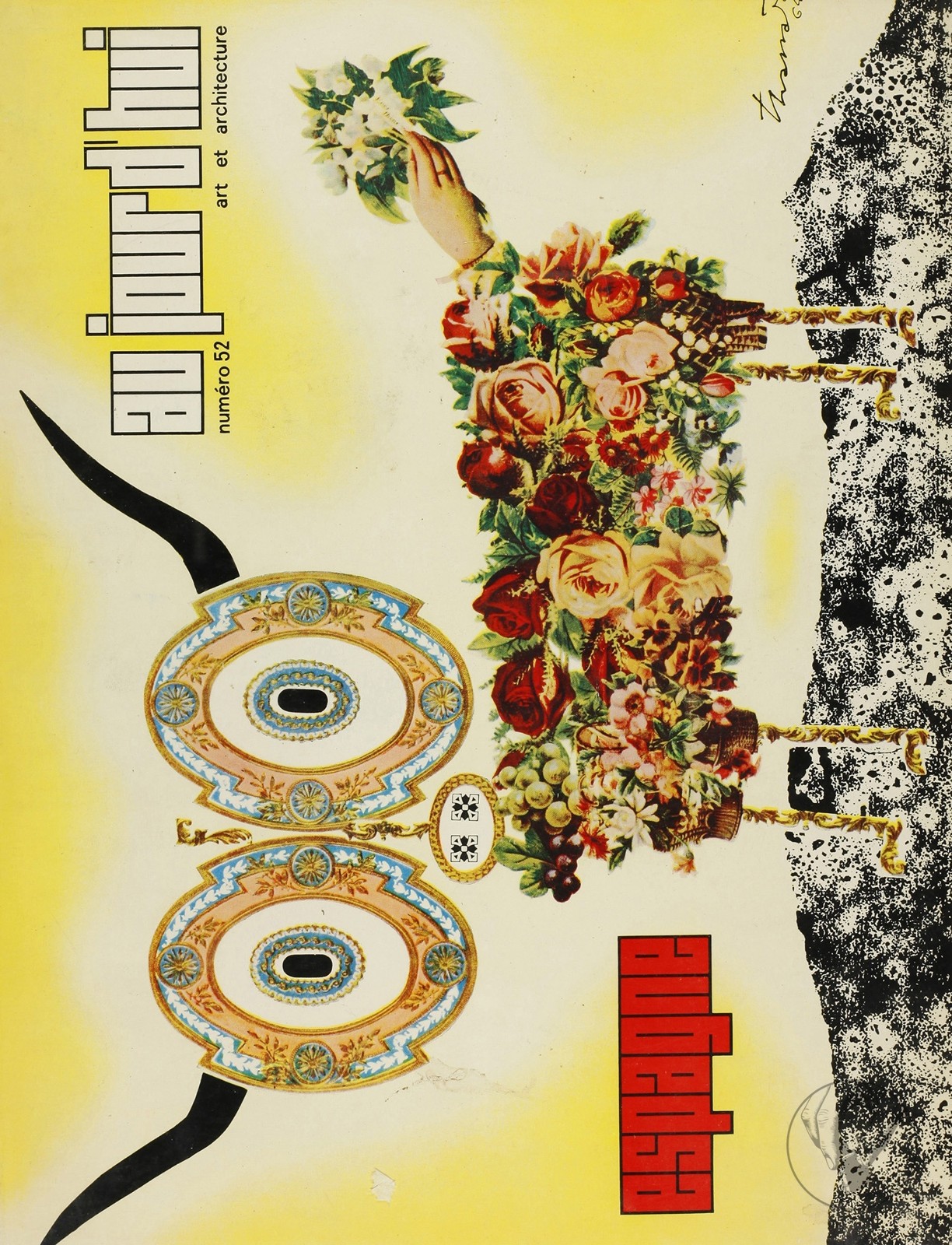
Ce numéro de la revue "Aujourd'hui - art et architecture" est le numéro 52, datant de février 1966. Il présente un dossier sur l'art et l'architecture en Espagne, incluant des articles sur les châteaux espagnols et l'architecture contemporaine. Le magazine aborde également d'autres sujets artistiques et culturels à travers des critiques d'expositions et des présentations d'artistes.