Page 1
cimaise art et architecture actuels 16e année n°91-92 present day art and architecture --- SALUT --- SALUT ---
First pages of the volume, freely accessible.
cimaise art et architecture actuels 16e année n°91-92 present day art and architecture --- SALUT --- SALUT ---
GALERIE DANIEL GERVIS 34 RUE DU BAC PARIS 7 548.20.59 JEAN DUBUFFET MATÉRIOLOGIES DU MERCREDI 11 JUIN AU SAMEDI 12 JUILLET 1969
GALERIE DE FRANCE 3, Fg St-Honoré - Paris 8 - 265.73.69 Alechinsky --- A.E. Bergman --- Campigli --- Roberta Gonzalez --- Hartung --- Levee --- Magnelli --- Manessier --- Music --- Nieto --- Pignon --- Prassinos --- Singier --- Soulages --- Zao wou-ki --- Marta Colvin --- Julio Gonzalez --- R. Jacobsen --- Liberaki --- Robert Muller --- Reinhoud --- Editions de gravures et lithographies des artistes de la galerie --- GALLERIA LORENZELLI BERGAMO --- LICINI MAGNELLI PRAMPOLINI SCHNEIDER VERONESI RADICE BONFANTI NANGERONI BAUMEISTER PIERLUCA TAVERNARI MUSIC KANDINSKY SOLDATI BISSIER KLEE SEUPHOR POLIAKOFF DUBUFFET PASMORE NICHOLSON HOSIASSON CHARCHOUNE MANSOUROFF FRUHTRUNK FAUTRIER VASARELY PFEIFFER LEVEDAG BERROCAL FEITO
GER LATASTER peintures de 1968-1969 Galerie Paul Facchetti 17 rue de Lille Paris
VISEUX sculptures LE POINT CARDINAL 12 rue de l’Échaudé-Saint-Germain 3 rue Jacob - 3 rue Cardinale PARIS VI --- LA HUNE a saint germain des prés. Livres d’Art du monde entier L’Ecole de Paris en Estampes 170, Boulevard Saint-Germain - Paris VI --- Appel - Bitran - Bootz - Duthoo - Gillet - Goëtz - Lindstron - Mihailovitch - Tabuchi - Weidemann - Wyckaërt Galerie ARIEL 140, Bd Haussmann PARIS 8e Tél : 227 - 13 . 09 Alechinsky - Bissière - Corneille Dubuffet - Hartung - Jorn - Messagier Poliakoff - Riopelle - de Staël Vieira da Silva Sculptures de : Anthoons Erhardy - Subira-puig
GALERIE FRAMOND 3 rue des Saint-Père Paris 6 — 548 - 50 - 8 BEAUDIN — BORÈS — DE CONINCK — DERYCKE — ESTÈVE — GARBELL — GUIRAMAN HUMBERT — DE LAPRADE — LÉGER — LESIEUR — PICASSO — POLIAKOFF — POUGN VIEIRA DA SILVA — ZAVARO --- GALERIE STADLER 51 rue de Seine Paris 6 Danton 91 - 10 TAPIÈS 8 Tableaux jusqu’au 12 Juillet --- GALERIE JEANNE BUCHER 53, Rue de Seine - Paris 6 Dubuffet - Vieira da Silva - Mark Tobey - Asger Jorn - Bissière - Stahly - Dodeigne - Aguayo - Carrade - Nallard - Moser - Segui - Nevelson
DENISE RENÉ PARIS JUILLET SEPTEMBRE EXPOSITION POSITION --- Comité Professionnel des Galeries d’art Secrétariat Général 3, faubourg Saint-Honoré, Paris 8 - Anjou 16-42 - 4e étage toutes informations professionnelles attestations d’exportations expertises interprofessionnelles
Galerie Arnaud 212 Boulevard Saint-Germain Paris VII tél : 548.46.31 peintures de : - ADO - DOWNING - FEITO - FICHET - GUITET - HAMISKY - J. F. KOENIG - TOUPIN - SCHNEIDER sculptures de : - MARTA PAN Prochaine exposition : - ADO Vernissage le 9 Octobre 1969
PITT & SCOTT, Ltd. Maison fondée en 1876 24, Rue du Mont-Thabor, PARIS-1er Opéra 33-62 (4 lignes) Maison à LONDRES : 1/3 St-Paul’s Churchyard E.C. 4 LIVERPOOL, GLASGOW, NEW-YORK LE HAVRE, MARSEILLE, BORDEAUX Spécialistes de l’Emballage et du Transport d’Objets d’Art et Antiquités Agents en Douane Agréés Déménagements Nous mettons la longue expérience de notre organisation au Service des Membres du Syndicat des Négociants en Objets d’Art et Curiosités. --- INTERNATIONAL ART TRANSPORT Transports et Emballages de Sculptures - d’objets d’Art et d’Expositions Pose de Monuments 60, rue Saint-Sabin - Paris 11 Télex: interar 222 - 11 Paris - Tel 700,93-87 + --- collection témoins et témoignages dans la série actualité WALTER GROPIUS préface de MICHEL RAGON LA NOUVELLE ARCHITECTURE ET LE BAUHAUS Enfin réunis et traduits en français, les écrits de Walter Gropius, fondateur du Bauhaus, cet enseignement révolutionnaire qui allait faire de l’architecture “un art total”, créant tout l’environnement humain du plus modeste ustensile au logis, à la ville toute entière. prix 17 f EDITIONS DE LA CONNAISSANCE exclusivité weber
cimaise art et architecture actuels present day art and architecture 16e année - N° 91 - 92 Avril-Mai-Juin-Juillet 1969 Ce numéro : France : 18 F Etranger : 22 F Directeur - Rédacteur en chef : Jean-Robert Arnaud Secrétaire général : René Barzilay Administration - Rédaction : 212, boulevard Saint-Germain, Paris 7, tél. : LITtré 46-31 Imprimé par la Société Mondiale d’Impression 41, rue Héricart, Paris 15 Abonnement France : 1 an, 6 numéros 50 F Le numéro : 10 F Etranger : 1 an, 6 numéros 60 F Le numéro : 12 F C.C.P. Cimaise Paris 5542.39 Abonnements pour le Canada : PÉRIODICA 5090 Av. Papineau Montréal 34, Canada --- NUMÉRO SPÉCIAL BAUHAUS Couverture : composition graphique de Hamisky Le rôle de GropiusThe role of Gropius --- Herta Wescher --- Histoire du BauhausHistory of the Bauhaus --- Architecture --- Michel Ragon --- Architecture et esthétique industrielle au BauhausArchitecture and industrial aesthetics of the Bauhaus --- L’esprit du BauhausThe spirit of the Bauhaus --- Philippe Sers --- L’enseignement au BauhausThe teaching of the Bauhaus --- Michel Hoog --- Le Bauhaus et la FranceThe Bauhaus and France --- Rencontre avec Nina KandinskyInterview with Nina Kandinsky --- Jean-Jacques Lévêque --- Kandinsky et le BauhausKandinsky and the Bauhaus --- Herta Wescher --- Oskar Schlemmer --- Notes d’un profaneNotes of an outsider --- François A. Viallet --- Graffiti sur le mur du BauhausGraffiti on the wall of the Bauhaus --- Entretien avec Jean LeppienInterview with Jean Leppien --- R.V. Gindertael --- Le Bauhaus vivantThe living Bauhaus --- L’actualité : --- John-Franklin Koenig --- La danse --- Jean Jacques Lévêque --- Les arts plastiques à Paris --- Michel Ragon --- Les livres ---
Le rôle de Gropius Herta Wescher HISTOIRE DU BAUHAUS HISTORY OF THE BAUHAUS The role of Gropius Walter Gropius a 36 ans quand, au printemps 1919, il prend la direction du Bauhaus à Weimar. Il s’est fait un nom d’architecte d’avant-garde en construisant, avec la collaboration d’Adolf Meyer, des bâtiments en verre et acier, comme une usine à Alfeld, en 1911, et des maisons pour la « Werkbund-Ausstellung » (exposition de l’union des artistes et artisans), à Cologne, en 1914. En 1915, le grand-duc de Saxe-Weimar lui propose la direction de l’Ecole d’Etat des Arts et Métiers, que l’architecte belge Henry van de Velde a dû abandonner, comme étranger, au début de la guerre. Gropius prépare des projets pour moderniser l’enseignement artistique, alors qu’il se trouve mobilisé au front. Son idée motrice est de réunir les arts libres et les arts appliqués pour assurer à l’architecture future l’unité qu’elle a perdue dans la dispersion des talents. Le programme qu’il préconise avait déjà été prôné, aux environs de 1870-80, par l’architecte anglais William Morris, épris de l’artisanat du Moyen Age, et trouvait une application plus actuelle dans le cadre du « Deutsche Werkbund », fondé en 1907 par Hermann Muthesius. Il groupait quelques architectes progressistes qui cherchaient à créer un style d’habitation au goût du jour en y intégrant les créations les plus intéressantes de l’industrie et de l’artisanat. Naissance à Weimar Le plan de Gropius se réalise quand, en 1918, le grand-duc le nomme directeur des deux écoles, des Beaux Arts et des Arts et Métiers. Le gouvernement républicain den Thuringe, mis en place après la révolution, confirme cette nomination, et, en avril 1919, le « Staatliche Bauhaus Weimar », installé dans le bâtiment de l’Ecole des Arts et Métiers, construit par van de Velde en 1906, ouvre ses portes. Le premier manifeste proclame: « Architectes, sculpteurs, peintres, retournez au métier ! » La distinction sociale entre artistes libres et artisans doit être abolie, car les uns ne sont que les compagnons supérieurs des autres. L’enseignement traditionnel des académies, où peintres, sculpteurs et graveurs imposent leur style personnel aux élèves, sera remplacé par le travail dans des ateliers artisanaux, visant, comme but final, le renouvellement de l’architecture auquel tous participeront. Des idées nouvelles Dans son choix des premiers professeurs qu’il engage, Gropius ne manifeste aucun attachement à un des mouvements en vogue. Il évite de solliciter des peintres expressionnistes, officiellement reconnus à ce moment, s’adressant, au contraire, à des artistes d’âges et de tendances différents, ouverts aux idées nouvelles. Si Gerhard Marcks, dans ses sculptures et plus nettement encore dans ses gravures sur bois, ne désavoue pas sa formation expressioniste, si Feininger, dans sa peinture, a subi l’influence des cubistes, Itten et Muche ont déjà fait des compositions non-figuratives, d’où, toutefois, tous les deux, Itten passagèrement et Muche définitivement, reviendront à une peinture figurative, plutôt romantique. Walter Gropius was thirty-six years old when, in the spring of 1919, he assumed the direction of the Bauhaus at Weimar. He was already well known as an avant-garde architect for constructing, in collaboration with Adolf Meyer, glass and steel buildings, such as a factory at Alfeld in 1911, and buildings for the “Werkbund-Ausstellung” (exhibition of the Union of Artists and Artisans) in Cologne in 1914. In 1915, the Grand Duke of Saxe-Weimar asked him to head the State School of Arts and Crafts, which was headed by Henry van de Velde, an architect from Belgium, who had to leave, as a foreigner, at the beginning of the war. Gropius is working out plans for the modernization of artistic instruction when he is called to the front. His master idea is the union of pure art and applied art which he believes will give the architecture of the future a unity which has been lost due to a dispersal of talents. The program which he lays out has already been advocated, around 1870-1880, by an English architect, William Morris, who is infatuated with the crafts of the Middle Ages; this same idea found a more up-to-date application within the framework of the “Deutsche Werkbund” which was founded in 1907 by Hermann Muthesius. This organization grouped together a number of progressive architects who sought to create a style of dwellings adapted to the taste of the times and integrating the most interesting creations of industry and crafts. Birth at Weimar The plan of Gropius is realized when, in 1918, the Grand Duke names him director of the two schools at Weimar: the Fine Arts and the Arts and Crafts. The republican government of Thuringe, in power following the revolution, approves this nomination and, in April 1919, the “Staatliche Bauhaus Weimar”, situated in the buildings of the School of Arts and Crafts built by van de Velde in 1906, opens its doors. The first manifesto proclaims: “Architects, sculptors, painters, return to craftsmanship!” The social distinction between pure artists and artisans must be abolished, because the former are but more advanced comrades of the latter. The traditional instruction in the academies, where painters, sculptors and engravers impose their personal style on their students, will be replaced by work in workshops which aim, as a final goal, at the renewal of architecture, in which all will participate. New ideas Choosing his first professors, Gropius shows no solidarity with currently fashionable trends. He avoids calling upon expressionist painters, officially recognized at the moment, and appeals instead to artists of different ages and tendencies, open to new ideas. If Gerhard Marcks, in his sculptures and more apparently still in his wood engravings, does not deny his expressionist formation and if Feininger, in his painting, has undergone the influence of the cubists, Itten and Muche have already created non-figurative
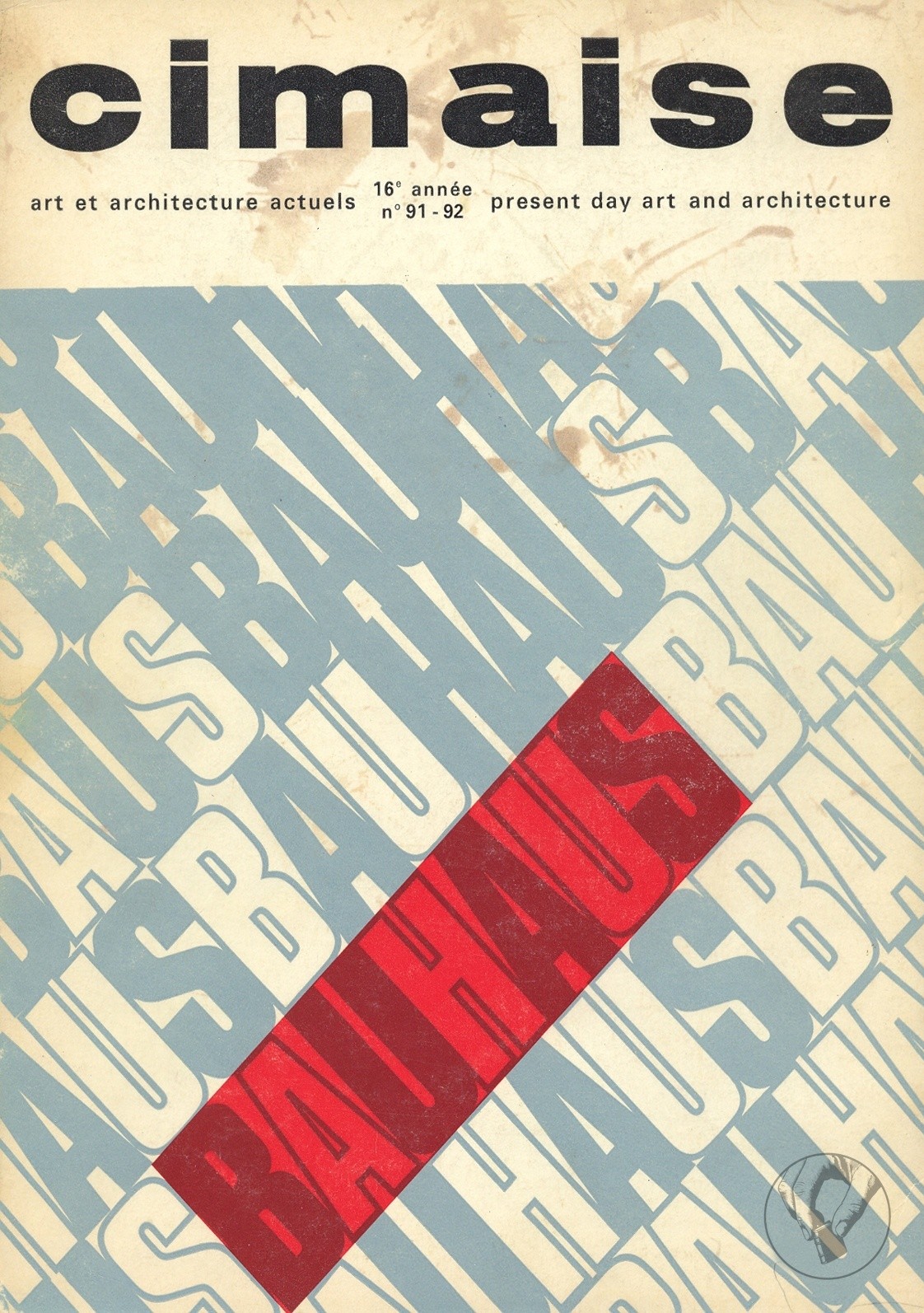
Ce numéro de la collection "Cimaise" présente des expositions d'art contemporain dans diverses galeries parisiennes, notamment la Galerie Daniel Gervis avec "Matériologies" de Jean Dubuffet, la Galerie de France avec des œuvres d'Alechinsky, Hartung, Soulages, et d'autres, ainsi que des expositions à la Galerie Paul Facchetti, Galerie Ariel, Galerie Framond, Galerie Stadler et Galerie Jeanne Bucher. Il inclut également des informations sur le transport d'objets d'art et une section sur "La Nouvelle Architecture et le Bauhaus" par Walter Gropius.