Page 1
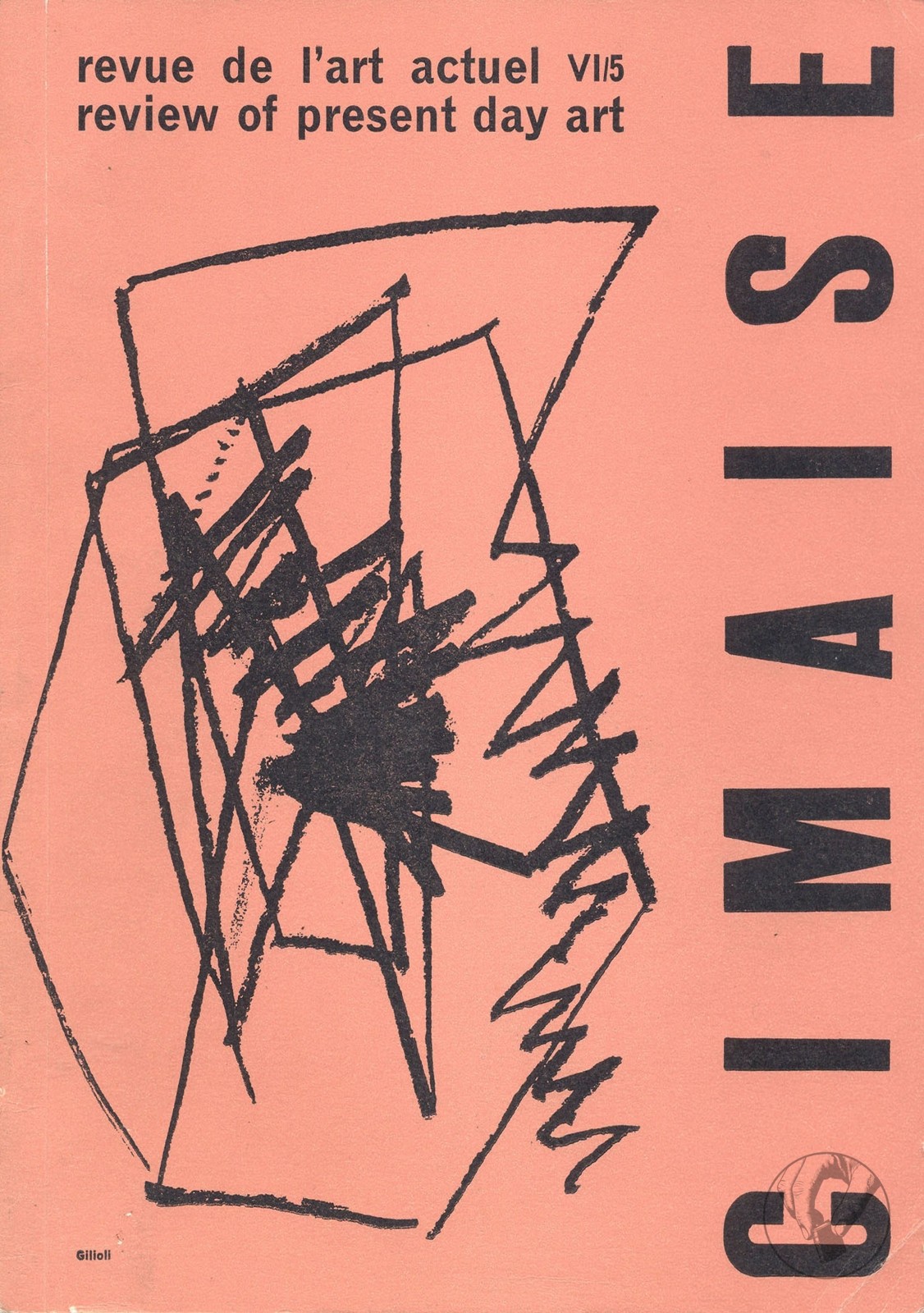
revue de l'art actuel VI/5 review of present day art ESIMAIS Gilloli
First pages of the volume, freely accessible.
revue de l'art actuel VI/5 review of present day art ESIMAIS Gilloli
Galerie de France 3 rue du Faubourg Saint-Honoré Paris 8, Anjou 69-37 --- Deyrolle, Hartung, Le Moal, Magnelli, Manessier, Music B. Nicholson, Pignon, Prassinos Singier, Soulages, Tamayo Zao Wou Ki --- Alechinsky, Bergman Gillet, Levee, Maryan
Galerie de France 3 rue du Faubourg Saint-Honoré Paris 8, Anjou 69-37 sculptures de Consagra, Coulentianos J. Gonzalez, Jacobsen Mastroianni, Robert Müller --- Gimpel Fils 50 South Molton Street London W I May 3720 works by K. Armitage, S. Blow L. Chadwick, A. Davie S. Francis, W. Gear D. Hamilton-Fraser, H. Hartung B. Hepworth, L. Le Brocquy P. Lanyon, J. Levee B. Meadows, H. Moore Ben Nicholson, J. P. Riopelle P. Soulages --- Helen Frankenthaler Adolph Gottlieb John Levee Miriam Shapiro Theodoros Stamos Adja Yunkers André Emmerich Gallery 17 East 64th Street New York 21 --- Galleria Apollinaire via Brera 4, Milano, tel. 862821 mai - juin peintures, dessins, gouaches récentes de Bryen juin - juillet Galleria l’Attico Roma Bruning, Helman, Laubiès Feito, Bellegarde, Halpern en permanence Fautrier, Hartung, Bryen, Meloni, Schneider
Kootz Gallery1018 Madison Avenue at 79th Street, New York 21 --- At the howard wise gallery of present day painting11322 euclid avenue cleveland 6 ohio u.s.a. --- Modern American and French paintings and sculpture --- Prints and watercolors by Gabor Peterdimay 17 - june 20 --- Albert Loeb Gallery à New York les œuvres de - Vieira da Silva, Lanskoy, Max Ernst - Szenes, Bram Van Velde, Garbell - Bernard Dufour, Romathier - Macris, Borès, Kallos - Raymonde Godin, Gilioli 12 East 57 New York 22, Plaza 3.7857
O. Le Corneur J. Roudillon présentent Formes humaines trois continents Afrique - Amérique - Océanie du 29 mai au 20 juin tous les jours (sauf dimanche) de 14 heures à 19 heures 3 bis, rue des Beaux-Arts, Paris 6 Exposition permanente d'objets primitifs 51 rue Bonaparte, Paris 6, Danton 90-06 Maternité - M ' Pongwé, Gabon, photo Facchetti
Galerie René Drouin 5 rue Visconti, Paris 6, Danton 20.99 œuvres récentes de Fautrier et de Cuixart Claude Georges Sonderborg Viseux Pierre Bettencourt --- DENISE RENE
Galerie Suffren (Philippe Bondon) 61 bis avenue de Suffren, Paris 7, Suf. 31-50 jusqu’au 20 juin Leyden du 23 juin au 20 juillet groupe Bocian, Demarne Clemente, Marie Raymond Monda, Planet Rodillon, Tabuchi sculptures de Guadagnucci --- Galerie Arnaud 34 rue du Four, Paris 6, Littré 40-26 John Koenig juin en permanence Barré, H. A. Bertrand, Carrade Coppel, Downing, Feito Fichet, Gauthier, Guitet Koenig, Panafieu, F. S. Tanaka sculptures de Marta Pan --- Les Cahiers du Musée de Poche Revue trimestrielle illustrée d’Art Moderne format : 14,5 x 22,5 cm., 180 pages, couverture illustrée d’une litho originale de Soulages. Plus de 100 clichés en noir. 4 quadrichromies. 1 litho de Sugai en hors texte EXTRAIT DU SOMMAIRE (N° I) Abstraction et co-naissance par Wilhelm Worringer Carnet de dessins de Nicolas de Staël Natura pictrix par Roger Caillois Japon d’Orient et Japon d’Occident par Pierre Schneider Mark Tobey par Michel Courtois L’Age de fer de la Sculpture catalane par Josep Palau Panorama critique par Jean Cathelin, Denys Chevalier, R. V. Gindertaël, Luce Hoctin, Guy Wheelen Le numéro 900 francs Abonnement : 4 numéros, France 3.200 francs - Etranger 3.500 francs Publié par les éditions Georges Fall 7, Rue de l’Odéon, Paris 6, Odé. 69-38 C. C. P. Paris 8277.18 PROCHAINE PARUTION : 15 JUIN 1959
Pascale 20, rue Jacob, Paris 6, Odéon 68-79 Stacha Halpern --- Synthèse 66, Boulevard Raspail, Paris 6, Lit. 47-32 Pelayo du 14 mai au 13 juin --- Robert David Téléphone Danton 16-26 Photographe spécialiste pour photos de tableaux, dessins, objets d’art --- Romain Weingarten 11 rue des Beaux-Arts, Paris 6. Méd. 06-87 Encadrements --- Cimaise revue de l’art actuel review of present day art 34 rue du Four, Paris 6 Directeur : J.R. Arnaud Secrétaire général : John Koenig Secrétaire administratif : René Barzilay Rédaction : G. Boudaille, M. Ragon, P. Restany Herta Wescher La rédaction reçoit sur rendez-vous Abonnement (6 numéros) 2.000 frs 34, rue du Four, Paris 6, téléphone Littré 40-26 C.C.P. Paris 5542.39 Diffusion : Allemagne : Librairie Hanna Weber, H.-J. Niepel, Dusseldorf 1, Grabenstrasse 11 Argentine : Editorial Victor Leru, Cangallo 2233, Buenos-Aires Autriche : Arnulf Neuwirth, Paracelsusgasse 8, Vienne 3 Belgique : Jean Milo, 28 rue de l’Arbre Bénit, Bruxelles C.C.P. Jean Milo, Bruxelles 1591.50 Italie : Le Noci, Via Brera 4, Milan Danemark : Galerie Birch, Bredgade 37 Copenhagen Grande-Bretagne : Alec Tiranti Ltd, 72 Charlotte Street, London W 1 Japon : Meiji-Shobo, Surugadai, Kanda Tokyo Norvège : J.W. Cappelen, Sortimentebokhandel, Oslo Suède : Eric H. Olson, Upplandsgatan 3, Stockholm, 10 23 77 Suisse : E. Genton, « L’Entr’acte », rue du Lion d’or 4, Lausanne, C.C.P. II 144-56 U.S.A. : Wittenborn and Co, 1018 Madison Ave, New-York 21 Sommaire Série VI N° 5 juin - juillet - août 1959 Couverture de Gillioli 9 Herta Wescher : Barbara Hepworth 19 Michel Seuphor : Promotion de la sculpture / The promotion of sculpture 34 Pierre Restany : Les coulisses de l’âge du fer / In the side-scenes of the iron age 37 Dore Ashton : Regards sur la saison New-Yorkaise / Report on the New York Gallery Season, Winter 1958-59 40 L’actualité par Georges Boudaille, Michel Ragon Pierre Restany, Herta Wescher 50 Bibliographie
Herta Wescher Barbara Hepworth Pour comprendre l’œuvre de Barbara Hepworth, il faut aller chez elle à Saint-Ives-en-Cornouailles, car certaines qualités de sa sculpture y paraissent refléter le paysage même. Le petit port, enfoncé dans la baie que les langues côtières protègent contre l’océan, ne livre-t-il pas le secret de ces formes qui s’entrepénètrent, principe essentiel de ses compositions ? Et quand, chez elle, vous quittez l’atmosphère intime et la pénombre du foyer pour la lumière éclatante du jardin avec sa vue lointaine sur la mer, ne ressentez-vous pas la sensation qu’elle éprouve en taillant les blocs massifs de pierre et de bois pour y percer des issues ? Depuis qu’elle s’est retirée, au début de la guerre, avec ses triplés alors tout jeunes, dans ce pays « fin de terre », elle y est restée définitivement, trouvant le climat et l’ambiance propices à son travail, la solitude et la tranquillité dont elle a besoin pour le poursuivre dans une lente et consciente progression d’une étape à l’autre. Sa décision de devenir sculpteur fut prise dès l’âge de 16 ans, au cours de sa première année d’études à l’Ecole des Beaux-Arts de Leeds dans le comté de York, dont elle est originaire. Elle y rencontrait Henry Moore, de cinq ans son ainé, et avec qui elle entrait dans la classe de sculpture au Collège Royal de Londres, pour lequel elle avait obtenu une bourse, suivie d’une autre pour une année scolaire à l’étranger qui l’amenaît en Italie. A Rome, par hasard, elle fit la connaissance du sculpteur Ardini, spécialisé dans la taille de la pierre, et cette rencontre fut décisive pour elle, lui révélant que, dans ce procédé et non dans le modelage appris auparavant, elle devrait trouver son moyen d’expression par excellence. C’est la fascination que la pierre et le bois exercent sur elle, qui explique ce choix, auquel elle est restée fidèle jusqu’à ces dernières années. En effet, elle a suivi son chemin sans professeur cherchant seule à clarifier ses buts artistiques, et s’adressant à la matière même pour en recevoir les inspirations. Elle a commencé par imposer à ses figures la forme du bloc ou du tronc d’où elles étaient taillées, les dotant ainsi de la monumentalité propre à l’art archaïque, égyptien ou grec. Mais bientôt, la rigidité formelle s’assouplit, les volumes semblent remus par des forces intérieures qui soulèvent les surfaces. Les figures allongées évoquent des formations géologiques où les contours se dissimulent, lors que des profils de visages, incisés en lignes graphiques, circonscrivent la signification humaine. Le parallélisme de ces recherches avec celles de Henry Moore est évident et s’explique par leur proche voisinage à Londres, où tous les deux étaient In order to understand Barbara Hepworth’s œuvre, you should go to visit to her in Saint Yves in Cornwall, for certain qualities in her sculpture find their image in the surrounding landscape. The little port, deep in the bay protected from the ocean by spits of land, delivers the secret of these interpenetrating forms that constitute the essential principle of her compositions. And at her home, when you leave the intimate atmosphere and the gloom of the fireside to go out into the sparkling light of the garden with its far-off view over the sea, it seems that you have the same sensation as the one she feels when she cuts the massive blocks of stone and wood, in order to pierce her way through them. Ever since she came off here, at the beginning of the war, with her triplets, to this country at the “end of land”, she has remained here definitely, finding here the proper climate and atmosphere for her work, the solitude and calm that she needs in order to follow her work in a slow and conscious progression from one step to another. She decided to become a sculptor when she was 16, during her first year at the Fine Arts School at Leeds, in Yorkshire, where she was born. She met Henry Moore, five years her elder, here, and both of them went on to the sculpture class at the Royal College in London, where she had a grant, followed by another one for a year in a foreign country; this brought her to Italy. By chance, in Rome, she met the sculptor Ardini, who was specialized in stone work, and this encounter was decisive for her, showing her that it was this means and not by modelling, that she could find her means of expression par excellence. Stone and wood fascinated her, and this decided her choice, to which she remained faithful up until the last few years. She has sought her way without professors, trying to clarify by herself her artistic goals, and only looking for her inspiration in the heart of the matter. She began by imposing upon her figures the form of the block or the trunk from which they were cut, thus giving them the monumentality peculiar to archaic, egyptian, or greek art. But soon, the formal rigidity became more supple, the volumes seeming to be moved by internal forces that swelled the surfaces. The elongated figures evoke geological formations where the contours are hidden, and profiles of faces, incised with graphic lines, bring in the human element. The parallels to be found with Henry Moore’s work are evident and can be explained by the fact that they lived close to one another in London, where both of them, as well as Ben Nicholson, settled down,
installés, à partir de 1926 environ, ainsi que Ben Nicholson. C’est lui qui raconte : « Il y avait un va-et-vient constant d’un atelier à l’autre dans ces années fertiles après 1930, et si l’un avait fait une découverte, l’autre était poussé à en explorer les possibilités immédiatement après lui. » A Barbara Hepworth revient d’avoir créé, en 1931, la première sculpture trouée, perçant la pierre pour vaincre la dureté et la transformer en corps vivant à l’aide de l’espace qui la pénètre. L’échange de vues qui animait la communauté des artistes vivant dans le même coin villageois de Hampstead, traversé de ruelles et de jardins — et qui a laissé un souvenir charmant chez tous ceux qui l’ont connu — a beaucoup aidé Barbara Hepworth à découvrir le langage artistique spécifique de son temps. Tout d’abord, la peinture de Ben Nicholson, son mari, plaçant les objets dans une perspective arbitraire et les colorant à sa guise, lui a ouvert les yeux sur la liberté de l’artiste d’établir des rapports nouveaux entre formes et couleurs, volumes et espace. En 1932, elle allait avec lui à Paris rendre visite à Brancusi, Arp, Picasso, et chacun l’impressionnait à sa manière. Mais c’est la sculpture pure et élémentaire de Brancusi qui a le plus visiblement marqué son évolution future. L’écho de ce qui se passait à Paris a électrisé en Angleterre nombre de jeunes artistes, décidés à réveiller l’art anglais de sa tradition somnolente. Ils ont formé, en 1935, le groupe « Unit One », où les tendances surréalistes et constructivistes se confrontaient. Celles-ci se trouvaient renforcées considérablement par l’arrivée à Londres des émigrés de l’Allemagne, peintres, sculpteurs et architectes, dont Gabo, Gropius, Moholy-Nagy, Breuer. Sur l’initiative de Gabo, Nicholson, Barbara et leurs amis, un livre « Circle » fut édité, dans lequel les divers collaborateurs acclamaient l’art abstrait comme langage universel de notre siècle. Mondrian, venu en Angleterre en 1938, rejoignait le groupe et contribuait de toute son autorité à ancrer l’idée d’un art nouveau, moyen de communication international. Il est resté deux ans et est allé voir les Nicholson à Saint-Ives avant son départ pour les Etats-Unis. A partir de 1934, pendant que Ben Nicholson procède aux reliefs blancs sur blanc, de simples cercles et carrés, Barbara Hepworth renonce également à toute figuration en faveur de formes extrêmement dépouillées, sphères, disques et ovoïdes, ou polyèdres de surfaces géométriques. En marbre blanc, albâtre gris ou pierre bleuâtre d’Ancaster, aussi bien qu’en bois de structures et de teintes variées, elle crée des œuvres d’une seule pièce, d’un parfait accord de volumes et matières, ou plus souvent, des compositions de deux ou de plusieurs éléments, réunis sur des plateaux rectangulaires, en des dimensions et des proportions subtilement calculées, pour que l’espace intermédiaire transmette la juste tension de l’un à l’autre. Des années de guerre, pendant lesquelles les nécessités de la vie obligèrent Barbara à interrompre la towards 1926. He recalls: “There was a constant going back-and-forth from one studio to the other, and if one of us made a discovery, the other pushed on to explore all of the immediate possibilities.” It was Barbara Hepworth who was the first to pierce her sculpture, in 1931, doing this to dominate its hardness, and change it into a living thing with the aid of the space that penetrated it. The exchange of views that animated the artists’ community in the village-like corner of Hampstead, cut through with alleys and gardens—that left a charming souvenir to all that knew it—helped Barbara Hepworth very much to discover the specific artistic idiom of her time. First, the painting of her husband Ben Nicholson, that placed objects in an arbitrary perspective and colored them to his liking, opened her eyes on the artist’s liberty to establish new relations between form and color, volume and space. In 1932, she went to Paris with him to visit Brancusi, Arp, and Picasso, and each of them impressed her in his own way. But it was Brancusi’s pure and elementary sculpture that most clearly marked her future evolution. The echo of what was happening in Paris electrified a number of young English artists, who decided to wake English art from its slumbering tradition. In 1935, they created the “Unit One” group, where surrealistic and constructivist tendencies confronted each other. These were considerably strengthened by the arrival in London of the refugees from Germany: painters, sculptors, and architects, such as Gabo, Gropius, Moholy-Nagy, Breuer. Edited by Gabo, Nicholson, Barbara, and their friends, the book “Circle” acclaimed abstract art as the universal idiom of our century. Mondrian, who came to England in 1938, joined the group and lent all his authority in anchoring the idea of a new art as a means of international communication. He remained two years in London, and visited the Nicholsons in Saint Ives before his departure for the United States. From 1934 on, during the time when Ben Nicholson was working in white-on-white reliefs with simple circles and squares, Barbara Hepworth also left aside any kind of figuration in favor of extremely strict forms: spheres, discs and ovoids, or polyhedrons with geometrical surfaces. Using white marble, grey alabaster, or blue Lancaster stone, as well as wood with different grains and colors, she made single pieces with a perfect relation between the volume and medium, or more often created compositions with two or more elements, brought together on rectangular bases, with subtly calculated dimensions and proportions, allowing the intermediate space to transmit the proper tension between the different elements. From the war years, during which everyday necessities obliged her to give up her sculpture, came
Barbara Hepworth : portrait, à gauche , La Cantate Domino, photo Alain Vines, “ Report ”, Londres
La revue "Cimaise" présente dans ce numéro des expositions d'art actuel à travers diverses galeries à Paris, Londres, Milan et New York. Elle inclut des articles sur des artistes tels que Barbara Hepworth, des réflexions sur la sculpture et la saison artistique new-yorkaise, ainsi qu'une revue de l'actualité artistique.