Extrait
Premières pages de l'ouvrage, en accès libre.
Page 1
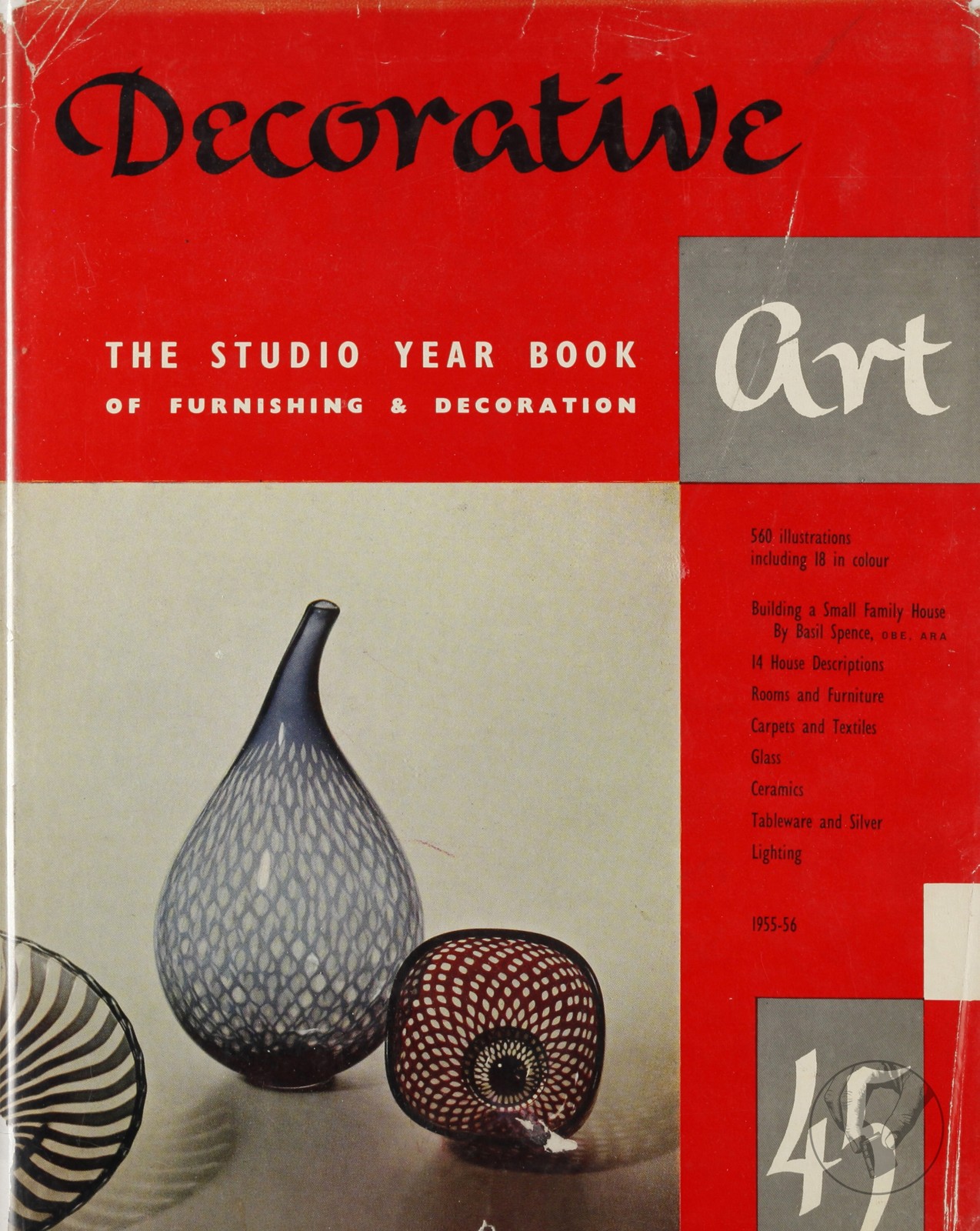
Decorative
THE STUDIO YEAR BOOK OF FURNISHING & DECORATION
Art
560 illustrations
including 18 in colour
Building a Small Family House
By Basil Spence, OBE. ARA.
14 House Descriptions
Rooms and Furniture
Carpets and Textiles
Glass
Ceramics
Tableware and Silver
Lighting
1955-56
Page 2
Decorative Art this year reaches its 45th issue and marks the occasion with a special article by Basil Spence, OBE, ARA, ARSA, architect of the new Coventry Cathedral. He describes a Canadian architect’s solution to the problem of housing his small family in a way which has not only fulfilled the family’s material needs but has also contributed in no small manner to their domestic happiness.
A similar problem faces many families throughout the world and the Canadian example demonstrates principles of design which are largely free from any national peculiarities and therefore capable of widespread interpretation.
Following this article are descriptions of 14 houses and apartments in several different countries, each one recently completed and all offering ideas in domestic design to meet a variety of needs.
The annual selection of new designs in furnishing and accessories, both useful and decorative, is this year as comprehensive and appetising as ever. Among them are included many examples of beautifully and excitingly furnished living-rooms in new homes selected from Europe, the Americas, and the Orient. A fine and representative international collection is also included of modern furniture design, textiles and carpets, silver and tableware, ceramics, glass and light fittings.
In all there are some 560 magnificent photographs of which 18 are reproduced in full colour.
30s
NET
Page 5
DECORATIVE ART 1955-56
Page 6
DECORATIVE
VOLUME 45
Page 7
ART
THE STUDIO YEAR BOOK OF FURNISHING & DECORATION 1955-1956
EDITORS: RATHBONE HOLME & KATHLEEN FROST
THE STUDIO PUBLICATIONS, LONDON AND NEW YORK
Page 8
ACKNOWLEDGMENTS
The Editors wish to express their sincere thanks for the kind assistance they have received from the many designers, architects and manufacturers whose work is represented in this volume. Their co-operation is indeed the foundation upon which its production is built. Tribute is also due to our many friends and correspondents overseas who are untiring in their efforts to help us achieve a wide international representation, and especially to Alfred Altherr, of the Schweizerischer Werkbund, Zürich; Mr Stig Björkman, of Svenska Hem, Stockholm; Mr. D. W. Buchanan, of The National Gallery of Canada, Ottawa; Mr Bryan Holme of The Studio Publications Inc, New York; Mr Bent Salicath, of Dansk Kunsthaandværk, Copenhagen; Mrs G. L. de Snellman-Jaderholm, of Helsinki; M. Pierre Vago, of Paris; and Miss Carmen Valdes, of Saber Vivir, Buenos Aires.
---
PUBLISHED IN LONDON BY THE STUDIO LTD, 66 CHANDOS PLACE, W.C.2
AND IN NEW YORK BY THE STUDIO PUBLICATIONS INC, 432 FOURTH AVENUE
PRINTED IN GREAT BRITAIN BY WILLIAM CLOWES AND SONS LIMITED
LONDON AND BECCLES
Page 9
CONTENTS
Editors’ Foreword
---
Building a Small Family Houseby Basil Spence, OBE, ARA, ARSA
---
House at San Bernardino, California
---
House at Santa Fe, New Mexico
---
House at Auckland, New Zealand
---
House at Uccle, Belgium
---
Houses at Harpenden, Hertfordshire
---
House at Oulton Broad, Suffolk
---
House at Martinez, Argentina
---
House at San Isidro, Argentina
---
House at Vancouver, British Columbia
---
House at Tunbridge Wells, Kent
---
House at Sydenham, London, S.E.26
---
House at Amsterdam, Holland
---
House at Chelsea, London, S.W.3
---
Flats at Richmond, Surrey
---
Rooms and Furniture
---
Carpets and Textiles
---
Glass
---
Ceramics
---
Silver and Tableware
---
Lighting
---
Index
---
Page 10
Editors’ Foreword
Contemporary design for the home and its furnishing is winning popular acceptance and is here to stay. That is the inescapable conclusion which must be arrived at after intensive study of the immense collection of specimens and photographs submitted to Decorative Art and its Editors for consideration over the past few years. It is endorsed by a study of the contents and advertising of the shops and stores which cater for home furnishing and accessories, where it is now more customary to see displayed styles, designs, textures and finishes conceived in the minds of living artists rather than the reproduction of articles, often poorly executed and finished, which for so long were hallowed and cherished because of their superficial resemblance to pieces of quality and elegance which have come down from the great days of the craftsman.
Having won his spurs, the contemporary designer, whether of furniture, ceramics, glass, silver or textiles, is somewhat—but not entirely—released from the feverish search for novelty and change, inevitable in the initiation and promotion of new ideas and theories. This search has sometimes resulted in extravagance and the production of designs more notable for the extent to which they depart from tradition than their suitability for the purpose to which they are intended to be put.
The designer of today nevertheless now has a much needed opportunity to review the achievements of the past decade and to give more attention to consolidation of the progress made. To some extent the past year has shown a clearing up of ideas and a fuller realisation of the paramount importance of fitness for purpose in all good design. Some of the extravagances have been eliminated or jettisoned and there is more evidence of serious thought for the comfort, convenience and interests of the owner or user.
This situation of pause following achievement is invaluable. The manufacturer of today can no longer fall back on the shibboleth that only reproduction pieces would sell; the evidence is there for all to see. Today, the production of goods for the home of contemporary design involves no more than an ordinary business risk. It is no longer essential on the one hand to reduce the ‘edition’ to such small proportions as to involve an inordinately high price for each piece, or on the other to provide the minimum in quality or materials to achieve a competitive price. A period has been reached where greater concentration can be given to the improvement of qualities in materials, workmanship and durability to the advantage of consumer and manufacturer alike.
If this is an interim period, as we believe it to be, it is also a period of gestation and of preparation for further development. Designers and manufacturers are mutually dependent upon each other and on both sides there should be an effort to promote closer understanding. It is important that both should remember that when utilitarian demands have been functionally satisfied, design would remain static if it were not for some further compulsion. Householders, generally speaking, are not always looking for furnishing changes. The major items remain in service for many years, but there are, in addition, certain expendables, such as ceramics and glass, which are fragile and require more frequent replacement. Except to make up the missing pieces in a depleted set, relatively few today will make a new purchase that exactly repeats one previously made. The
Page 11
instinctive urge for change provides sufficient compulsion for the creation of new designs where expendables are concerned.
So long as functional satisfaction is at all times adequately maintained, the designer’s main concern is the provision of wares which will excite the beholder and kindle the desire for possession. The kind of design that will do this has to be ‘dreamed up’ and this, quite literally, may often be the way in which new designs are born.
The dream has indeed become a useful handle. Dream cars, dream kitchens, dream houses, or at least somebody’s dream of these things, have been made the more possible of achievement by the aid of science and technology. The miracle is commonplace and, in order to make it recognizable as a dream answer to a housewife’s prayer, the designer strives to endow it with those qualities that preserve and enhance its magic and a good deal of fantasy is thereby introduced.
By some such process as this, fashion comes into the home and is found, not only in the things that most often need replacement, but in what used to be the more solid articles of furniture which one generation inherited from another. Such heirlooms are usually subject to more gentle handling, leaving the modern pieces to meet the rough and tumble of everyday life. With the accent on surface treatment which conceals or camouflages the basic structure of contemporary furniture, are designers and manufacturers facing up to the real needs of householders who demand substance in their furnishings as well as stimulus? A chair which develops wobbly legs, a loose back and soggy springs may well have repercussions on the retailer and manufacturer, and dissuade the buyer against contemporary design as a whole. An attractive print at once loses its appeal if it comes to grief at the first wash. A thick pile carpet becomes a sorry investment if the pile fills the bag of the vacuum cleaner, every time it is ‘gone over’. An exciting shape or colour scheme is an irritation if functionally the article it clothes is a failure. The designer of today has proved his imaginative capacity and the public is responding to the stimulus he has provided. Now both producer and designer can concentrate to mutual advantage on the virtues of good materials properly used, good workmanship and functional adequacy. By doing so they will ensure public goodwill and open the way for further advance.
In view of the preceding remarks, it would perhaps be misleading to omit to record the great developments which have been made over the past decade in the appreciation of colour values and textures. Clear colour and its harmonious blending, the ‘judicious’ choice and understanding of the decorative values of weaves and textures are much more in evidence in fabrics of all descriptions and prices, while the use of abstract pattern and design has added gaiety to
materials which not long ago were drab and monotonous in their repetition or adaptation of themes that failed to inspire the new generation. Here is a valuable development which seems to have stimulated designers in many countries and given satisfaction to a wide public.
There are many delightful and desirable things to put into the home, which are now being produced, for international sale, in many countries and the choice for the individual is wide. These are the jewels to be set in the frame of bricks or stone—the house or flat which constitutes the home. How do the latter measure up to their contents? Each family is an individual unit with its own particular set of tastes, interests and activities and our requirements are far from uniform. Do the thousands of houses and flats now being built provide room for the expression of our own likes and dislikes and cater for our own circumstances? Or do they restrict, conforming us to a pattern not necessarily our own, thereby imposing settings which irritate instead of soothe us in our daily life? It is an important consideration, having long term effects upon national morale and the well-being of large communities.
Basil Spence, OBE, ARA, whose name is now indissolubly linked with the design of the new Coventry Cathedral, is a convinced believer in the need for individuality in the design of the home and its compatibility with the needs and outlook of its occupants. In his view, domestic happiness depends to a high degree on a proper assessment of personal needs and their fulfilment through skilled planning and the use of local conditions and materials in harmony with environment. We have asked him to demonstrate his conviction by the illustration and discussion of some one house which, in his view, fulfils all the requirements for its occupant. In the pages immediately following we reproduce his choice accompanied by his own comments. He has selected a Canadian home, which admirably carries out this purpose. If, as is evident, it is said that this is an individual proposition, peculiar to a particular terrain and requirements and is therefore impossible in crowded city or town, it in no way invalidates Mr Spence’s basic theme, but merely proves that human beings are not alike in needs or preferences and that their differences as well as their similarities are equally important in the planning of their homes.
It has been suggested that the inclusion of prices in Decorative Art would add to its value as a shopping guide, but as there is no international monetary system and, as prices current when the book goes to press may be out of date before its publication, such information might be misleading and only cause confusion. The function of Decorative Art is to review world events in the contemporary field of domestic furnishing and to provide a stimulus to the creation of a gracious setting for family life.
THE EDITORS